Part 1: The Physics of Profit

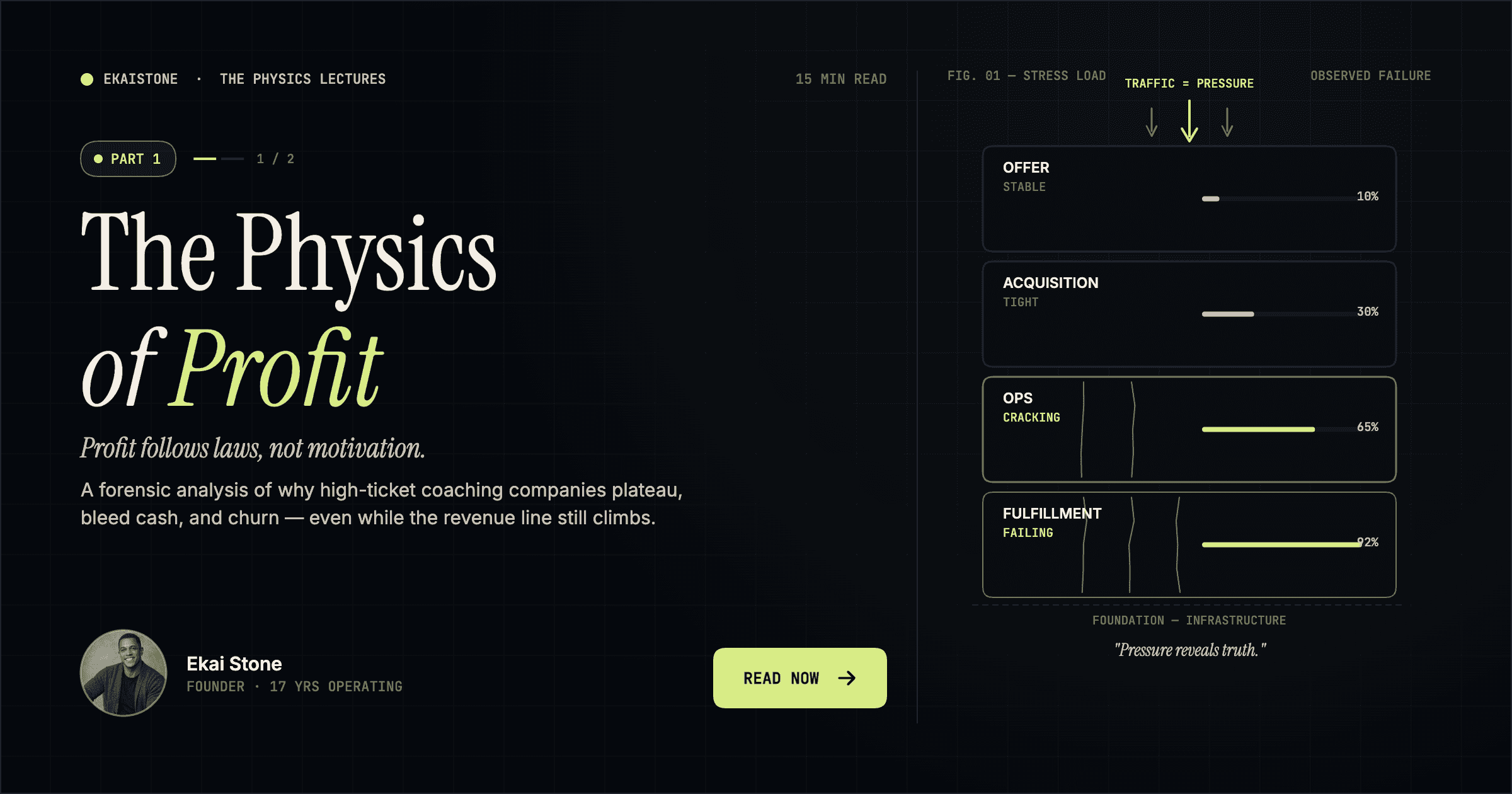
Profit follows laws, not motivation.
When a coaching business scales, it doesn’t fail because of mindset, creativity, or effort. It fails because volume exposes structural weaknesses that were invisible at lower levels of demand. Traffic is pressure. Pressure reveals truth.
Part 1 of 2: A forensic analysis on why high-ticket coaching companies plateau, destabilize, and quietly bleed cash and have high churn even while revenue appears strong. We’ll diagnose the operational and architectural failures that cause “good ROAS” to lie, and why scaling without infrastructure turns growth into risk.
This isn’t a motivational piece. It’s a physics lesson.
The Silence of the Plateau
There is a specific frequency of silence that haunts the Slack channels of a coaching company doing $300,000 a month.
It isn’t the silence of inactivity. The ad account is spending. The setters are dialing. The calendar has appointments. But there is a silence in the bank account where the profit should be. There is a silence in the fulfillment department, where the noise of valid client complaints is being muffled by a team that is too afraid to tell the CEO that the product is breaking.
If you are reading this, you likely know this silence. You know the texture of it.
It is the 2:00 AM realization that you have hit the revenue milestones that the internet promised would make you happy, yet you feel less secure than you did when you were making $20k a month. You have the "Two Comma Club" plaque, or at least the Stripe screenshots to justify one. You have a team. You have a proven offer. You have the external validation of "success."
But you also have a gnawing, low-level anxiety that never quite goes away.
You have the suspicion that your entire operation is a house of cards held together by a media buyer who "just runs ads" and a sales team that requires constant, exhausting motivation to do their jobs. You are scaling, but you aren’t sleeping. You are spending more to acquire a customer today than you did six months ago, and you have a sneaking suspicion that the "scaling strategies" you bought from a mastermind are actually accelerating your demise.
You're right.
This is not a motivational post. This is a forensic analysis of why coaching businesses plateau, rot, and eventually collapse when they try to scale using the "Slaughterhouse Model."
I am writing this because the market has shifted. We are currently living through a massive correction in the online education space. The tactics that built the empires of 2020 through 2023 are currently destroying the cash flow of those same empires in 2026. The "easy money" era is dead, and what is left is a market that demands excellence, truth, and architecture.
This is a manifesto for the adults in the room. This is for the operator who wants to understand the physics of their business, not just the optics.
Dear Online CEO…
If I were to audit your business right now, not just look at your marketing slides, but actually dig into your P&L and your team culture, I suspect I would find a disconnect.
Let’s be honest about the conversation happening in your head at 3:00 PM on a Tuesday.
You look at your financial reports, if you even have an accurate, accrual-based P&L, and you see revenue, but you don't see cash. You see "booked calls" on the setter’s tracker, but when you listen to the recordings, you hear unqualified prospects with no purchasing power. You see a "3.5 ROAS" on the agency report, but your bank account balance is staying flat.
You're the CEO, but you feel like a glorified referee breaking up fights between departments that should be working together.
Your setters complain that the leads are "trash" and "broke."
Your closers complain that the setters are putting "low-intent" people on the calendar.
Your media buyer complains that the sales team "sucks at follow-up" and that the algorithm needs more time.
And you? You're stuck in the middle, writing the checks, wondering why a business that makes this much money feels so fragile.
You know that if you turned off the ads tomorrow, the revenue would stop instantly. You haven't built a business; you've built a high-pressure promotion that requires your constant manual labor to keep spinning. You are effectively a high-paid manager of a volatile department, not the owner of a sovereign firm.
You're dealing with the "Media Buyer Disconnect." You have someone running your ads, maybe an agency, maybe a freelancer, but they don’t understand your business. They report on CPL (Cost Per Lead) and CTR (Click-Through Rate). They celebrate when leads are cheap. But they have no idea what your show rate is. They don’t know that the 50 leads they generated yesterday were all 19-year-olds with no credit. They press buttons; they don’t strategize revenue.
You're dealing with "Fake Support" Fatigue. You’ve hired business coaches who gave you generic templates. You’ve hired agencies that onboarded you with a smile and then passed you off to a junior account manager who learned Facebook Ads six months ago on YouTube. You’ve bought the courses. You’ve joined the masterminds. And yet, you are still the one fixing the Zapier automation at 11 PM on a Tuesday because nobody else understands how the data flows.
Most "business coaches" will tell you this is a mindset issue. They will tell you to manifest abundance, raise your prices, or "step into your power."
Most "ad agencies" will tell you this is a creative issue. They will tell you to test more hooks, run more UGC, or try TikTok.
I am telling you it's neither. It is an architecture issue.
You're running a high-speed train on tracks that were built for a handcar. The vibration of speed is shaking the bolts loose. The problem is not that you can't drive traffic; the problem is that your ecosystem cannot metabolize the traffic you are already buying.
The Hidden Bottleneck Isn’t Your Ads
The single biggest lie in the high-ticket industry is that "scaling" simply means "spending more money on Meta."
Scaling is not a math problem; it is a physics problem. Traffic is a stress test.
Volume exposes weakness. If there is a microscopic crack in your foundation at $10k/month, a missed follow-up, a slow onboarding email, a vague promise, that crack becomes a canyon at $100k/month.
I've analyzed the backends of coaching programs scaling from huge numbers, and I see a repeating pattern that nobody talks about because it isn’t sexy. It’s the Fulfillment Paradox.
The paradox is this: The faster you scale your ads to grow revenue, the faster you degrade the product that creates the revenue.
When ad spend scales past roughly $10k/month, the most common failure point is not the ads. The ads often do exactly what they are supposed to do: they bring people to your door. The failure point is that fulfillment capacity collapses. Service quality drops. The "magic" that got you your first 50 testimonials disappears because you are now treating people like cattle in a holding pen.
Let me give you a specific, real-world example of how this physics plays out.
I watched a "high-scale coaching company" that was the envy of their niche. They were running at extreme efficiency. I’m talking about a 47x ROAS (Return on Ad Spend) at launch. The next month they were at 30x, then 27x. These are numbers that make most marketers salivate. These are numbers that make you feel invincible.
Naturally, the decision was made: Scale.
They doubled, tripled, then quadrupled the spend over a period of three to four months. The revenue numbers shot up. On a spreadsheet, it looked like a massive victory.
But the fulfillment capacity collapsed.
The team could not handle the influx of human beings requiring support. The "high touch" promise that sold the program became impossible to deliver. The coaching calls became overcrowded. The community became noisy. The personal attention that justified the high ticket price evaporated.
To cope with the volume, the business owners made a panicked pivot: they converted the offer into a "course/video-vault" model to reduce the fulfillment load. They ended up with one Customer Success Manager (CSM) trying to manage 60+ active clients.
The result was catastrophic. Perceived support collapsed. Clients felt abandoned. Churn skyrocketed. The "efficiency" of the ads didn’t matter anymore because the bucket had a hole in the bottom. They burned through their total addressable market, damaged their reputation, and watched that beautiful ROAS evaporate because the backend ecosystem wasn't architected to hold the weight of the success the ads created.
This is the hidden bottleneck. It wasn't the ads. The ads did their job. The architecture failed.
If you do not respect the mechanics of fulfillment, volume will not make you rich; it will destroy your reputation faster.
Lead Gen vs. Revenue Architecture
Most of the industry is obsessed with "Lead Gen."
Lead Gen is a commodity. It is a list of names in a CSV file. It is a metric that agencies use to justify their retainers so they can say, "Hey, we got you 500 leads at $4.00 each, why aren't you closing them?"
Lead Gen is vanity. Revenue Architecture is sanity.
Revenue Architecture is the engineering of a pressure system that forces revenue out of the market. It is not just about getting a name and email; it is about the entire journey of trust, authority, and transaction. It is about understanding that a lead is a human being with a specific psychology, entering your world at a specific moment in time.
My perspective on this is different because I didn’t grow up in the "online guru" bubble.
Before COVID, long before the online coaching boom, I worked in regional marketing and advertising for major automotive brands. The auto industry is ruthless. It is high volume, high pressure, and very expensive.
I saw firsthand that you can generate hundreds or even thousands of leads for a dealership, people literally raising their hands for a test drive, but if those leads aren't worked correctly, they're worthless. I watched salespeople ignore internet leads because they were "too busy" standing on the lot waiting for "ups" (ups are people driving into the dealership). I watched thousands of dollars of ad spend rot in the CRM because there was no automated follow-up protocol.
This drove an early obsession for me. Starting around 2012, I became obsessed with CRM (Customer Relationship Management) systems. I realized that the money wasn't in the ad; the money was in the infrastructure that caught the ad traffic. I worked with Car Research XRM to perfect their software that they sold nationwide.
Fast forward to the online coaching space around 2019 through 2022. I watched as sophisticated coaches, people with brilliant offers, operated like amateurs on the backend. They were letting hundreds of leads "rot" in spreadsheets. There was no structured follow-up. No automation. No logic.
CRMs were a "late adoption" in this space. I spent years advising top operators to adopt systems like HubSpot and GoHighLevel before it was the industry standard, simply because I knew what happens when you don't have a container for your traffic.
Here is the metric that changed everything for me: Lead-to-client time lag (Conversion Velocity).
Some people are ready to buy in 7 days.
Some take 30 days.
Organic leads might watch you for 6 months.
Advertising compresses time. That is its primary function. It speeds up the decision-making process. But without Revenue Architecture, without the systems to nurture, segment, and follow up, you only capture the "hyper-responders" (the 1-3% who buy immediately). You lose the other 97% who would have bought if you had a system to hold them.
Lead Gen creates a pile of contacts. Revenue Architecture creates a bankable asset.
The Slaughterhouse Model (and why it collapses)
There is a dark side to the "scale at all costs" mentality. I call it the Slaughterhouse Model. You might understand it as the Assembly Line Model. You know, with one CSM (customer success manager) for every 60 clients that's moving those clients through a cookie-cutter startup process..
This is the default setting for many large agencies and aggressive coaching programs. The logic is simple: Buy leads cheap, churn them through a high-pressure sales team, close as many as possible, and ignore the fallout.
It treats human beings like cattle. It treats the market like an infinite resource.
But the market is not infinite. And reputation is finite.
The physics of this model are brutal. When demand generation (ads) over-delivers, it floods the "assembly line." If the product is coaching, which requires time, energy, and empathy, you cannot automate the core value without degrading it.
I've sat in the meetings where this reality hits. As a demand-driver (the guy running the ads & marketing strategy), I've felt the heavy, complicit feeling of knowing I'm sending traffic to a broken system.
There comes a point where you have to draw an ethical line.
I now recognize the deep responsibility of refusing to scale demand when fulfillment is failing. Why? Because it harms real people.
I've seen the human impact of this. I've seen aspirational young buyers, some very young, effectively kids with dreams, invest significant amounts of money into these "high-ticket" containers. They enter a system that promised them the world, but the system cannot support them. They get lost in the shuffle. They fail. They leave discouraged, with debt and a shattered belief in themselves.
I am not blaming the individual business owners. Often, they'e good people trapped in a bad advice loop. The incentive structure of the industry pushes volume over outcomes. It pushes "new blood" over "retention."
But eventually, the Slaughterhouse Model collapses. It collapses because churn is the hardest metric to fake.
You can fake a screenshot of a Stripe notification. You can fake a video testimonial of someone 1 month into a program and still on a sugar high. You cannot fake the fact that your clients are leaving faster than they are arriving. You cannot fake the "invisible CPM" tax that the market places on you when your reputation erodes.
You cannot build a legacy on a graveyard of burnt-out customers. The market correction we are seeing in 2026 is the result of thousands of people waking up to this model and rejecting it. They are demanding safer harbors. They are demanding Architecture.
If You’ve Been Burned, Here’s Why
If you're reading this, there's a high chance you've been burned before.
You’ve hired the "big name" agency that ignored you after the onboarding call.
You’ve bought the $10k course that turned out to be a folder of outdated videos.
You’ve hired a media buyer who promised "proprietary secrets" but just turned on a broad-targeting campaign and prayed.
Why is the industry like this?
Because it's filled with people who copy tactics without understanding principles.
There is a phrase I use often: "You cannot copy-paste a nervous system."
A business is a living organism. It has a nervous system. A unique combination of offer economics, team dynamics, founder personality, and market positioning. When you try to "copy-paste" someone else's funnel onto your business, it’s like trying to transplant an organ without checking for blood type compatibility. The body rejects it.
I speak from experience on this. I have the receipts.
Years ago, I originated several specific ad strategies that became industry standards. For example, I developed a method for early Instagram DM ad keyword tracking that utilized specific targeting layers. It was producing incredible results. We're talking $3 for high-quality, authentic conversations. It was an arbitrage moment in the market. It was the end of 2021 when I launched the IG DM strategy. It was an evolution from using ManyChat ref links and then Lead Gen Automated Chat, and then I arrived at the IG DM campaign. It was right when FB announced we could run ads with more text on them.
I made the mistake (or perhaps the necessary move) of publicly sharing some of these wins. I posted about 34x ROAS. I showed the consistent 21x returns I was getting for my clients.
The market reacted as the market does. "Gurus" and competitors saw my data, reverse-engineered the tactic, and started selling it as their own "secret method."
I watched as a prominent coaching organization effectively copied my entire system. They stripped it of nuance, packaged it into a template, and sold it to thousands of people.
When I confronted the situation, the response I got was essentially: "Take it as flattery."
The result? The marketplace got saturated with that specific tactic. After 2.5 years my edge was dulled. The $3 conversations became $15 conversations because everyone was running the same play.
This forced me to evolve. It forced me to realize that tactics have a half-life. If your business relies on a "hack" or a "secret setting" in Facebook Ads, you are on a ticking clock.
This is why you've been burned. You've been sold tactics that are already decaying. You've been sold templates by people who didn't build the engine, they just traced the blueprints.
Real authority comes from the ability to troubleshoot when the template breaks. Real scale comes from building a system that is unique to your nervous system, not a clone of someone else’s 2022 wins.
The Pivot to Truth
So, where does this leave us?
It leaves us with a choice. You can continue to play the lottery. You can keep looking for the next "magic script" or the next "unicorn media buyer." You can keep riding the revenue roller coaster, stressing out your adrenal system, and wondering why you feel like an employee in your own company.
Or, you can decide to build Architecture.
You can decide to respect the data.
You can decide to build a system that honors the customer journey.
You can decide to align your revenue goals with your fulfillment reality.
The market in 2026 is ruthless to amateurs, but it is incredibly generous to professionals. The "easy money" is gone. The "dumb money" has left the building. What remains is a market of sophisticated buyers who want truth, competence, and results.
If you are ready to stop churning and start building, you're ready for Part 2.
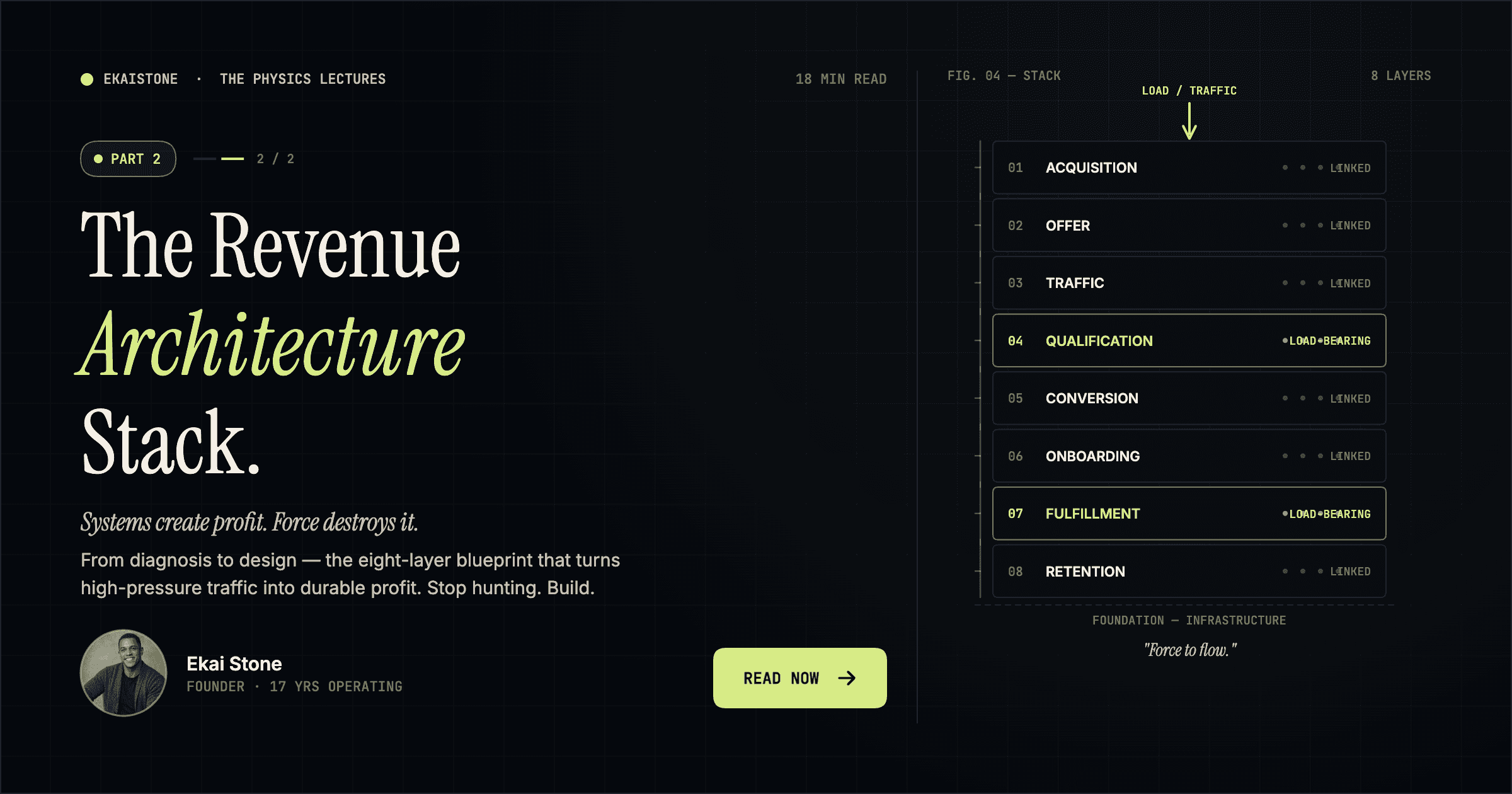
In the next article, I'm going to break down the exact framework I use. I'll walk you through the Revenue Architecture Stack. The 8-stage system that replaces the "funnel." We will talk about the mechanics of pre-selling, the science of qualification, and how to build a reporting system that tells you the truth about your cash collected.
We're done with the diagnosis. Next, we perform the surgery.
[Continue to Part 2: The Revenue Architecture Stack & The Physics of Profit]
Profit follows laws, not motivation.
When a coaching business scales, it doesn’t fail because of mindset, creativity, or effort. It fails because volume exposes structural weaknesses that were invisible at lower levels of demand. Traffic is pressure. Pressure reveals truth.
Part 1 of 2: A forensic analysis on why high-ticket coaching companies plateau, destabilize, and quietly bleed cash and have high churn even while revenue appears strong. We’ll diagnose the operational and architectural failures that cause “good ROAS” to lie, and why scaling without infrastructure turns growth into risk.
This isn’t a motivational piece. It’s a physics lesson.
The Silence of the Plateau
There is a specific frequency of silence that haunts the Slack channels of a coaching company doing $300,000 a month.
It isn’t the silence of inactivity. The ad account is spending. The setters are dialing. The calendar has appointments. But there is a silence in the bank account where the profit should be. There is a silence in the fulfillment department, where the noise of valid client complaints is being muffled by a team that is too afraid to tell the CEO that the product is breaking.
If you are reading this, you likely know this silence. You know the texture of it.
It is the 2:00 AM realization that you have hit the revenue milestones that the internet promised would make you happy, yet you feel less secure than you did when you were making $20k a month. You have the "Two Comma Club" plaque, or at least the Stripe screenshots to justify one. You have a team. You have a proven offer. You have the external validation of "success."
But you also have a gnawing, low-level anxiety that never quite goes away.
You have the suspicion that your entire operation is a house of cards held together by a media buyer who "just runs ads" and a sales team that requires constant, exhausting motivation to do their jobs. You are scaling, but you aren’t sleeping. You are spending more to acquire a customer today than you did six months ago, and you have a sneaking suspicion that the "scaling strategies" you bought from a mastermind are actually accelerating your demise.
You're right.
This is not a motivational post. This is a forensic analysis of why coaching businesses plateau, rot, and eventually collapse when they try to scale using the "Slaughterhouse Model."
I am writing this because the market has shifted. We are currently living through a massive correction in the online education space. The tactics that built the empires of 2020 through 2023 are currently destroying the cash flow of those same empires in 2026. The "easy money" era is dead, and what is left is a market that demands excellence, truth, and architecture.
This is a manifesto for the adults in the room. This is for the operator who wants to understand the physics of their business, not just the optics.
Dear Online CEO…
If I were to audit your business right now, not just look at your marketing slides, but actually dig into your P&L and your team culture, I suspect I would find a disconnect.
Let’s be honest about the conversation happening in your head at 3:00 PM on a Tuesday.
You look at your financial reports, if you even have an accurate, accrual-based P&L, and you see revenue, but you don't see cash. You see "booked calls" on the setter’s tracker, but when you listen to the recordings, you hear unqualified prospects with no purchasing power. You see a "3.5 ROAS" on the agency report, but your bank account balance is staying flat.
You're the CEO, but you feel like a glorified referee breaking up fights between departments that should be working together.
Your setters complain that the leads are "trash" and "broke."
Your closers complain that the setters are putting "low-intent" people on the calendar.
Your media buyer complains that the sales team "sucks at follow-up" and that the algorithm needs more time.
And you? You're stuck in the middle, writing the checks, wondering why a business that makes this much money feels so fragile.
You know that if you turned off the ads tomorrow, the revenue would stop instantly. You haven't built a business; you've built a high-pressure promotion that requires your constant manual labor to keep spinning. You are effectively a high-paid manager of a volatile department, not the owner of a sovereign firm.
You're dealing with the "Media Buyer Disconnect." You have someone running your ads, maybe an agency, maybe a freelancer, but they don’t understand your business. They report on CPL (Cost Per Lead) and CTR (Click-Through Rate). They celebrate when leads are cheap. But they have no idea what your show rate is. They don’t know that the 50 leads they generated yesterday were all 19-year-olds with no credit. They press buttons; they don’t strategize revenue.
You're dealing with "Fake Support" Fatigue. You’ve hired business coaches who gave you generic templates. You’ve hired agencies that onboarded you with a smile and then passed you off to a junior account manager who learned Facebook Ads six months ago on YouTube. You’ve bought the courses. You’ve joined the masterminds. And yet, you are still the one fixing the Zapier automation at 11 PM on a Tuesday because nobody else understands how the data flows.
Most "business coaches" will tell you this is a mindset issue. They will tell you to manifest abundance, raise your prices, or "step into your power."
Most "ad agencies" will tell you this is a creative issue. They will tell you to test more hooks, run more UGC, or try TikTok.
I am telling you it's neither. It is an architecture issue.
You're running a high-speed train on tracks that were built for a handcar. The vibration of speed is shaking the bolts loose. The problem is not that you can't drive traffic; the problem is that your ecosystem cannot metabolize the traffic you are already buying.
The Hidden Bottleneck Isn’t Your Ads
The single biggest lie in the high-ticket industry is that "scaling" simply means "spending more money on Meta."
Scaling is not a math problem; it is a physics problem. Traffic is a stress test.
Volume exposes weakness. If there is a microscopic crack in your foundation at $10k/month, a missed follow-up, a slow onboarding email, a vague promise, that crack becomes a canyon at $100k/month.
I've analyzed the backends of coaching programs scaling from huge numbers, and I see a repeating pattern that nobody talks about because it isn’t sexy. It’s the Fulfillment Paradox.
The paradox is this: The faster you scale your ads to grow revenue, the faster you degrade the product that creates the revenue.
When ad spend scales past roughly $10k/month, the most common failure point is not the ads. The ads often do exactly what they are supposed to do: they bring people to your door. The failure point is that fulfillment capacity collapses. Service quality drops. The "magic" that got you your first 50 testimonials disappears because you are now treating people like cattle in a holding pen.
Let me give you a specific, real-world example of how this physics plays out.
I watched a "high-scale coaching company" that was the envy of their niche. They were running at extreme efficiency. I’m talking about a 47x ROAS (Return on Ad Spend) at launch. The next month they were at 30x, then 27x. These are numbers that make most marketers salivate. These are numbers that make you feel invincible.
Naturally, the decision was made: Scale.
They doubled, tripled, then quadrupled the spend over a period of three to four months. The revenue numbers shot up. On a spreadsheet, it looked like a massive victory.
But the fulfillment capacity collapsed.
The team could not handle the influx of human beings requiring support. The "high touch" promise that sold the program became impossible to deliver. The coaching calls became overcrowded. The community became noisy. The personal attention that justified the high ticket price evaporated.
To cope with the volume, the business owners made a panicked pivot: they converted the offer into a "course/video-vault" model to reduce the fulfillment load. They ended up with one Customer Success Manager (CSM) trying to manage 60+ active clients.
The result was catastrophic. Perceived support collapsed. Clients felt abandoned. Churn skyrocketed. The "efficiency" of the ads didn’t matter anymore because the bucket had a hole in the bottom. They burned through their total addressable market, damaged their reputation, and watched that beautiful ROAS evaporate because the backend ecosystem wasn't architected to hold the weight of the success the ads created.
This is the hidden bottleneck. It wasn't the ads. The ads did their job. The architecture failed.
If you do not respect the mechanics of fulfillment, volume will not make you rich; it will destroy your reputation faster.
Lead Gen vs. Revenue Architecture
Most of the industry is obsessed with "Lead Gen."
Lead Gen is a commodity. It is a list of names in a CSV file. It is a metric that agencies use to justify their retainers so they can say, "Hey, we got you 500 leads at $4.00 each, why aren't you closing them?"
Lead Gen is vanity. Revenue Architecture is sanity.
Revenue Architecture is the engineering of a pressure system that forces revenue out of the market. It is not just about getting a name and email; it is about the entire journey of trust, authority, and transaction. It is about understanding that a lead is a human being with a specific psychology, entering your world at a specific moment in time.
My perspective on this is different because I didn’t grow up in the "online guru" bubble.
Before COVID, long before the online coaching boom, I worked in regional marketing and advertising for major automotive brands. The auto industry is ruthless. It is high volume, high pressure, and very expensive.
I saw firsthand that you can generate hundreds or even thousands of leads for a dealership, people literally raising their hands for a test drive, but if those leads aren't worked correctly, they're worthless. I watched salespeople ignore internet leads because they were "too busy" standing on the lot waiting for "ups" (ups are people driving into the dealership). I watched thousands of dollars of ad spend rot in the CRM because there was no automated follow-up protocol.
This drove an early obsession for me. Starting around 2012, I became obsessed with CRM (Customer Relationship Management) systems. I realized that the money wasn't in the ad; the money was in the infrastructure that caught the ad traffic. I worked with Car Research XRM to perfect their software that they sold nationwide.
Fast forward to the online coaching space around 2019 through 2022. I watched as sophisticated coaches, people with brilliant offers, operated like amateurs on the backend. They were letting hundreds of leads "rot" in spreadsheets. There was no structured follow-up. No automation. No logic.
CRMs were a "late adoption" in this space. I spent years advising top operators to adopt systems like HubSpot and GoHighLevel before it was the industry standard, simply because I knew what happens when you don't have a container for your traffic.
Here is the metric that changed everything for me: Lead-to-client time lag (Conversion Velocity).
Some people are ready to buy in 7 days.
Some take 30 days.
Organic leads might watch you for 6 months.
Advertising compresses time. That is its primary function. It speeds up the decision-making process. But without Revenue Architecture, without the systems to nurture, segment, and follow up, you only capture the "hyper-responders" (the 1-3% who buy immediately). You lose the other 97% who would have bought if you had a system to hold them.
Lead Gen creates a pile of contacts. Revenue Architecture creates a bankable asset.
The Slaughterhouse Model (and why it collapses)
There is a dark side to the "scale at all costs" mentality. I call it the Slaughterhouse Model. You might understand it as the Assembly Line Model. You know, with one CSM (customer success manager) for every 60 clients that's moving those clients through a cookie-cutter startup process..
This is the default setting for many large agencies and aggressive coaching programs. The logic is simple: Buy leads cheap, churn them through a high-pressure sales team, close as many as possible, and ignore the fallout.
It treats human beings like cattle. It treats the market like an infinite resource.
But the market is not infinite. And reputation is finite.
The physics of this model are brutal. When demand generation (ads) over-delivers, it floods the "assembly line." If the product is coaching, which requires time, energy, and empathy, you cannot automate the core value without degrading it.
I've sat in the meetings where this reality hits. As a demand-driver (the guy running the ads & marketing strategy), I've felt the heavy, complicit feeling of knowing I'm sending traffic to a broken system.
There comes a point where you have to draw an ethical line.
I now recognize the deep responsibility of refusing to scale demand when fulfillment is failing. Why? Because it harms real people.
I've seen the human impact of this. I've seen aspirational young buyers, some very young, effectively kids with dreams, invest significant amounts of money into these "high-ticket" containers. They enter a system that promised them the world, but the system cannot support them. They get lost in the shuffle. They fail. They leave discouraged, with debt and a shattered belief in themselves.
I am not blaming the individual business owners. Often, they'e good people trapped in a bad advice loop. The incentive structure of the industry pushes volume over outcomes. It pushes "new blood" over "retention."
But eventually, the Slaughterhouse Model collapses. It collapses because churn is the hardest metric to fake.
You can fake a screenshot of a Stripe notification. You can fake a video testimonial of someone 1 month into a program and still on a sugar high. You cannot fake the fact that your clients are leaving faster than they are arriving. You cannot fake the "invisible CPM" tax that the market places on you when your reputation erodes.
You cannot build a legacy on a graveyard of burnt-out customers. The market correction we are seeing in 2026 is the result of thousands of people waking up to this model and rejecting it. They are demanding safer harbors. They are demanding Architecture.
If You’ve Been Burned, Here’s Why
If you're reading this, there's a high chance you've been burned before.
You’ve hired the "big name" agency that ignored you after the onboarding call.
You’ve bought the $10k course that turned out to be a folder of outdated videos.
You’ve hired a media buyer who promised "proprietary secrets" but just turned on a broad-targeting campaign and prayed.
Why is the industry like this?
Because it's filled with people who copy tactics without understanding principles.
There is a phrase I use often: "You cannot copy-paste a nervous system."
A business is a living organism. It has a nervous system. A unique combination of offer economics, team dynamics, founder personality, and market positioning. When you try to "copy-paste" someone else's funnel onto your business, it’s like trying to transplant an organ without checking for blood type compatibility. The body rejects it.
I speak from experience on this. I have the receipts.
Years ago, I originated several specific ad strategies that became industry standards. For example, I developed a method for early Instagram DM ad keyword tracking that utilized specific targeting layers. It was producing incredible results. We're talking $3 for high-quality, authentic conversations. It was an arbitrage moment in the market. It was the end of 2021 when I launched the IG DM strategy. It was an evolution from using ManyChat ref links and then Lead Gen Automated Chat, and then I arrived at the IG DM campaign. It was right when FB announced we could run ads with more text on them.
I made the mistake (or perhaps the necessary move) of publicly sharing some of these wins. I posted about 34x ROAS. I showed the consistent 21x returns I was getting for my clients.
The market reacted as the market does. "Gurus" and competitors saw my data, reverse-engineered the tactic, and started selling it as their own "secret method."
I watched as a prominent coaching organization effectively copied my entire system. They stripped it of nuance, packaged it into a template, and sold it to thousands of people.
When I confronted the situation, the response I got was essentially: "Take it as flattery."
The result? The marketplace got saturated with that specific tactic. After 2.5 years my edge was dulled. The $3 conversations became $15 conversations because everyone was running the same play.
This forced me to evolve. It forced me to realize that tactics have a half-life. If your business relies on a "hack" or a "secret setting" in Facebook Ads, you are on a ticking clock.
This is why you've been burned. You've been sold tactics that are already decaying. You've been sold templates by people who didn't build the engine, they just traced the blueprints.
Real authority comes from the ability to troubleshoot when the template breaks. Real scale comes from building a system that is unique to your nervous system, not a clone of someone else’s 2022 wins.
The Pivot to Truth
So, where does this leave us?
It leaves us with a choice. You can continue to play the lottery. You can keep looking for the next "magic script" or the next "unicorn media buyer." You can keep riding the revenue roller coaster, stressing out your adrenal system, and wondering why you feel like an employee in your own company.
Or, you can decide to build Architecture.
You can decide to respect the data.
You can decide to build a system that honors the customer journey.
You can decide to align your revenue goals with your fulfillment reality.
The market in 2026 is ruthless to amateurs, but it is incredibly generous to professionals. The "easy money" is gone. The "dumb money" has left the building. What remains is a market of sophisticated buyers who want truth, competence, and results.
If you are ready to stop churning and start building, you're ready for Part 2.
In the next article, I'm going to break down the exact framework I use. I'll walk you through the Revenue Architecture Stack. The 8-stage system that replaces the "funnel." We will talk about the mechanics of pre-selling, the science of qualification, and how to build a reporting system that tells you the truth about your cash collected.
We're done with the diagnosis. Next, we perform the surgery.
[Continue to Part 2: The Revenue Architecture Stack & The Physics of Profit]
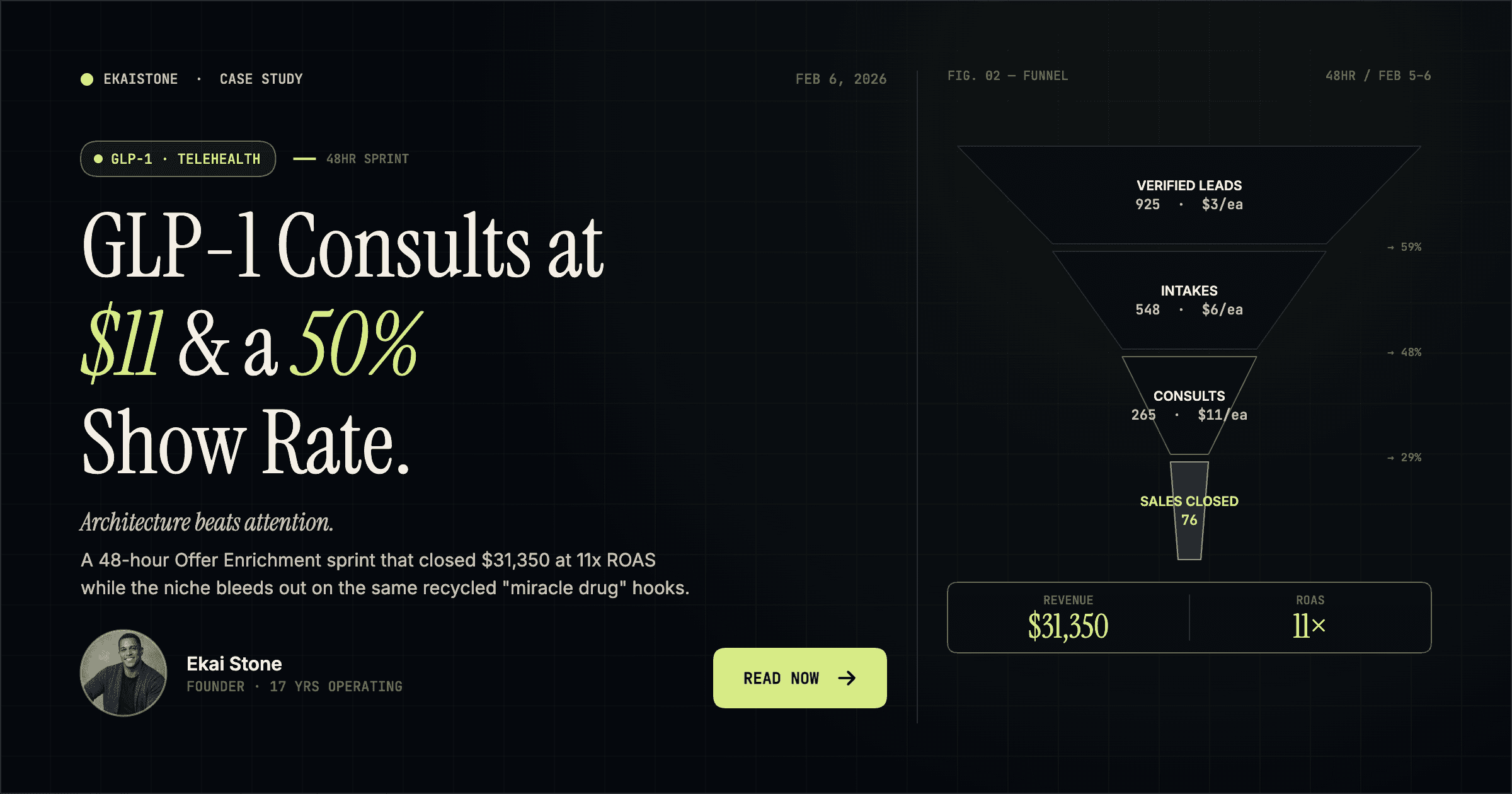
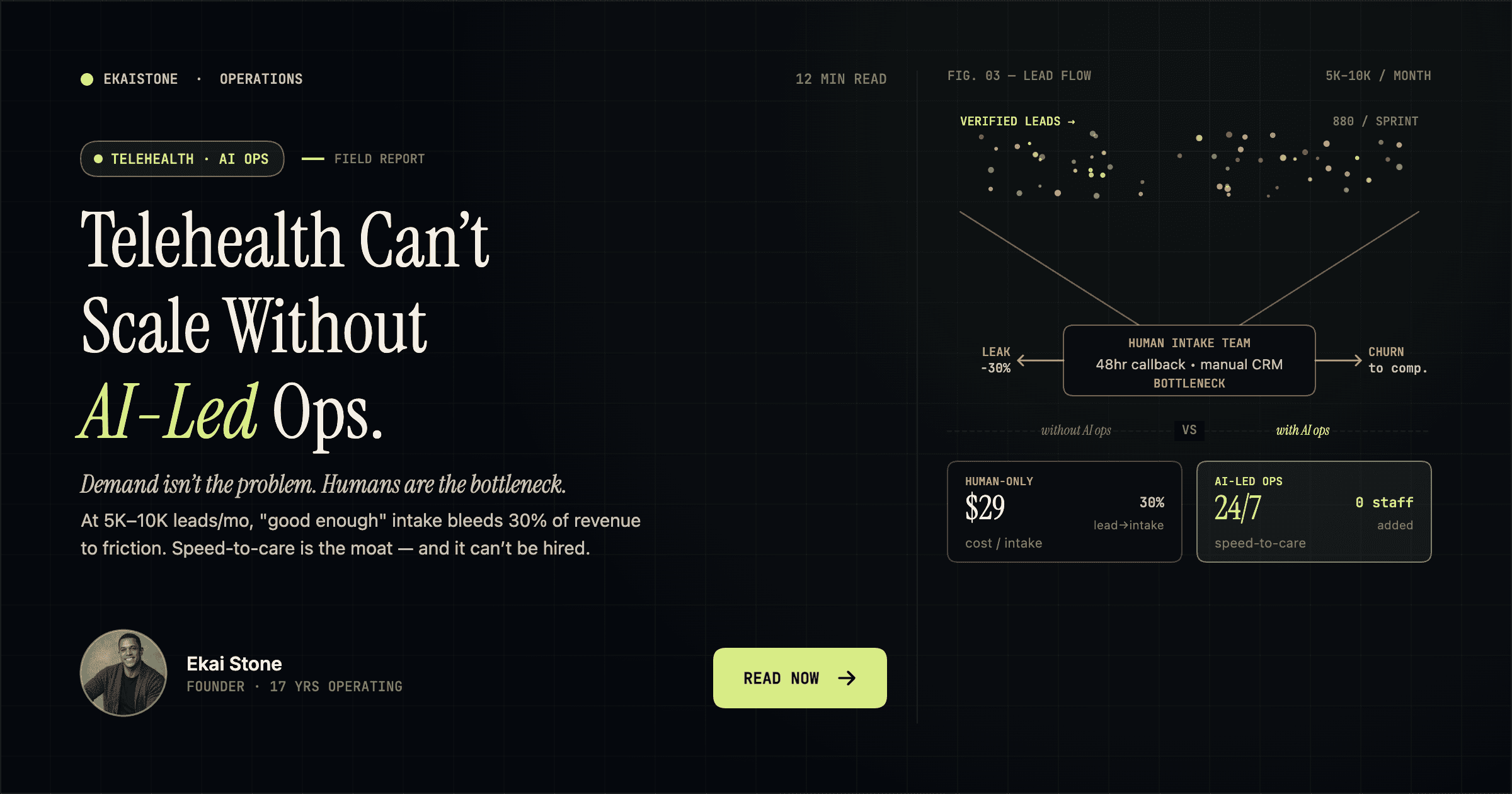

Where online business owners learn how to scale with structure, discipline, and long-term stability.
Where online business owners learn how to scale with structure, discipline, and long-term stability.