Part 1: Why the "Easy" Money is Gone

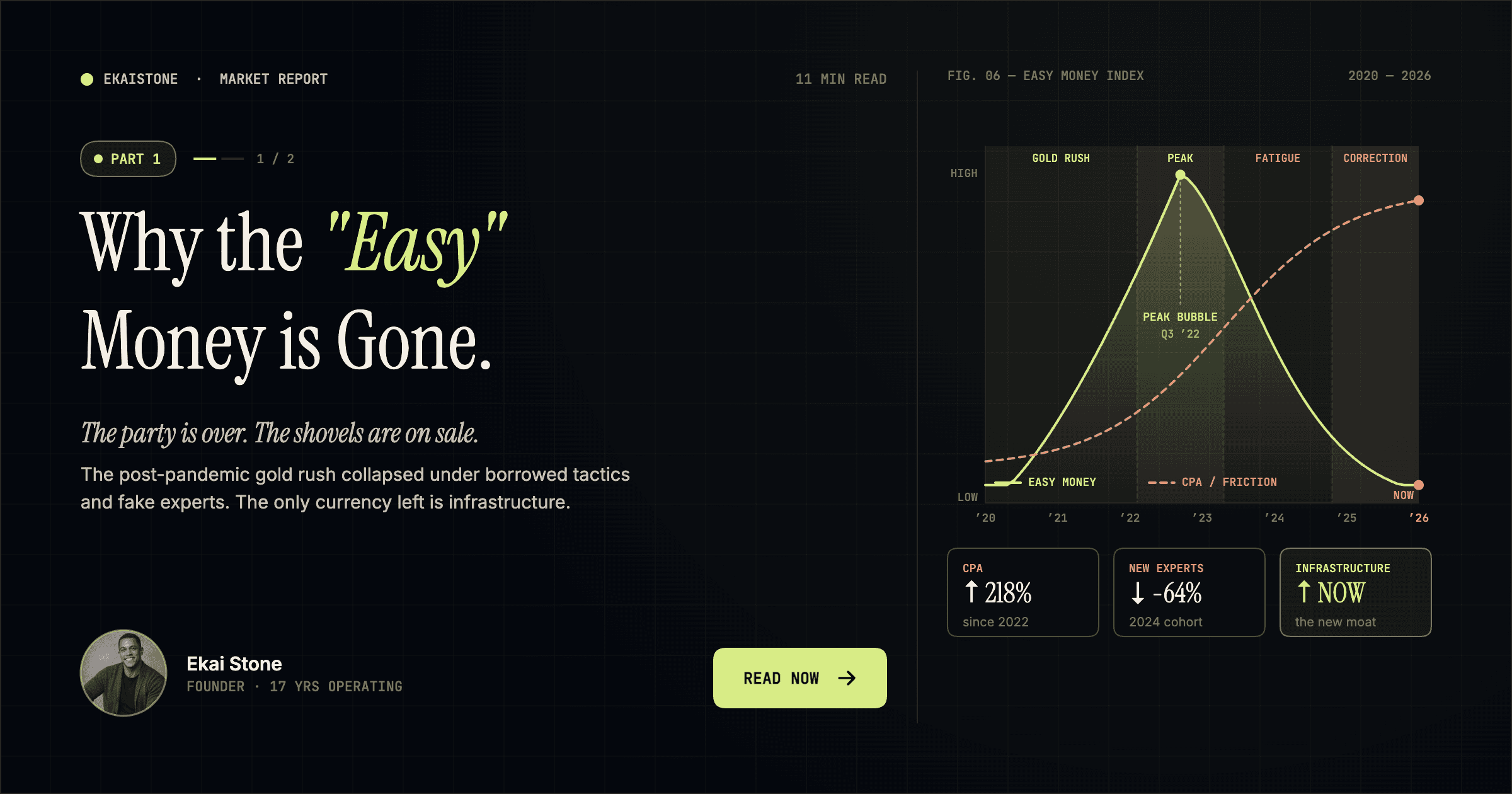
The party is over. The "Gold Rush" of the post-pandemic digital economy has collapsed under the weight of borrowed tactics and fake experts.
The calendar reads 2026, but if you look closely at the online coaching and agency landscape, it feels like we are waking up from a long, chaotic fever dream. We're entering a period of necessary correction. I don’t say this to be an alarmist; I say this as a Revenue Architect who looks at the data every day. The era of "fake it 'til you make it" is dead. We are standing at the precipice of a new era where the only currency that matters is infrastructure. To understand where we are going, we have to honestly appraise where we’ve been.
For the better part of five years, the digital economy has been running on a potent mixture of adrenaline, easy credit, and the lingering momentum of the post-pandemic digital boom. It was a gold rush. And like all gold rushes, it created a very specific type of economy: one built on speed, volume, and the aggressive selling of shovels.
But the ground has shifted. You can feel it in your increased KPI's and engagement numbers. You can see it in the rising cost per acquisition (CPA). Most importantly, you can hear it in the private conversations between founders who are tired of pretending that the old playbooks are still working.
We are entering a period of necessary correction.
I say this as someone who builds the back-end infrastructure that actually makes businesses run, rather than just selling the front-end promise of what a business could be.
The era of "fake it 'til you make it" didn't just end; it collapsed under its own weight. We are now standing at the precipice of a new era, one where borrowed conviction is no longer a currency, and where the only thing that holds value is lived experience and engineered infrastructure.
To understand where we are going, we have to honestly appraise where we’ve been.
The Archaeology of a Bubble
When the world went inside in 2020, the barrier to entry for online business evaporated. Suddenly, anyone with a laptop and a decent Wi-Fi connection could declare themselves an expert. Fitness coaches, marketing consultants, life coaches, and agency owners flooded the market.
This wasn't inherently bad. Democratized access to entrepreneurship is a beautiful thing. But a dangerous pattern emerged almost immediately.
New entrants were entering the market without prior business experience. They weren't coming from logistics, or corporate management, or traditional advertising. They were coming from valid, but unrelated, backgrounds. They were buying courses that taught them tactics—how to run a Facebook ad, how to send a cold DM, how to script a sales call—but almost none of these curriculums taught them architecture.
They learned how to generate revenue, but they didn't learn how to build a business.
For a few years, it didn't matter. The demand was so high that you could run a sloppy business and still profit. You could ignore client retention because there were always fresh leads. You could ignore Customer Relationship Management (CRM) hygiene because the volume masked the inefficiencies. You could operate without Standard Operating Procedures (SOPs) because you were fueled by hustle and caffeine.
But markets mature. They always do.
As we moved through 2023 and 2024, the "easy" inventory dried up. The sophisticated buyers remained, but they became skeptical. They had been burned. They had bought the $10,000 package, only to find that the "guru" they trusted was nowhere to be found, replaced by a junior Customer Success Manager reading from a script.
This created the quiet crisis we are seeing today. We have a massive population of operators who are generating revenue but are structurally insolvent in terms of time and energy. They are exhausted. They are pivoting frantically from fitness, to business coaching, to Ai automation, to "systems" hoping that a new niche will solve an operational problem. The saddest I've seen is old online coaches going back to corporate work, or back to being a personal trainer at a gym giving up on their entrepreneur dreams all together.
It won’t.
The High-Ticket Mirage
One of the most pervasive issues I’ve observed from the trenches is the distortion of the "High Ticket" model.
The premise is sound: charge a premium price for a premium transformation. I agree with this fundamentally. But in practice, the model morphed into a game of proximity rather than mastery.
Operators were taught to sell access to themselves. They built personal brands that promised intimacy and mentorship. Buyers paid $15,000, $30,000, sometimes $50,000, believing they were buying a relationship with a seasoned expert who could guide them through the fire.
Then, the reality of fulfillment hit.
To scale a "proximity" offer, you have to remove the founder. So, the founder steps back. They hire media buyers who are often learning on the job. They hire support staff who are well-intentioned but lack the deep, nuanced experience required to solve complex client problems.
The client, who bought the vision of the founder, ends up in a Slack channel or a Discord server, getting advice from peers who are just as confused as they are.
The curriculum usually assumes the buyer has a team. It assumes they have a budget for ad spend testing. It assumes they have time to troubleshoot tech stacks. But most buyers are solo operators. They are drowning in execution, and the "support" they paid for is just a library of videos telling them to work harder.
This is a failure of product architecture. It is a failure to understand the lifecycle of the client.
When I look at the back end of these businesses, and I've looked at many, the data tells a sobering story. Churn is high. Refund requests are managed by aggressive legal threats rather than resolution. The "profit" is often consumed by a bloated team required to manually patch the holes in a leaky system.
There is no equity being built. There is no asset that can be sold. There is only a cash-flow machine that requires the founder to dance on social media every day to keep the lights on.
The Pivot Fatigue
Because the foundation is shaky, when the tactics stop working, the operator panics.
We’ve all seen the cycle. The fitness coach who hits a revenue ceiling and decides the solution is to teach other fitness coaches how to build a business. Then, when the "business coaching" market feels saturated, they pivot to "AI Automation Agency." When that gets hard, they pivot to "Mindset."
This constant pivoting is a symptom of a deeper issue: a lack of transferable infrastructure.
If you build a proper Revenue Architecture—a system that tracks attribution, manages lead flow automations, nurtures prospects based on behavior, and delivers a consistent client experience—you don’t need to pivot your entire identity every 18 months. You simply adjust the offer.
But because most operators skipped the "boring" stuff—the CRM workflows, the attribution tracking, the SOP development—they have no baseline. Every pivot is a restart. They are building from scratch, over and over again, eroding their credibility with their audience each time.
It is heartbreaking to watch smart, capable people burn out because they are trying to run a marathon in shoes made of cardboard.
The Missing Layer: Infrastructure as Authority
In 2026, authority is no longer about how loud you can shout or how much rented luxury you can display in a reel. Authority is about competence.
Competence is quiet. It is evidenced by systems that work without constant intervention.
The operators who will win in the next decade are the ones who are currently doing the unglamorous work of retrofitting their businesses with steel and concrete. They are implementing tracking protocols so they know exactly where their dollars are going. They are building automations that treat every lead like a human being, not a number. They are documenting their processes so that their team can execute with precision, not just enthusiasm.
This is where I spend my days. I don't sell the dream of the four-hour work week. I build the infrastructure that makes a forty-hour work week manageable, predictable, and profitable.
I’ve been in this industry for over a decade. I’ve managed the spend. I’ve stared at the attribution windows. I’ve seen the difference between a business that runs on hype and a business that runs on systems.
The difference is longevity.
The hype businesses explode bright and fast, leaving a trail of ash. The systems businesses grow like trees—slowly at first, then undeniably. They weather the algorithm changes. They survive the recessions. They retain their clients because they actually deliver on the promise.
The Distinction Between "Borrowed" and "Earned"
Perhaps the most critical shift we are facing is the rejection of "borrowed frameworks."
For too long, the industry has been an echo chamber. Expert A buys a course from Expert B, rebrands the framework, and sells it to Aspirant C. By the time the strategy reaches the end user, it is a photocopy of a photocopy—blurred, distorted, and often completely irrelevant to the current market conditions.
This is why we see so much generic advice. "Post three times a day." "Send 50 DMs." "Use this exact script."
These are tactics divorced from strategy. They are borrowed conviction.
The market can smell it now. In 2026, you cannot teach what you have not lived. You cannot lead someone through a minefield if you have only ever studied a map. You have to have walked the path.
This is why we are seeing a return to specialization. The generalist "business coach" is losing ground to the specialist who understands the specific unit economics of a telehealth offer, or the precise compliance nuances of a B2B AI service.
Deep expertise requires deep data. It requires looking at the numbers—the boring, unsexy numbers—and understanding what they mean for the health of the organization.
Why I Am Speaking Up Now
I have stayed relatively quiet for years, preferring to work in the background. I’ve helped build the engines for high-level operators, fixing the plumbing while they painted the house.
But the noise has become too loud to ignore. The gap between what is being sold and what is being built has become too wide.
I am writing this because I believe the online education and agency space is vital. It is one of the few remaining avenues for genuine class mobility and independent wealth creation. It deserves to be protected. And protecting it means exposing the structural rot that threatens to collapse it.
We need to normalize the idea that a business is not just a funnel. A business is a complex system of moving parts—people, processes, technology, and capital—that must work in harmony.
We need to stop celebrating revenue and start celebrating net margin.
We need to stop celebrating "launches" and start celebrating "lifecycle."
We need to stop celebrating speed and start celebrating durability.
The Opportunity Ahead
If you are reading this and feeling a sense of heaviness, let me offer a reframing.
The fatigue you feel is not a sign of failure. It is a sign of maturation. You are outgrowing the "hustle" phase and craving the "architect" phase.
This is the inflection point.
The operators who survive 2026 will not be the ones with the best hooks or the trendiest audio. They will be the ones who pause, look at their foundation, and realize that you cannot build a skyscraper on sand.
They will be the ones who decide to build from truth.
They will invest in their CRM not as a contact list, but as a central nervous system. They will view marketing not as a slot machine, but as a measurable feedback loop. They will treat their clients not as transactions, but as partners in a long-term relationship.
This is a harder path. It requires patience. It requires humility. It requires admitting that you might have to tear down some drywall to fix the electrical wiring.
But it is the only path that leads to a business you can actually keep.
The era of the "easy win" is over.
The era of the "Revenue Architect" has begun.
This is just the surface. In the next part of this series, I’m going to break down exactly how the traditional agency model is failing both the owner and the client, and what the specific structural alternative looks like. We’re going to talk about the mechanics of the "Performance Ecosystem" and why the old retainer model is dead walking.
If this resonated with you, if you’re tired of the noise and ready to build something real, then you’re exactly who I’m writing for.
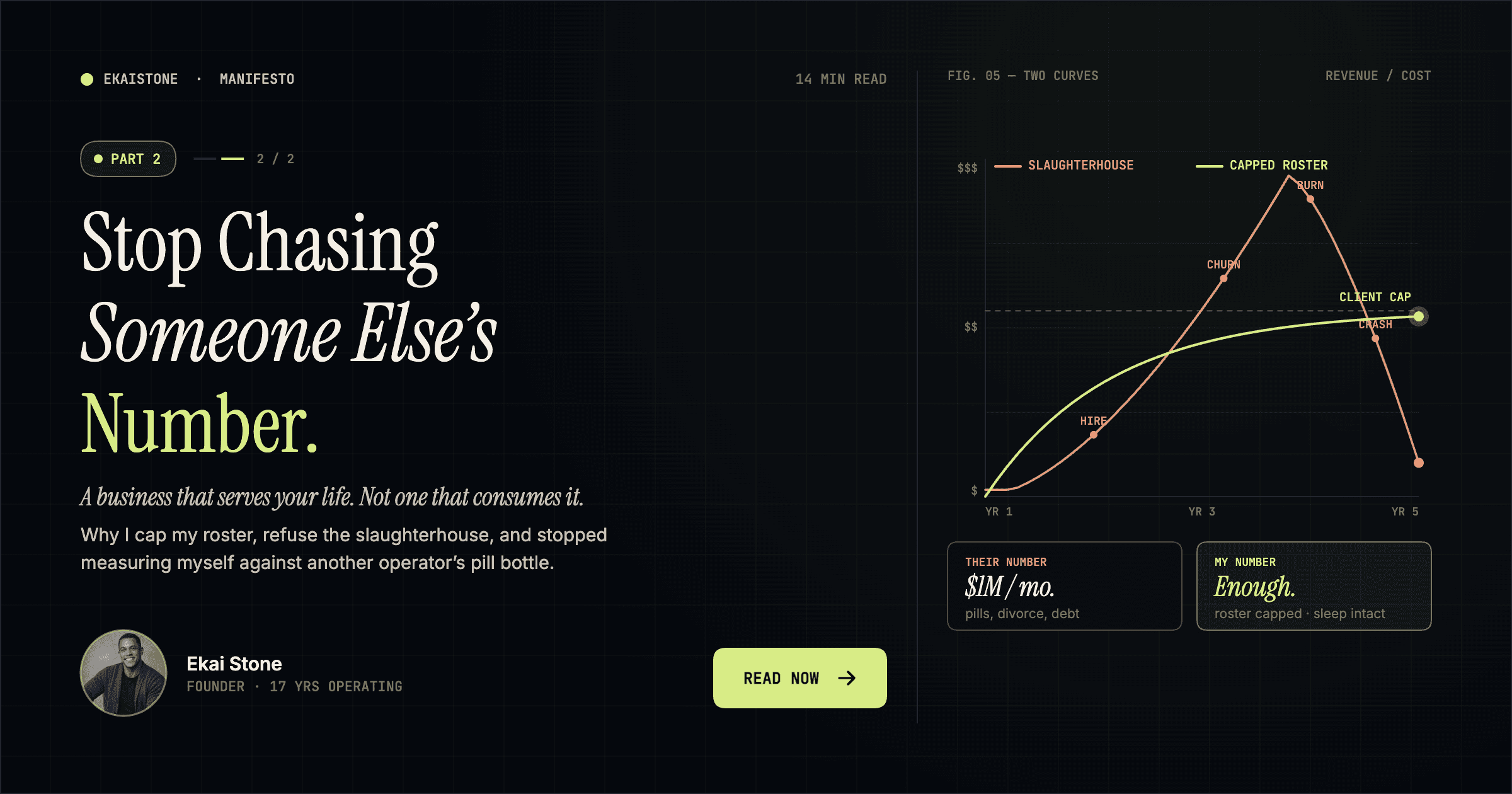
In Part 2, I break down the specific operational model I use to escape the "churn and burn" cycle. It’s not about scaling to the moon, it’s about scaling to your Sovereignty.
The party is over. The "Gold Rush" of the post-pandemic digital economy has collapsed under the weight of borrowed tactics and fake experts.
The calendar reads 2026, but if you look closely at the online coaching and agency landscape, it feels like we are waking up from a long, chaotic fever dream. We're entering a period of necessary correction. I don’t say this to be an alarmist; I say this as a Revenue Architect who looks at the data every day. The era of "fake it 'til you make it" is dead. We are standing at the precipice of a new era where the only currency that matters is infrastructure. To understand where we are going, we have to honestly appraise where we’ve been.
For the better part of five years, the digital economy has been running on a potent mixture of adrenaline, easy credit, and the lingering momentum of the post-pandemic digital boom. It was a gold rush. And like all gold rushes, it created a very specific type of economy: one built on speed, volume, and the aggressive selling of shovels.
But the ground has shifted. You can feel it in your increased KPI's and engagement numbers. You can see it in the rising cost per acquisition (CPA). Most importantly, you can hear it in the private conversations between founders who are tired of pretending that the old playbooks are still working.
We are entering a period of necessary correction.
I say this as someone who builds the back-end infrastructure that actually makes businesses run, rather than just selling the front-end promise of what a business could be.
The era of "fake it 'til you make it" didn't just end; it collapsed under its own weight. We are now standing at the precipice of a new era, one where borrowed conviction is no longer a currency, and where the only thing that holds value is lived experience and engineered infrastructure.
To understand where we are going, we have to honestly appraise where we’ve been.
The Archaeology of a Bubble
When the world went inside in 2020, the barrier to entry for online business evaporated. Suddenly, anyone with a laptop and a decent Wi-Fi connection could declare themselves an expert. Fitness coaches, marketing consultants, life coaches, and agency owners flooded the market.
This wasn't inherently bad. Democratized access to entrepreneurship is a beautiful thing. But a dangerous pattern emerged almost immediately.
New entrants were entering the market without prior business experience. They weren't coming from logistics, or corporate management, or traditional advertising. They were coming from valid, but unrelated, backgrounds. They were buying courses that taught them tactics—how to run a Facebook ad, how to send a cold DM, how to script a sales call—but almost none of these curriculums taught them architecture.
They learned how to generate revenue, but they didn't learn how to build a business.
For a few years, it didn't matter. The demand was so high that you could run a sloppy business and still profit. You could ignore client retention because there were always fresh leads. You could ignore Customer Relationship Management (CRM) hygiene because the volume masked the inefficiencies. You could operate without Standard Operating Procedures (SOPs) because you were fueled by hustle and caffeine.
But markets mature. They always do.
As we moved through 2023 and 2024, the "easy" inventory dried up. The sophisticated buyers remained, but they became skeptical. They had been burned. They had bought the $10,000 package, only to find that the "guru" they trusted was nowhere to be found, replaced by a junior Customer Success Manager reading from a script.
This created the quiet crisis we are seeing today. We have a massive population of operators who are generating revenue but are structurally insolvent in terms of time and energy. They are exhausted. They are pivoting frantically from fitness, to business coaching, to Ai automation, to "systems" hoping that a new niche will solve an operational problem. The saddest I've seen is old online coaches going back to corporate work, or back to being a personal trainer at a gym giving up on their entrepreneur dreams all together.
It won’t.
The High-Ticket Mirage
One of the most pervasive issues I’ve observed from the trenches is the distortion of the "High Ticket" model.
The premise is sound: charge a premium price for a premium transformation. I agree with this fundamentally. But in practice, the model morphed into a game of proximity rather than mastery.
Operators were taught to sell access to themselves. They built personal brands that promised intimacy and mentorship. Buyers paid $15,000, $30,000, sometimes $50,000, believing they were buying a relationship with a seasoned expert who could guide them through the fire.
Then, the reality of fulfillment hit.
To scale a "proximity" offer, you have to remove the founder. So, the founder steps back. They hire media buyers who are often learning on the job. They hire support staff who are well-intentioned but lack the deep, nuanced experience required to solve complex client problems.
The client, who bought the vision of the founder, ends up in a Slack channel or a Discord server, getting advice from peers who are just as confused as they are.
The curriculum usually assumes the buyer has a team. It assumes they have a budget for ad spend testing. It assumes they have time to troubleshoot tech stacks. But most buyers are solo operators. They are drowning in execution, and the "support" they paid for is just a library of videos telling them to work harder.
This is a failure of product architecture. It is a failure to understand the lifecycle of the client.
When I look at the back end of these businesses, and I've looked at many, the data tells a sobering story. Churn is high. Refund requests are managed by aggressive legal threats rather than resolution. The "profit" is often consumed by a bloated team required to manually patch the holes in a leaky system.
There is no equity being built. There is no asset that can be sold. There is only a cash-flow machine that requires the founder to dance on social media every day to keep the lights on.
The Pivot Fatigue
Because the foundation is shaky, when the tactics stop working, the operator panics.
We’ve all seen the cycle. The fitness coach who hits a revenue ceiling and decides the solution is to teach other fitness coaches how to build a business. Then, when the "business coaching" market feels saturated, they pivot to "AI Automation Agency." When that gets hard, they pivot to "Mindset."
This constant pivoting is a symptom of a deeper issue: a lack of transferable infrastructure.
If you build a proper Revenue Architecture—a system that tracks attribution, manages lead flow automations, nurtures prospects based on behavior, and delivers a consistent client experience—you don’t need to pivot your entire identity every 18 months. You simply adjust the offer.
But because most operators skipped the "boring" stuff—the CRM workflows, the attribution tracking, the SOP development—they have no baseline. Every pivot is a restart. They are building from scratch, over and over again, eroding their credibility with their audience each time.
It is heartbreaking to watch smart, capable people burn out because they are trying to run a marathon in shoes made of cardboard.
The Missing Layer: Infrastructure as Authority
In 2026, authority is no longer about how loud you can shout or how much rented luxury you can display in a reel. Authority is about competence.
Competence is quiet. It is evidenced by systems that work without constant intervention.
The operators who will win in the next decade are the ones who are currently doing the unglamorous work of retrofitting their businesses with steel and concrete. They are implementing tracking protocols so they know exactly where their dollars are going. They are building automations that treat every lead like a human being, not a number. They are documenting their processes so that their team can execute with precision, not just enthusiasm.
This is where I spend my days. I don't sell the dream of the four-hour work week. I build the infrastructure that makes a forty-hour work week manageable, predictable, and profitable.
I’ve been in this industry for over a decade. I’ve managed the spend. I’ve stared at the attribution windows. I’ve seen the difference between a business that runs on hype and a business that runs on systems.
The difference is longevity.
The hype businesses explode bright and fast, leaving a trail of ash. The systems businesses grow like trees—slowly at first, then undeniably. They weather the algorithm changes. They survive the recessions. They retain their clients because they actually deliver on the promise.
The Distinction Between "Borrowed" and "Earned"
Perhaps the most critical shift we are facing is the rejection of "borrowed frameworks."
For too long, the industry has been an echo chamber. Expert A buys a course from Expert B, rebrands the framework, and sells it to Aspirant C. By the time the strategy reaches the end user, it is a photocopy of a photocopy—blurred, distorted, and often completely irrelevant to the current market conditions.
This is why we see so much generic advice. "Post three times a day." "Send 50 DMs." "Use this exact script."
These are tactics divorced from strategy. They are borrowed conviction.
The market can smell it now. In 2026, you cannot teach what you have not lived. You cannot lead someone through a minefield if you have only ever studied a map. You have to have walked the path.
This is why we are seeing a return to specialization. The generalist "business coach" is losing ground to the specialist who understands the specific unit economics of a telehealth offer, or the precise compliance nuances of a B2B AI service.
Deep expertise requires deep data. It requires looking at the numbers—the boring, unsexy numbers—and understanding what they mean for the health of the organization.
Why I Am Speaking Up Now
I have stayed relatively quiet for years, preferring to work in the background. I’ve helped build the engines for high-level operators, fixing the plumbing while they painted the house.
But the noise has become too loud to ignore. The gap between what is being sold and what is being built has become too wide.
I am writing this because I believe the online education and agency space is vital. It is one of the few remaining avenues for genuine class mobility and independent wealth creation. It deserves to be protected. And protecting it means exposing the structural rot that threatens to collapse it.
We need to normalize the idea that a business is not just a funnel. A business is a complex system of moving parts—people, processes, technology, and capital—that must work in harmony.
We need to stop celebrating revenue and start celebrating net margin.
We need to stop celebrating "launches" and start celebrating "lifecycle."
We need to stop celebrating speed and start celebrating durability.
The Opportunity Ahead
If you are reading this and feeling a sense of heaviness, let me offer a reframing.
The fatigue you feel is not a sign of failure. It is a sign of maturation. You are outgrowing the "hustle" phase and craving the "architect" phase.
This is the inflection point.
The operators who survive 2026 will not be the ones with the best hooks or the trendiest audio. They will be the ones who pause, look at their foundation, and realize that you cannot build a skyscraper on sand.
They will be the ones who decide to build from truth.
They will invest in their CRM not as a contact list, but as a central nervous system. They will view marketing not as a slot machine, but as a measurable feedback loop. They will treat their clients not as transactions, but as partners in a long-term relationship.
This is a harder path. It requires patience. It requires humility. It requires admitting that you might have to tear down some drywall to fix the electrical wiring.
But it is the only path that leads to a business you can actually keep.
The era of the "easy win" is over.
The era of the "Revenue Architect" has begun.
This is just the surface. In the next part of this series, I’m going to break down exactly how the traditional agency model is failing both the owner and the client, and what the specific structural alternative looks like. We’re going to talk about the mechanics of the "Performance Ecosystem" and why the old retainer model is dead walking.
If this resonated with you, if you’re tired of the noise and ready to build something real, then you’re exactly who I’m writing for.
In Part 2, I break down the specific operational model I use to escape the "churn and burn" cycle. It’s not about scaling to the moon, it’s about scaling to your Sovereignty.

Where online business owners learn how to scale with structure, discipline, and long-term stability.
Where online business owners learn how to scale with structure, discipline, and long-term stability.