Part 2: Stop Chasing Someone Else’s Number
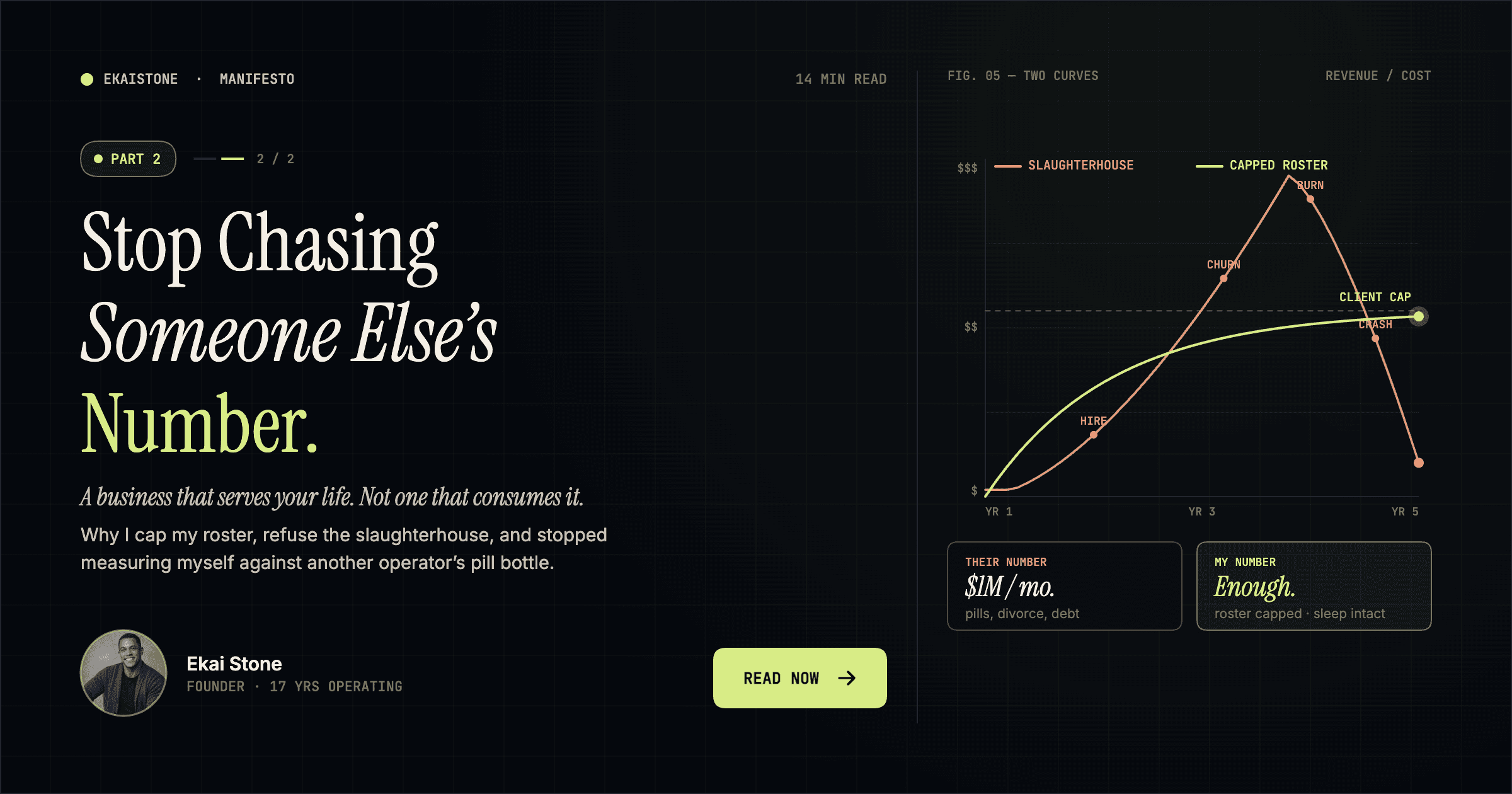
Diagnosing the sickness is easy. The hard part is deciding how you are going to live now that the fever has broken. In Part 2, I am pivoting from industry analysis to personal philosophy. I want to talk about why I refuse to scale like a "Slaughterhouse," why I cap my client roster, and how to build a business that serves your life, rather than consuming it.
The Client Cap Advantage: Why I Refuse to Scale Like Everyone Else
If you read Part 1, you know exactly what I’m talking about. We walked through the "Quiet Crisis". The structural rot inside the coaching and agency world where revenue is high, but the backend is hollow. We talked about how the industry has been running on adrenaline and borrowed tactics, and why that era is ending.
But diagnosing the sickness is the easy part. The harder part, and the only part that actually matters, is deciding how you are going to live now that the fever has broken.
I want to pivot quickly here. I want to talk about how I operate, why I operate this way, and why most of the "goals" we are sold are actually traps in disguise.
I read a lot. I’ve read plenty of business books, sure. But if you look at my library, you’ll see I’ve read far more books about self-development. I’ve read about physics, human nature, and natural sciences. I read about botany, mathematics, astrology, and numerology. I am fascinated by systems, not just CRM systems, but the systems that govern the universe. Cause and effect. Inputs and outputs. The feedback loops of nature.
In all that reading, in that self-erudition, I’ve gathered one curriculum that matters more than any marketing tactic:
"You are not a drop in the ocean. You are the entire ocean in a drop." - Rumi
My life is my own. I do not compare myself to anyone else. I am a piece of the whole. I want to be an asset as an individual to the system as a whole.
This sounds simple, right? But in our industry, it’s radical. Just because the people who hire me, people making $100,000 or $1 million a month, are chasing a certain number, doesn't mean that's what I want.
I’ve worked for those kinds of business owners. I’ve looked under the hood of the 8-figure and 9-figure machines. And I’ll tell you something the Instagram reels won’t: they had many problems.
I saw operators who were on pills to get through the day.
I saw addicts: alcohol, adrenaline, validation. They were burning out. They weren’t really fulfilled, I don't think. They were chasing a number, or perhaps they were working out some past anger or resentment. They were trying to prove something to an ex-girlfriend, or an ex-boyfriend, or a parent who didn't believe in them.
They’d say,
“I’m gonna work so hard. I’m gonna make so much money. I’m gonna show them.”
And they did show them. But at what cost? You don’t know what that person’s personal life is like. You see the revenue stripe; you don't see the divorce papers. You don't see the health crash. You don't see their debt. You don't see the staff and clients they burned.
I realized very early on that I wasn't going to fall into that trap. I know what works for me. I know what I need to make per month. I’ve already seen myself as 60 years old. I’ve visualized the children, the grandchildren, the kind of life I want to live with them.
And by no means is that future vision of me always working 24-7.
Everybody has to find what happiness means to them. What is their definition of wealth? What is their definition of rich?
You don't need to make a million dollars a month to be happy. You don't need to strive to be a billionaire. There are some people who strive to do that, and that's great. I have no qualms or quarrels with them. But I feel a lot of people are suffering because they are running a race they didn't sign up for. They are not naturally aligned with these ostentatious goals.
I’m on strategy calls constantly. I’m helping clients with their mindset, and they always bring up some external benchmark.
“Well, there’s this guy, he’s making $500,000 a month.”
“There’s this brand, and they have 100,000 clients.”
They are always comparing themselves to somebody else. But what they need to do is do the numbers themselves.
We need to strip away the vanity metrics and look at the reality of your existence. Whether you’re single, in a loving relationship, married with kids, or divorced paying child support, what do YOU actually need?
What is your rent? Your food? Your entertainment? Your insurance? Your car note? What are the things you have to take care of every month?
This is your baseline. I call this The Sovereignty Baseline.
Let’s create a real number. Let’s say it’s $5,000. You need to make $5,000 a month to cover your rent or mortgage, your car payment, your insurance, gas, utilities, your phone, food. The basics.
That is survival. But we aren't here just to survive. You know you want to travel. You want to learn more, invest in education. You want to put money aside for savings. You want to give 5 to 10% to charity because circulation is part of the law of nature.
So maybe you add another $5,000. Your Sovereignty Growth Line $10,000 a month.
At $10,000 a month, you are living very comfortably. You have enough money to cover all your bills, you’re putting money away, you’re traveling, and you’re funding your own growth. For many people, this is freedom.
But maybe you have a vision that requires more physics, more mass to move.
Let's Use My Personal Dream As Your Example.
I am building a family ranch. It's on two acres. I have six horses. There's two highly trained security dogs. We have two to three children. My wife has her own art studio on the property where she can teach and create. Our family and closest friends come and go as they please.
We have staff that takes care of the ranch: cooking, cleaning, landscaping. We have security protocols. I get to pay for the utilities of a compound like that. I get to pay for the feed for all the animals, the vet bills, the supplies for the art business.
I've done the math on this.
I can either save up for 20 years to build this ranch, slowly grinding away, or I can create a number from my heart that will allow me to reach this dream within two years.
Right now, my fiancé and I have a beautiful apartment in Mexico. It takes about $5,000 a month to give us a very happy, comfortable life. If we want to travel freely and give to charity, $7,000 to $10,000 is all we need. THAT'S IT! We are perfectly content. Absolutely everything is taken care of. Our family, future children, retirement products… everything.
But if I want the ranch, let’s say the project will cost $750,000 or a million dollars, I need to reverse engineer the numbers.
How much money do I need to make? How many clients do I need to get there? How soon do I want this achieved?
This is where the divergence happens. This is where most people choose the "Slaughterhouse."
The traditional agency or coaching model looks at that "Million Dollar Ranch" goal and says: "Okay, I need to get 1,000 customers. I need to run massive ads. I need a sales floor of 20 people closing deals all day long."
They prioritize volume because they don't understand architecture.
And what happens? They build a Slaughterhouse Business Model.
I see this constantly. Online coaches of any niche and specialty are spending $10,000 to $50,000 a month on ads. They are running ads all the time to get more clients. Why? Because they have terrible churn. Unhealthy churn.
They treat leads like cattle. They bring them in, extract the cash, and move them through a broken fulfillment system that leaves the client confused and the operator exhausted.
The client pays $7,000 to $20,000+ to learn from the "Guru," but they never see the Guru. They get passed off to a support rep who is reading a script. The infrastructure isn't there. The tracking isn't there. The care isn't there.
They are running a slaughterhouse. It’s a cashflow machine that eats its own customers to stay alive.
I refuse to build that.
What I do is the opposite. And this isn't just a moral stance; it's a systems stance. In nature, ecosystems that grow too fast without root systems collapse. I prefer the strength of the oak tree to the speed of the weed.
I operate on what I call The Sovereign Ecosystem.
Here is how it works:
I have a client cap. I work with a limited number of partners, around 13.
Why? Because if I take on 50, I can’t be the architect. I become a manager, not the builder.
When a client comes into my world, we aren't just running ads. We are building the entire backend. I am teaching them "click to revenue." We are setting up tracking systems so precise they know exactly where every dollar returns. We are building CRM automations, workflows, and pipeline stages.
I am helping them create their onboarding material so their clients feel held from day one. I’m helping them draft the SOPs (Standard Operating Procedures) so their team knows what to do without asking. We are recruiting, training, and hiring staff together.
We work on creative, copy, angles, and avatar testing. We build the remarketing logic: Top of Funnel, Middle of Funnel, Bottom of Funnel using ads, email and content.
I spend time with them to ensure the system will work without me. Then,
I leave.
This is the paradox that scares most agencies:
My goal is to make myself obsolete.
I don’t want clients forever because they are dependent. I want clients for years because the system works.
If a client leaves, it is mutually agreed. The contract term is done. The responsibilities are all met. Expectations are exceeded. They are leaving as smarter operators, confident in their numbers, saving for retirement, and owning a machine that they understand.
No one is leaving on bad terms.
Or, more often, they choose to stay. They keep me on a retainer for years, not because they have to, but because we are building the next phase together. We are scaling from the apartment to the ranch.
This is beautiful. This is sustainable.
This model requires patience. It requires you to say "no" to the quick cash grab of the slaughterhouse. It requires you to be an architect, not just a salesperson. It requires you to stop chasing bright shiny objects. Stop listening to lambo gurus. Stop thinking that spending $20,000 for a guru = value. 60% of that $20k goes to their overheard.
I call this specific approach The Legacy Infrastructure Model.
It relies on a few core pillars:
The Client Cap: Artificial scarcity protects quality.
The Infrastructure First: We build the CRM and tracking before we scale the spend.
The Sovereignty Baseline: We know exactly why we are doing this, so we never scale out of alignment with our lives.
When you operate this way, the anxiety disappears. You aren't worried about the next algorithm update because you own your data. You aren't worried about a client demanding a refund because you over-delivered on the infrastructure.
You can look at your bank account and see the money for the ranch accumulating, but you don't have the ulcers that usually come with it.
I want to be very clear: scaling isn’t evil. Scaling without architecture is.
If you are tired of the noise, and you are tired of the "churn and burn" energy of the industry, there is a different way to do this. It involves slowing down to speed up. It involves looking at your business as a living system that needs care, not just a slot machine you pull for cash.
If you’re ready to stop comparing yourself to strangers and start building your own sovereign number, you’ll want to see how the engine is wired.
The Final Word: Mechanics Over Philosophy
I could write a Part 3 breaking down the specific CRM workflows, the attribution models, and the "Click to Revenue" tracking I build. But the truth is, infrastructure isn't content. It’s custom.
You cannot copy-paste a nervous system.
If you are tired of the noise, and you are tired of the "churn and burn" energy of the industry, there is a different way to do this. It involves slowing down to speed up. It involves looking at your business as a living system that needs care, not just a slot machine you pull for cash.
I don't sell courses. I don't sell group coaching. I enter your business, audit your infrastructure, and build the "Click to Revenue" systems that allow you to scale without breaking.
If you are a mature operator ready for that level of precision, I’d love to meet you.
If you’re ready for this I'd love to meet you.
Diagnosing the sickness is easy. The hard part is deciding how you are going to live now that the fever has broken. In Part 2, I am pivoting from industry analysis to personal philosophy. I want to talk about why I refuse to scale like a "Slaughterhouse," why I cap my client roster, and how to build a business that serves your life, rather than consuming it.
The Client Cap Advantage: Why I Refuse to Scale Like Everyone Else
If you read Part 1, you know exactly what I’m talking about. We walked through the "Quiet Crisis". The structural rot inside the coaching and agency world where revenue is high, but the backend is hollow. We talked about how the industry has been running on adrenaline and borrowed tactics, and why that era is ending.
But diagnosing the sickness is the easy part. The harder part, and the only part that actually matters, is deciding how you are going to live now that the fever has broken.
I want to pivot quickly here. I want to talk about how I operate, why I operate this way, and why most of the "goals" we are sold are actually traps in disguise.
I read a lot. I’ve read plenty of business books, sure. But if you look at my library, you’ll see I’ve read far more books about self-development. I’ve read about physics, human nature, and natural sciences. I read about botany, mathematics, astrology, and numerology. I am fascinated by systems, not just CRM systems, but the systems that govern the universe. Cause and effect. Inputs and outputs. The feedback loops of nature.
In all that reading, in that self-erudition, I’ve gathered one curriculum that matters more than any marketing tactic:
"You are not a drop in the ocean. You are the entire ocean in a drop." - Rumi
My life is my own. I do not compare myself to anyone else. I am a piece of the whole. I want to be an asset as an individual to the system as a whole.
This sounds simple, right? But in our industry, it’s radical. Just because the people who hire me, people making $100,000 or $1 million a month, are chasing a certain number, doesn't mean that's what I want.
I’ve worked for those kinds of business owners. I’ve looked under the hood of the 8-figure and 9-figure machines. And I’ll tell you something the Instagram reels won’t: they had many problems.
I saw operators who were on pills to get through the day.
I saw addicts: alcohol, adrenaline, validation. They were burning out. They weren’t really fulfilled, I don't think. They were chasing a number, or perhaps they were working out some past anger or resentment. They were trying to prove something to an ex-girlfriend, or an ex-boyfriend, or a parent who didn't believe in them.
They’d say,
“I’m gonna work so hard. I’m gonna make so much money. I’m gonna show them.”
And they did show them. But at what cost? You don’t know what that person’s personal life is like. You see the revenue stripe; you don't see the divorce papers. You don't see the health crash. You don't see their debt. You don't see the staff and clients they burned.
I realized very early on that I wasn't going to fall into that trap. I know what works for me. I know what I need to make per month. I’ve already seen myself as 60 years old. I’ve visualized the children, the grandchildren, the kind of life I want to live with them.
And by no means is that future vision of me always working 24-7.
Everybody has to find what happiness means to them. What is their definition of wealth? What is their definition of rich?
You don't need to make a million dollars a month to be happy. You don't need to strive to be a billionaire. There are some people who strive to do that, and that's great. I have no qualms or quarrels with them. But I feel a lot of people are suffering because they are running a race they didn't sign up for. They are not naturally aligned with these ostentatious goals.
I’m on strategy calls constantly. I’m helping clients with their mindset, and they always bring up some external benchmark.
“Well, there’s this guy, he’s making $500,000 a month.”
“There’s this brand, and they have 100,000 clients.”
They are always comparing themselves to somebody else. But what they need to do is do the numbers themselves.
We need to strip away the vanity metrics and look at the reality of your existence. Whether you’re single, in a loving relationship, married with kids, or divorced paying child support, what do YOU actually need?
What is your rent? Your food? Your entertainment? Your insurance? Your car note? What are the things you have to take care of every month?
This is your baseline. I call this The Sovereignty Baseline.
Let’s create a real number. Let’s say it’s $5,000. You need to make $5,000 a month to cover your rent or mortgage, your car payment, your insurance, gas, utilities, your phone, food. The basics.
That is survival. But we aren't here just to survive. You know you want to travel. You want to learn more, invest in education. You want to put money aside for savings. You want to give 5 to 10% to charity because circulation is part of the law of nature.
So maybe you add another $5,000. Your Sovereignty Growth Line $10,000 a month.
At $10,000 a month, you are living very comfortably. You have enough money to cover all your bills, you’re putting money away, you’re traveling, and you’re funding your own growth. For many people, this is freedom.
But maybe you have a vision that requires more physics, more mass to move.
Let's Use My Personal Dream As Your Example.
I am building a family ranch. It's on two acres. I have six horses. There's two highly trained security dogs. We have two to three children. My wife has her own art studio on the property where she can teach and create. Our family and closest friends come and go as they please.
We have staff that takes care of the ranch: cooking, cleaning, landscaping. We have security protocols. I get to pay for the utilities of a compound like that. I get to pay for the feed for all the animals, the vet bills, the supplies for the art business.
I've done the math on this.
I can either save up for 20 years to build this ranch, slowly grinding away, or I can create a number from my heart that will allow me to reach this dream within two years.
Right now, my fiancé and I have a beautiful apartment in Mexico. It takes about $5,000 a month to give us a very happy, comfortable life. If we want to travel freely and give to charity, $7,000 to $10,000 is all we need. THAT'S IT! We are perfectly content. Absolutely everything is taken care of. Our family, future children, retirement products… everything.
But if I want the ranch, let’s say the project will cost $750,000 or a million dollars, I need to reverse engineer the numbers.
How much money do I need to make? How many clients do I need to get there? How soon do I want this achieved?
This is where the divergence happens. This is where most people choose the "Slaughterhouse."
The traditional agency or coaching model looks at that "Million Dollar Ranch" goal and says: "Okay, I need to get 1,000 customers. I need to run massive ads. I need a sales floor of 20 people closing deals all day long."
They prioritize volume because they don't understand architecture.
And what happens? They build a Slaughterhouse Business Model.
I see this constantly. Online coaches of any niche and specialty are spending $10,000 to $50,000 a month on ads. They are running ads all the time to get more clients. Why? Because they have terrible churn. Unhealthy churn.
They treat leads like cattle. They bring them in, extract the cash, and move them through a broken fulfillment system that leaves the client confused and the operator exhausted.
The client pays $7,000 to $20,000+ to learn from the "Guru," but they never see the Guru. They get passed off to a support rep who is reading a script. The infrastructure isn't there. The tracking isn't there. The care isn't there.
They are running a slaughterhouse. It’s a cashflow machine that eats its own customers to stay alive.
I refuse to build that.
What I do is the opposite. And this isn't just a moral stance; it's a systems stance. In nature, ecosystems that grow too fast without root systems collapse. I prefer the strength of the oak tree to the speed of the weed.
I operate on what I call The Sovereign Ecosystem.
Here is how it works:
I have a client cap. I work with a limited number of partners, around 13.
Why? Because if I take on 50, I can’t be the architect. I become a manager, not the builder.
When a client comes into my world, we aren't just running ads. We are building the entire backend. I am teaching them "click to revenue." We are setting up tracking systems so precise they know exactly where every dollar returns. We are building CRM automations, workflows, and pipeline stages.
I am helping them create their onboarding material so their clients feel held from day one. I’m helping them draft the SOPs (Standard Operating Procedures) so their team knows what to do without asking. We are recruiting, training, and hiring staff together.
We work on creative, copy, angles, and avatar testing. We build the remarketing logic: Top of Funnel, Middle of Funnel, Bottom of Funnel using ads, email and content.
I spend time with them to ensure the system will work without me. Then,
I leave.
This is the paradox that scares most agencies:
My goal is to make myself obsolete.
I don’t want clients forever because they are dependent. I want clients for years because the system works.
If a client leaves, it is mutually agreed. The contract term is done. The responsibilities are all met. Expectations are exceeded. They are leaving as smarter operators, confident in their numbers, saving for retirement, and owning a machine that they understand.
No one is leaving on bad terms.
Or, more often, they choose to stay. They keep me on a retainer for years, not because they have to, but because we are building the next phase together. We are scaling from the apartment to the ranch.
This is beautiful. This is sustainable.
This model requires patience. It requires you to say "no" to the quick cash grab of the slaughterhouse. It requires you to be an architect, not just a salesperson. It requires you to stop chasing bright shiny objects. Stop listening to lambo gurus. Stop thinking that spending $20,000 for a guru = value. 60% of that $20k goes to their overheard.
I call this specific approach The Legacy Infrastructure Model.
It relies on a few core pillars:
The Client Cap: Artificial scarcity protects quality.
The Infrastructure First: We build the CRM and tracking before we scale the spend.
The Sovereignty Baseline: We know exactly why we are doing this, so we never scale out of alignment with our lives.
When you operate this way, the anxiety disappears. You aren't worried about the next algorithm update because you own your data. You aren't worried about a client demanding a refund because you over-delivered on the infrastructure.
You can look at your bank account and see the money for the ranch accumulating, but you don't have the ulcers that usually come with it.
I want to be very clear: scaling isn’t evil. Scaling without architecture is.
If you are tired of the noise, and you are tired of the "churn and burn" energy of the industry, there is a different way to do this. It involves slowing down to speed up. It involves looking at your business as a living system that needs care, not just a slot machine you pull for cash.
If you’re ready to stop comparing yourself to strangers and start building your own sovereign number, you’ll want to see how the engine is wired.
The Final Word: Mechanics Over Philosophy
I could write a Part 3 breaking down the specific CRM workflows, the attribution models, and the "Click to Revenue" tracking I build. But the truth is, infrastructure isn't content. It’s custom.
You cannot copy-paste a nervous system.
If you are tired of the noise, and you are tired of the "churn and burn" energy of the industry, there is a different way to do this. It involves slowing down to speed up. It involves looking at your business as a living system that needs care, not just a slot machine you pull for cash.
I don't sell courses. I don't sell group coaching. I enter your business, audit your infrastructure, and build the "Click to Revenue" systems that allow you to scale without breaking.
If you are a mature operator ready for that level of precision, I’d love to meet you.
If you’re ready for this I'd love to meet you.

Where online business owners learn how to scale with structure, discipline, and long-term stability.
Where online business owners learn how to scale with structure, discipline, and long-term stability.