Part 2: The Revenue Architecture Stack

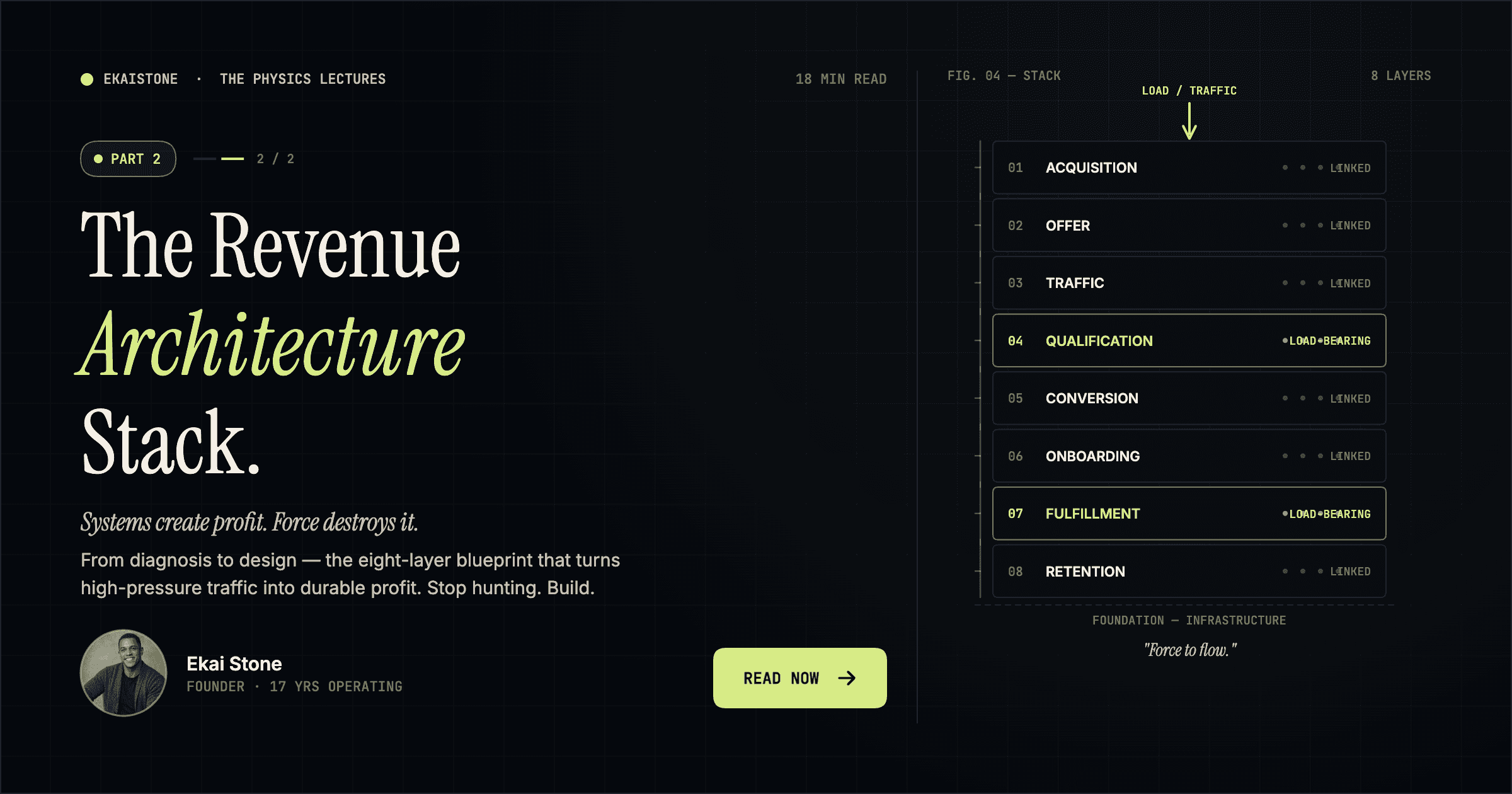
Systems create profit. Force destroys it.
Once the failure points are exposed, the work is no longer psychological or tactical. It becomes mechanical. The same pressure that revealed the cracks now demands a structure capable of holding it.
This is Part 2 of a two-part series. In Part 1, we diagnosed why high-ticket coaching businesses plateau, destabilize, and quietly bleed cash even while revenue appears strong. In this article, we move from explanation to execution. We lay out the exact architecture required to convert traffic into durable profit without sacrificing fulfillment, reputation, or sanity.
This isn’t a funnel.
It’s a system.
From Diagnosis to Design
In Part 1, we stripped away the comforting illusions of the coaching industry. We acknowledged that traffic is not a business, that volume often breaks fulfillment, and that the "Slaughterhouse Model" of churning leads into a broken backend is a mathematical dead end. We agreed that the anxiety you feel is not a mindset flaw, but a structural signal that your business mechanics are misaligned.
If you are reading this, you are done with the diagnosis. You are not looking for motivation to "hustle harder." You are looking for a schematic to build smarter.
You understand that the transition from a "High-Ticket Coach" to a Sovereign Operator requires a fundamental shift in how you view the machine. You must stop acting like a hunter dependent on the next kill (the next launch, the next ad creative) and start thinking like an architect building a structure that stands on its own.
The shift we are making today is from Force to Flow.
Amateurs try to force the market to yield revenue through aggression, hype, and volume. Professionals design systems where revenue is the inevitable output of a well-engineered machine. This is not a philosophy; it is an operational overhaul.
What follows is the exact blueprint I install for high-ticket coaching businesses doing $20k to $500k a month. This is not theory. This is the manual for replacing chaos with control.
The Revenue Architecture Stack
Most agencies view your business as a linear path: Ad → Click → Call → Close.
This is why they fail. And this is why you feel disjointed.
A business is not a line; it is a stack of pressure systems. Each layer must be able to handle the pressure from the layer above it, or the pipe bursts. If you pour high-pressure traffic (Stage 3) into a low-pressure qualification system (Stage 4), you don't get more sales—you get a broken sales team and a calendar full of ghosts.
I build what I call the Revenue Architecture Stack.
This is a vertical integration of eight distinct systems that must communicate with each other. If one layer is missing or disconnected, the load cannot transfer, and the structure collapses under the weight of ad spend.
But before we even look at Stage 1, we must address the Digital Identity Layer.
This is the invisible foundation that 90% of agencies ignore because it isn’t "sexy" and it doesn’t look like a marketing strategy. I am talking about the plumbing of the Meta ecosystem.
I have audited ad accounts spending $50,000 a month that were built on sand. They treat the Business Manager (BM) like a junk drawer. To build a machine that survives, we first establish technical integrity.
We treat the Meta ecosystem not as a marketing channel, but as an entity system that requires strict identity verification. This means:
✓
Business Manager Integrity: Ensuring the hierarchy of assets protects you from random bans.
✓
Signal Redundancy: The Pixel and Conversion API (CAPI) must be implemented server-side, not just browser-side, to bypass iOS blocking.
✓
Domain Verification: This must be absolute.
✓
Asset Connection: Ensuring all assets—Instagram accounts, datasets, catalogs, and the Lead Center—are connected with the correct Asset IDs.
Many operators do not realize that actions taken inside Meta’s Leads Center (like marking a lead as "bad" or "converted") feed data directly back to the algorithm's brain. If your sales team is lazy with this data, or if the connection is broken, you are effectively training the AI to send you worse traffic. Position this as the "system identity"—without it, you are a ghost to the machine.
We fix the plumbing first. We establish identity. Only then do we build the skyscraper.
Stage-by-Stage: How the System Actually Works
The Revenue Architecture Stack consists of eight stages. These are not a menu; you do not pick and choose. They are sequential dependencies.
Here is the operational breakdown of the machine, including the specific actions we take and the failure modes we avoid.
Most people skip this. They want to "scale" immediately. But you cannot scale a leak.
Stage 1: Revenue & Funnel Audit (The Forensic Phase)
Most people skip this. They want to "scale" immediately. But you cannot scale a leak.
✓
The Mechanism: We do not guess where the bottlenecks are; we look for the mathematical discrepancy between effort and result. We audit the CRM logic, the email deliverability, and the show-up rates. We look for the "silent killers": the drop-off between application and booking, or the lag time between lead generation and first contact.
✓
The Operator Nuance: We look for "Constraint Migration." If we fix the ad performance, the constraint moves to the setter. If we fix the setter, it moves to the closer. We map this in advance so we aren't surprised when the bottleneck shifts.
✓
The Failure Mode: Pouring new traffic into a leaking bucket. If your lead-to-booking rate is broken, doubling your ad spend will only double your losses. We isolate the "Constraint of the System" first.
Stage 2: Offer + Pre-sell Mechanics (The Filter)
Marketing is not just about attraction; it is about repulsion. A strong architecture repels the wrong people before they cost you a click.
✓
The Mechanism: We deploy "Pre-sell" assets—landing pages and VSLs (Video Sales Letters) designed to repel free-seekers and attract investors. We restructure the offer positioning to ensure the economics support paid traffic (margin analysis). We want the prospect to enter your world feeling understood, not just "sold."
✓
The Operator Nuance: We look at "Consumption Rates" of pre-sell assets. We don't just care if they clicked; we care if they watched 75% of the video. This data point tells us if the argument is landing before they ever speak to a human.
✓
The Failure Mode: Running ads to a "generic" offer. If your offer sounds like everyone else's, your ad costs will triple. We must engineer "Message-Market Match" before we scale spend.
Stage 3: Demand Engine (Campaign Phasing)
This is where "ads" happen, but we don't just "boost posts." We build a Phased Campaign Structure.
✓
The Mechanism: We separate campaigns by intent level: •
✓
TOF (Top of Funnel): Broad, concept-driven creative that captures attention based on problem-awareness.
✓
MOF (Middle of Funnel): "Proof and Logic" content that retargets the engaged audience with case studies and methodology.
✓
BOF (Bottom of Funnel): Direct invitation to qualified leads.
✓
The Operator Nuance: We use "Exclusion Logic" rigorously. Once someone converts, they should never see a TOF ad again. This saves budget and increases user experience. We treat the ad account like a conversation, not a megaphone.
✓
The Failure Mode: Mashing these audiences together. If you ask a cold stranger to marry you (high-ticket pitch) on the first date, you lose. We separate the lanes so we can throttle them independently based on your sales team's capacity.
Stage 4: Qualification UX (The Velvet Rope)
This is the most critical defense for your sales team.
✓
The Mechanism: We build segmentation logic. We do not just ask "Name, Email, Phone." We ask behavioral questions. We implement friction intentionally. If a lead cannot answer three questions about their business/goals, they do not deserve 45 minutes of your closer's time. We use conditional logic: unqualified leads get routed to a digital product or nurture sequence; qualified leads see the calendar.
✓
The Operator Nuance: We track "Application Abandonment." If 80% of people drop off at question #4, we know that question is too heavy for the current level of trust. We adjust the friction to match the relationship.
✓
The Failure Mode: The "Open Calendar" strategy. This leads to burnout. We protect the calendar by forcing the lead to invest effort before they can book.
Stage 5: Appointment Flow (The Show Rate Engine)
A booked call is not a held call. The gap between "Application Submitted" and "Zoom Start" is the Valley of Death.
✓
The Mechanism: We architect the "Limbo Phase." This involves an automated orchestration of SMS and email touchpoints that add value, not just "reminders." We use "speed-to-lead" protocols to ensure that a conversation happens while the intent is fresh. We frame the call as a consultation, not a sales pitch, to protect authority.
✓
The Operator Nuance: We deploy "Anti-Ghosting" assets. If a prospect books on Monday for a Thursday call, they receive a specific piece of content on Wednesday that addresses the most common objection (price or timing). This "pre-handles" the objection before the salesperson ever hears it.
✓
The Failure Mode: Silence after booking. If the prospect doesn't hear from you, buyer's remorse sets in before they even speak to you. We keep them warm.
Stage 6: Sales System (The Feedback Loop)
Marketing ends when the call starts, right? Wrong. The architecture must support the sales team.
✓
The Mechanism: We ensure the CRM notifies the sales team instantly with context. The closer sees the application answers and the ad the lead clicked on. Post-call, the disposition (Close, No Show, Bad Fit) triggers the next automation.
✓
The Operator Nuance: We build "Reactivation Pipelines." If a lead says "Not now, check back in 3 months," the system automatically creates a task for the closer in 85 days. We do not rely on human memory.
✓
The Failure Mode: Sales reps keeping notes on notepads or mental spreadsheets. If the data isn't in the CRM, it didn't happen. We enforce CRM compliance so we can track the "why" behind lost deals.
Stage 7: Email Monetization + Retention (The Asset Layer)
Only 3% of your market is ready to buy now. The money is in the other 97%.
✓
The Mechanism: We build "Long-Term Nurture" ecosystems. This isn't a generic newsletter. It’s a strategic sequence of value, authority building, and soft offers that monetizes the lead 30, 60, or 90 days later. We also use this layer for Retention—automating check-ins for active clients to reduce churn.
✓
The Operator Nuance: We use "Trigger Links." If a lead clicks a link about "hiring setters" in an email, the system tags them as "Interested in Setters" and triggers a specific mini-campaign about that topic. We listen to digital body language.
✓
The Failure Mode: The "Buy or Die" blast. Spamming your list burns the asset. We nurture for longevity, turning "dead leads" into found revenue.
Stage 8: Attribution & Reporting (The Truth)
Finally, we install the dashboard.
✓
The Mechanism: We track "Cash Collected," not just "Contract Value." We track "MER" (Marketing Efficiency Ratio). We look at the bank account truth.
✓
The Operator Nuance: We reconcile the "Ad Manager Reality" with the "Bank Account Reality" weekly. If Ads Manager says you made $50k but the bank says $20k, we find the discrepancy (payment plans, failed payments, or attribution errors).
✓
The Failure Mode: Vanity metrics. We strip away the fluff (Likes, Clicks, ROAS) and look at the only metric that matters: Is the business becoming more solvent?
Why I Cap My Roster (The Real Reason)
You will notice I do not run a massive agency with 500 clients. I do not sell a "Done-For-You" template to the masses.
My roster is capped strictly at 13 clients.
This is not a scarcity marketing tactic. It is an operational necessity born from hard experience.
Historically, I grew my firm almost exclusively via referrals. In fact, since 2009, I have only run ads for my own services twice. My growth engine was simple: I offered clients roughly 30% off their monthly management fee for bringing me qualified business. It worked too well. The inbound demand was aggressive, and at one point, I let the roster swell.
The data was undeniable: When I exceed 13 clients—and specifically when I push past 15—the quality of attention drops. The deep, forensic work required to maintain these architectures cannot be delegated to a junior account manager. It requires my eyes. When I go wide, performance dilutes.
But there is a deeper, more personal reason for the cap.
I am a recovering alcoholic, sober for roughly 15 months. I credit my sobriety to God, spiritual discipline, and a rigorous commitment to prayer, meditation, and conscious contact. My clarity as a strategist is directly tied to my clarity as a man.
I know my limits. Overwork and chaotic stress disrupt the rituals that keep me sober and grounded. If I allow the business to become a chaotic storm, I increase the risk of sliding back into unhealthy patterns. I refuse to do that.
I position this as a safeguard for my clients: Client outcomes require founder stability. I am not willing to build a firm that endangers my health, because if I fall, your strategy falls with me. By capping the roster, I protect my sobriety, which in turn protects your business.
Ethics, Boundaries, and the Line I Won’t Cross
There is a reason I emphasize "Revenue Architecture" over "Ad Hacks." Hacks can be stolen. Architecture must be built.
I learned this the hard way.
Years ago, I originated a specific strategy for Instagram DM ads. It involved precise keyword tracking and targeting layers that were, at the time, groundbreaking. We were generating high-quality conversations for $2 to $3. It was an arbitrage moment.
I posted the receipts. I shared publicly that we were hitting 34x ROAS, with consistent 21x returns.
A prominent coaching organization saw the data. They didn't just study it; they funnel-hacked it. They copied the structure, the targeting logic, and the flow, and they sold it as their own. When I confronted the situation, the response was dismissive—essentially telling me to "take it as flattery."
The result was predictable. The marketplace was flooded with a watered-down version of my strategy. The saturation dulled the edge. The $3 conversations disappeared because every amateur in the niche was running the same play.
This forced me to innovate, but it also forced me to erect boundaries.
I no longer share my "secret sauce" on public timelines. I no longer work with operators who have a history of poaching or ethical gray zones.
I have been targeted by large operators who have gone so far as to publicly disclose private medical history to discredit me when I refused to play their game. I did not buckle then, and I do not buckle now.
Today, my service agreement includes explicit IP protection language. When we partner, you must initial that section. It states that what we build is for your business, but the intellectual property of the architecture belongs to the firm. I do not work with people who steal. I work with builders.
What Partnership Actually Means To me
Because of these boundaries, "partnership" is not a loose term for me.
I am not an agency you hire to "do the ads."
I am not a coach you pay to "give you advice."
I am a Fractional CMO and Revenue Architect who embeds into your company.
I am not here to impress you with screenshots of a "million-dollar launch" that happened three years ago. I am most proud of the wins that don’t screenshot well.
I keep a mental catalog of the real outcomes: The client who bought their dream home because the cash flow finally stabilized. The client who was able to start a family and navigate a high-risk pregnancy without financial stress because the system was doing the heavy lifting. The marriages that were saved because the founder stopped working 16-hour days.
These are good people living good lives because the machine works.
When we partner, here is the deal:
✓
You Own Everything: I build inside your Business Manager. You own the data. You own the pixel. You own the ad account. If we part ways, you keep the machine. I do not hold assets hostage.
✓
I Am Not a Yes-Man: If your offer is bad, I will tell you. If your sales team is lazy, I will show you the data. If you are the bottleneck, we will have a difficult conversation.
✓
I Do Not Guarantee Income: No serious professional does. I guarantee execution. I guarantee that the system will be built to the highest standard of technical and strategic integrity.
Who This Is For / Who This Is Not For
This is not a mass-market offer. It is a filter.
This IS for you if:
✓
You are an established operator doing $20k–$500k+ per month.
✓
You have a validated offer and verifiable social proof.
✓
You have a team (setters/closers) or are ready to hire them.
✓
You value systems over hype.
✓
You are tired of the agency carousel and want a senior partner.
This is NOT for you if:
×
You are looking for a "get rich quick" scheme.
×
You want to micromanage the ad creative while ignoring the data.
×
You are unwilling to invest in the necessary tech stack (CRM, Tracking).
×
You treat vendors poorly or have a history of IP theft.
×
You want me to "save" a dying business with zero cash flow.
I prioritize Fit Over Fees. I'll turn down money if the energetic fit is wrong.
The Quiet Math of Longevity
Finally, let’s talk about why we're doing this.
We're not doing this to buy a Lamborghini. We're doing this to buy freedom.
I've seen the back end of businesses doing huge volume with 14% margins. They are bleeding out because of bloated staffing, subscription sprawl, and an addiction to "shiny object" programs. They rebuy the same coaching programs over and over, hoping for a different result.
This is unacceptable. It's fixable through architecture.
I had a moment with my Grandmother in 2022 that shifted my entire perspective. She simply asked me, "What is your retirement plan?"
It snapped my attention away from the vanity metrics and toward the reality of wealth preservation. I realized I was scaling cash flow, but I wasn't building wealth. That question shifted my focus toward financial advisors, retirement vehicles, life insurance, and profit retention.
My goal for you is not just to have a $100k month. It is to build a business that funds your exit. Even a business doing $25k/month, if structured correctly with high margins, can fund a wealthy retirement.
But you have to stop burning cash on vanity. You have to focus on the quiet math of longevity. You have to build to last.
Closing: The Invitation
If you have read this far—through the diagnosis in Part 1 and the architecture in Part 2—then you know if this is a fit.
I do not use pressure tactics. My calendar is not "closing in 10 minutes."
I am looking for partners who want to build a high-fidelity revenue engine that generates cash and protects their sanity.
I have a hard cap of 13 clients. If the roster is full, there is a waitlist. If there is a spot open, we can talk.
This is a "fit over fees" model. I only make an offer if I can see the clear path to architecture.
If you are ready to stop guessing and start building, the next step is a forensic audit of your current system.
God + Data + Truth.
Systems create profit. Force destroys it.
Once the failure points are exposed, the work is no longer psychological or tactical. It becomes mechanical. The same pressure that revealed the cracks now demands a structure capable of holding it.
This is Part 2 of a two-part series. In Part 1, we diagnosed why high-ticket coaching businesses plateau, destabilize, and quietly bleed cash even while revenue appears strong. In this article, we move from explanation to execution. We lay out the exact architecture required to convert traffic into durable profit without sacrificing fulfillment, reputation, or sanity.
This isn’t a funnel.
It’s a system.
From Diagnosis to Design
In Part 1, we stripped away the comforting illusions of the coaching industry. We acknowledged that traffic is not a business, that volume often breaks fulfillment, and that the "Slaughterhouse Model" of churning leads into a broken backend is a mathematical dead end. We agreed that the anxiety you feel is not a mindset flaw, but a structural signal that your business mechanics are misaligned.
If you are reading this, you are done with the diagnosis. You are not looking for motivation to "hustle harder." You are looking for a schematic to build smarter.
You understand that the transition from a "High-Ticket Coach" to a Sovereign Operator requires a fundamental shift in how you view the machine. You must stop acting like a hunter dependent on the next kill (the next launch, the next ad creative) and start thinking like an architect building a structure that stands on its own.
The shift we are making today is from Force to Flow.
Amateurs try to force the market to yield revenue through aggression, hype, and volume. Professionals design systems where revenue is the inevitable output of a well-engineered machine. This is not a philosophy; it is an operational overhaul.
What follows is the exact blueprint I install for high-ticket coaching businesses doing $20k to $500k a month. This is not theory. This is the manual for replacing chaos with control.
The Revenue Architecture Stack
Most agencies view your business as a linear path: Ad → Click → Call → Close.
This is why they fail. And this is why you feel disjointed.
A business is not a line; it is a stack of pressure systems. Each layer must be able to handle the pressure from the layer above it, or the pipe bursts. If you pour high-pressure traffic (Stage 3) into a low-pressure qualification system (Stage 4), you don't get more sales—you get a broken sales team and a calendar full of ghosts.
I build what I call the Revenue Architecture Stack.
This is a vertical integration of eight distinct systems that must communicate with each other. If one layer is missing or disconnected, the load cannot transfer, and the structure collapses under the weight of ad spend.
But before we even look at Stage 1, we must address the Digital Identity Layer.
This is the invisible foundation that 90% of agencies ignore because it isn’t "sexy" and it doesn’t look like a marketing strategy. I am talking about the plumbing of the Meta ecosystem.
I have audited ad accounts spending $50,000 a month that were built on sand. They treat the Business Manager (BM) like a junk drawer. To build a machine that survives, we first establish technical integrity.
We treat the Meta ecosystem not as a marketing channel, but as an entity system that requires strict identity verification. This means:
✓
Business Manager Integrity: Ensuring the hierarchy of assets protects you from random bans.
✓
Signal Redundancy: The Pixel and Conversion API (CAPI) must be implemented server-side, not just browser-side, to bypass iOS blocking.
✓
Domain Verification: This must be absolute.
✓
Asset Connection: Ensuring all assets—Instagram accounts, datasets, catalogs, and the Lead Center—are connected with the correct Asset IDs.
Many operators do not realize that actions taken inside Meta’s Leads Center (like marking a lead as "bad" or "converted") feed data directly back to the algorithm's brain. If your sales team is lazy with this data, or if the connection is broken, you are effectively training the AI to send you worse traffic. Position this as the "system identity"—without it, you are a ghost to the machine.
We fix the plumbing first. We establish identity. Only then do we build the skyscraper.
Stage-by-Stage: How the System Actually Works
The Revenue Architecture Stack consists of eight stages. These are not a menu; you do not pick and choose. They are sequential dependencies.
Here is the operational breakdown of the machine, including the specific actions we take and the failure modes we avoid.
Most people skip this. They want to "scale" immediately. But you cannot scale a leak.
Stage 1: Revenue & Funnel Audit (The Forensic Phase)
Most people skip this. They want to "scale" immediately. But you cannot scale a leak.
✓
The Mechanism: We do not guess where the bottlenecks are; we look for the mathematical discrepancy between effort and result. We audit the CRM logic, the email deliverability, and the show-up rates. We look for the "silent killers": the drop-off between application and booking, or the lag time between lead generation and first contact.
✓
The Operator Nuance: We look for "Constraint Migration." If we fix the ad performance, the constraint moves to the setter. If we fix the setter, it moves to the closer. We map this in advance so we aren't surprised when the bottleneck shifts.
✓
The Failure Mode: Pouring new traffic into a leaking bucket. If your lead-to-booking rate is broken, doubling your ad spend will only double your losses. We isolate the "Constraint of the System" first.
Stage 2: Offer + Pre-sell Mechanics (The Filter)
Marketing is not just about attraction; it is about repulsion. A strong architecture repels the wrong people before they cost you a click.
✓
The Mechanism: We deploy "Pre-sell" assets—landing pages and VSLs (Video Sales Letters) designed to repel free-seekers and attract investors. We restructure the offer positioning to ensure the economics support paid traffic (margin analysis). We want the prospect to enter your world feeling understood, not just "sold."
✓
The Operator Nuance: We look at "Consumption Rates" of pre-sell assets. We don't just care if they clicked; we care if they watched 75% of the video. This data point tells us if the argument is landing before they ever speak to a human.
✓
The Failure Mode: Running ads to a "generic" offer. If your offer sounds like everyone else's, your ad costs will triple. We must engineer "Message-Market Match" before we scale spend.
Stage 3: Demand Engine (Campaign Phasing)
This is where "ads" happen, but we don't just "boost posts." We build a Phased Campaign Structure.
✓
The Mechanism: We separate campaigns by intent level: •
✓
TOF (Top of Funnel): Broad, concept-driven creative that captures attention based on problem-awareness.
✓
MOF (Middle of Funnel): "Proof and Logic" content that retargets the engaged audience with case studies and methodology.
✓
BOF (Bottom of Funnel): Direct invitation to qualified leads.
✓
The Operator Nuance: We use "Exclusion Logic" rigorously. Once someone converts, they should never see a TOF ad again. This saves budget and increases user experience. We treat the ad account like a conversation, not a megaphone.
✓
The Failure Mode: Mashing these audiences together. If you ask a cold stranger to marry you (high-ticket pitch) on the first date, you lose. We separate the lanes so we can throttle them independently based on your sales team's capacity.
Stage 4: Qualification UX (The Velvet Rope)
This is the most critical defense for your sales team.
✓
The Mechanism: We build segmentation logic. We do not just ask "Name, Email, Phone." We ask behavioral questions. We implement friction intentionally. If a lead cannot answer three questions about their business/goals, they do not deserve 45 minutes of your closer's time. We use conditional logic: unqualified leads get routed to a digital product or nurture sequence; qualified leads see the calendar.
✓
The Operator Nuance: We track "Application Abandonment." If 80% of people drop off at question #4, we know that question is too heavy for the current level of trust. We adjust the friction to match the relationship.
✓
The Failure Mode: The "Open Calendar" strategy. This leads to burnout. We protect the calendar by forcing the lead to invest effort before they can book.
Stage 5: Appointment Flow (The Show Rate Engine)
A booked call is not a held call. The gap between "Application Submitted" and "Zoom Start" is the Valley of Death.
✓
The Mechanism: We architect the "Limbo Phase." This involves an automated orchestration of SMS and email touchpoints that add value, not just "reminders." We use "speed-to-lead" protocols to ensure that a conversation happens while the intent is fresh. We frame the call as a consultation, not a sales pitch, to protect authority.
✓
The Operator Nuance: We deploy "Anti-Ghosting" assets. If a prospect books on Monday for a Thursday call, they receive a specific piece of content on Wednesday that addresses the most common objection (price or timing). This "pre-handles" the objection before the salesperson ever hears it.
✓
The Failure Mode: Silence after booking. If the prospect doesn't hear from you, buyer's remorse sets in before they even speak to you. We keep them warm.
Stage 6: Sales System (The Feedback Loop)
Marketing ends when the call starts, right? Wrong. The architecture must support the sales team.
✓
The Mechanism: We ensure the CRM notifies the sales team instantly with context. The closer sees the application answers and the ad the lead clicked on. Post-call, the disposition (Close, No Show, Bad Fit) triggers the next automation.
✓
The Operator Nuance: We build "Reactivation Pipelines." If a lead says "Not now, check back in 3 months," the system automatically creates a task for the closer in 85 days. We do not rely on human memory.
✓
The Failure Mode: Sales reps keeping notes on notepads or mental spreadsheets. If the data isn't in the CRM, it didn't happen. We enforce CRM compliance so we can track the "why" behind lost deals.
Stage 7: Email Monetization + Retention (The Asset Layer)
Only 3% of your market is ready to buy now. The money is in the other 97%.
✓
The Mechanism: We build "Long-Term Nurture" ecosystems. This isn't a generic newsletter. It’s a strategic sequence of value, authority building, and soft offers that monetizes the lead 30, 60, or 90 days later. We also use this layer for Retention—automating check-ins for active clients to reduce churn.
✓
The Operator Nuance: We use "Trigger Links." If a lead clicks a link about "hiring setters" in an email, the system tags them as "Interested in Setters" and triggers a specific mini-campaign about that topic. We listen to digital body language.
✓
The Failure Mode: The "Buy or Die" blast. Spamming your list burns the asset. We nurture for longevity, turning "dead leads" into found revenue.
Stage 8: Attribution & Reporting (The Truth)
Finally, we install the dashboard.
✓
The Mechanism: We track "Cash Collected," not just "Contract Value." We track "MER" (Marketing Efficiency Ratio). We look at the bank account truth.
✓
The Operator Nuance: We reconcile the "Ad Manager Reality" with the "Bank Account Reality" weekly. If Ads Manager says you made $50k but the bank says $20k, we find the discrepancy (payment plans, failed payments, or attribution errors).
✓
The Failure Mode: Vanity metrics. We strip away the fluff (Likes, Clicks, ROAS) and look at the only metric that matters: Is the business becoming more solvent?
Why I Cap My Roster (The Real Reason)
You will notice I do not run a massive agency with 500 clients. I do not sell a "Done-For-You" template to the masses.
My roster is capped strictly at 13 clients.
This is not a scarcity marketing tactic. It is an operational necessity born from hard experience.
Historically, I grew my firm almost exclusively via referrals. In fact, since 2009, I have only run ads for my own services twice. My growth engine was simple: I offered clients roughly 30% off their monthly management fee for bringing me qualified business. It worked too well. The inbound demand was aggressive, and at one point, I let the roster swell.
The data was undeniable: When I exceed 13 clients—and specifically when I push past 15—the quality of attention drops. The deep, forensic work required to maintain these architectures cannot be delegated to a junior account manager. It requires my eyes. When I go wide, performance dilutes.
But there is a deeper, more personal reason for the cap.
I am a recovering alcoholic, sober for roughly 15 months. I credit my sobriety to God, spiritual discipline, and a rigorous commitment to prayer, meditation, and conscious contact. My clarity as a strategist is directly tied to my clarity as a man.
I know my limits. Overwork and chaotic stress disrupt the rituals that keep me sober and grounded. If I allow the business to become a chaotic storm, I increase the risk of sliding back into unhealthy patterns. I refuse to do that.
I position this as a safeguard for my clients: Client outcomes require founder stability. I am not willing to build a firm that endangers my health, because if I fall, your strategy falls with me. By capping the roster, I protect my sobriety, which in turn protects your business.
Ethics, Boundaries, and the Line I Won’t Cross
There is a reason I emphasize "Revenue Architecture" over "Ad Hacks." Hacks can be stolen. Architecture must be built.
I learned this the hard way.
Years ago, I originated a specific strategy for Instagram DM ads. It involved precise keyword tracking and targeting layers that were, at the time, groundbreaking. We were generating high-quality conversations for $2 to $3. It was an arbitrage moment.
I posted the receipts. I shared publicly that we were hitting 34x ROAS, with consistent 21x returns.
A prominent coaching organization saw the data. They didn't just study it; they funnel-hacked it. They copied the structure, the targeting logic, and the flow, and they sold it as their own. When I confronted the situation, the response was dismissive—essentially telling me to "take it as flattery."
The result was predictable. The marketplace was flooded with a watered-down version of my strategy. The saturation dulled the edge. The $3 conversations disappeared because every amateur in the niche was running the same play.
This forced me to innovate, but it also forced me to erect boundaries.
I no longer share my "secret sauce" on public timelines. I no longer work with operators who have a history of poaching or ethical gray zones.
I have been targeted by large operators who have gone so far as to publicly disclose private medical history to discredit me when I refused to play their game. I did not buckle then, and I do not buckle now.
Today, my service agreement includes explicit IP protection language. When we partner, you must initial that section. It states that what we build is for your business, but the intellectual property of the architecture belongs to the firm. I do not work with people who steal. I work with builders.
What Partnership Actually Means To me
Because of these boundaries, "partnership" is not a loose term for me.
I am not an agency you hire to "do the ads."
I am not a coach you pay to "give you advice."
I am a Fractional CMO and Revenue Architect who embeds into your company.
I am not here to impress you with screenshots of a "million-dollar launch" that happened three years ago. I am most proud of the wins that don’t screenshot well.
I keep a mental catalog of the real outcomes: The client who bought their dream home because the cash flow finally stabilized. The client who was able to start a family and navigate a high-risk pregnancy without financial stress because the system was doing the heavy lifting. The marriages that were saved because the founder stopped working 16-hour days.
These are good people living good lives because the machine works.
When we partner, here is the deal:
✓
You Own Everything: I build inside your Business Manager. You own the data. You own the pixel. You own the ad account. If we part ways, you keep the machine. I do not hold assets hostage.
✓
I Am Not a Yes-Man: If your offer is bad, I will tell you. If your sales team is lazy, I will show you the data. If you are the bottleneck, we will have a difficult conversation.
✓
I Do Not Guarantee Income: No serious professional does. I guarantee execution. I guarantee that the system will be built to the highest standard of technical and strategic integrity.
Who This Is For / Who This Is Not For
This is not a mass-market offer. It is a filter.
This IS for you if:
✓
You are an established operator doing $20k–$500k+ per month.
✓
You have a validated offer and verifiable social proof.
✓
You have a team (setters/closers) or are ready to hire them.
✓
You value systems over hype.
✓
You are tired of the agency carousel and want a senior partner.
This is NOT for you if:
×
You are looking for a "get rich quick" scheme.
×
You want to micromanage the ad creative while ignoring the data.
×
You are unwilling to invest in the necessary tech stack (CRM, Tracking).
×
You treat vendors poorly or have a history of IP theft.
×
You want me to "save" a dying business with zero cash flow.
I prioritize Fit Over Fees. I'll turn down money if the energetic fit is wrong.
The Quiet Math of Longevity
Finally, let’s talk about why we're doing this.
We're not doing this to buy a Lamborghini. We're doing this to buy freedom.
I've seen the back end of businesses doing huge volume with 14% margins. They are bleeding out because of bloated staffing, subscription sprawl, and an addiction to "shiny object" programs. They rebuy the same coaching programs over and over, hoping for a different result.
This is unacceptable. It's fixable through architecture.
I had a moment with my Grandmother in 2022 that shifted my entire perspective. She simply asked me, "What is your retirement plan?"
It snapped my attention away from the vanity metrics and toward the reality of wealth preservation. I realized I was scaling cash flow, but I wasn't building wealth. That question shifted my focus toward financial advisors, retirement vehicles, life insurance, and profit retention.
My goal for you is not just to have a $100k month. It is to build a business that funds your exit. Even a business doing $25k/month, if structured correctly with high margins, can fund a wealthy retirement.
But you have to stop burning cash on vanity. You have to focus on the quiet math of longevity. You have to build to last.
Closing: The Invitation
If you have read this far—through the diagnosis in Part 1 and the architecture in Part 2—then you know if this is a fit.
I do not use pressure tactics. My calendar is not "closing in 10 minutes."
I am looking for partners who want to build a high-fidelity revenue engine that generates cash and protects their sanity.
I have a hard cap of 13 clients. If the roster is full, there is a waitlist. If there is a spot open, we can talk.
This is a "fit over fees" model. I only make an offer if I can see the clear path to architecture.
If you are ready to stop guessing and start building, the next step is a forensic audit of your current system.
God + Data + Truth.


Where online business owners learn how to scale with structure, discipline, and long-term stability.
Where online business owners learn how to scale with structure, discipline, and long-term stability.