Part 3: The $150k Failure Hidden in the Data

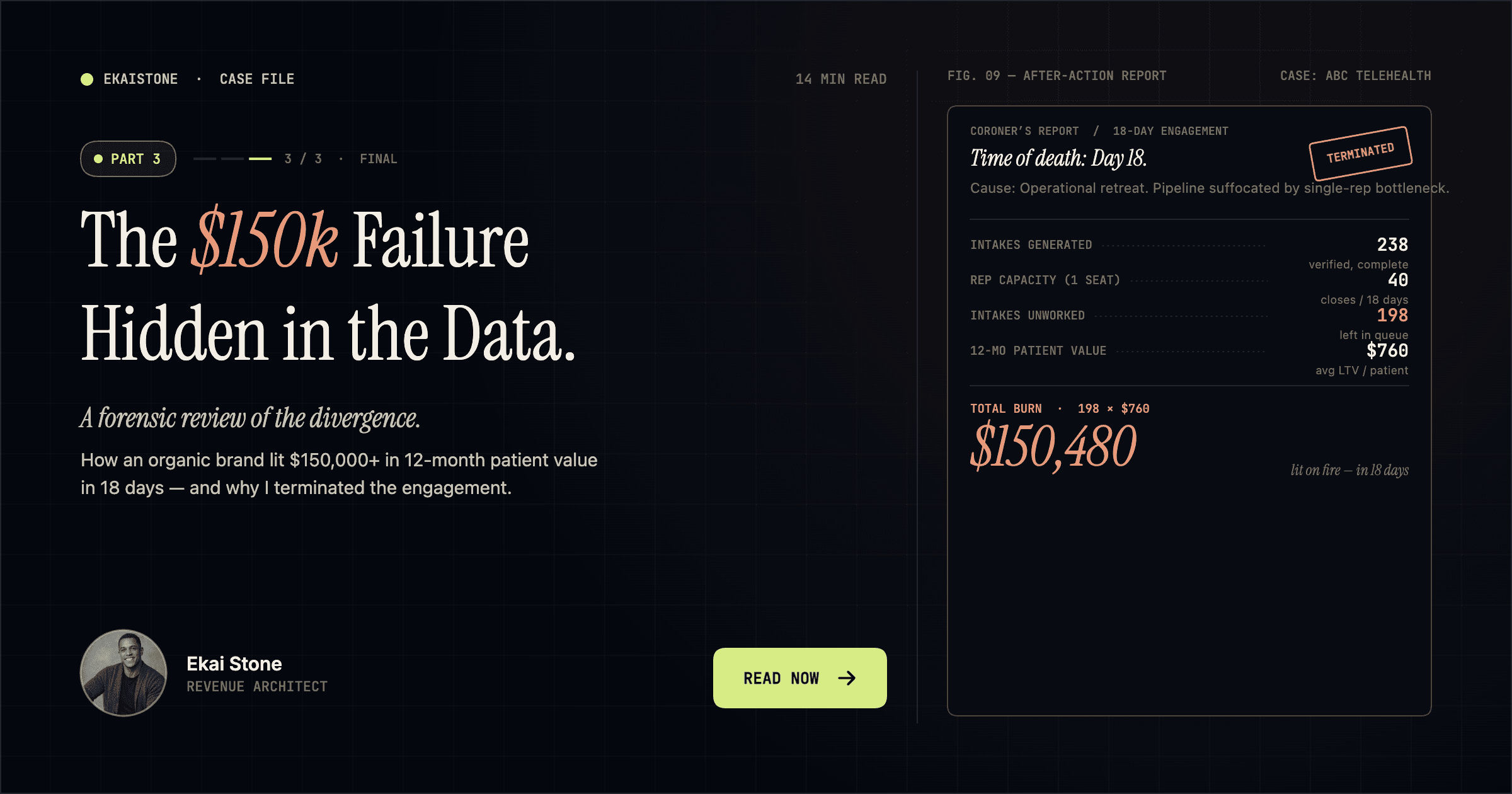
How They Lit $150,000+ in 12-Month Patient Value in 18 Days
In Part 2, I detailed the operational crash. The moment 238 new patient intakes hit a bottleneck of a single sales rep. In Part 3, I break down the final exit, the financial aftermath, and the difference between "Lead Gen" and "Revenue Architecture."
Operator Disclaimer: This series is a forensic review. It highlights a critical lesson for successful organic brands: The systems that got you to $500k/month often break when you try to scale to $1M. This is about the physics of expansion.
Act III: The Divergence
There is a moment in every challenging business relationship where the dynamic shifts.
For 18 days, I operated as the partner trying to optimize the machine. But when I read the CFO’s text requesting to "pause the ads" because the "lead quality was bad," the reality changed.
I was no longer a growth partner; I was a witness to an operational retreat.
They were suffocating their own pipeline, and rather than fixing the intake valve, they blamed the fuel. Most agencies would panic here. They would apologize, scramble to change targeting, or beg to keep the retainer.
I did the opposite. I initiated a formal termination of the agreement.
This is the conclusion of the ABC Telehealth case study. It is a story about why I walked away from revenue to protect my standards, and the "After Action Report" that followed.
The After-Action Report
I didn't just reply "Okay, let's pause. What can I do for you next, email? Assist the lead queue?"
Silence is validation. If I allowed them to walk away believing the narrative that verified phone numbers and complete medical intakes were "bad leads," I would be validating a delusion. I am paid to build reality, not support false confidence.
I drafted a final summary, a "Coroner’s Report" for the campaign. This document ensures the truth is preserved, even if the relationship isn't.
I sent this to the executive team: John (CFO), Jack (Founder), and Aaron (Partner).
Here is the breakdown of that finally summary:
1. The Refusal of the Narrative: I started by rejecting their premise entirely.
"I am accepting your request to terminate the agreement immediately. However, I cannot accept the narrative that 'lead quality' was the issue. The data does not support this, and I will not allow my work to be mischaracterized."
2. The Evidence: I re-stated the numbers one last time.
"I generated 238 new patient intakes. These individuals provided verified phone numbers, government IDs, and signed consent for treatment. To label these patients 'unserious' is factually incorrect. If they are not closing, it is because they are being contacted 3 to 10 days post-inquiry."
3. The Accountability Dagger: I addressed the root cause. The false confidence and operations failure.
"Marketing didn't fail. Marketing worked exactly as designed. It exposed that your Operations were not ready for scale. You claimed you were staffed for and additional $500k/month. In reality, the system buckled at $20k/month in ad spend. I cannot build a skyscraper on a cracked foundation, and I cannot work with a leadership team that shifts blame rather than addressing the structural repair."
4. The Financial Bleed: I quantified the opportunity cost.
"I spent $7,000 and generated 238 medical intakes. Let’s look at the unit economics of a Self-Liquidating Offer (SLO). Even at a conservative 30% conversion rate (71 patients) on just the baseline Labs ($155) and Consult ($75), we should have generated $16,330 immediately. That liquidates the ad spend 2.3x over before a single prescription is written. (You could have gotten a 2.3x return before a single prescription was written).
Then comes the treatment revenue. At a minimum medication baseline of $210 (meds, supplies, shipping), that is an additional $14,910. However, seeing as invoices often range from $500 to $2,500 for upsells to GLP-1s and peptides, the real number is likely significantly higher.
You were sitting on a conservative 5x ROAS floor, with likely 10x or more with upsells and LTV from just these 71 patients.
Instead, because the queue was ignored, you collected only $3,250. The operational failure didn't just waste the ad spend; it lit $150,000+ in 12-month patient value on fire… and again, that’s a conservative floor."
I hit send.
The reaction? Silence.
They didn't fight back. They didn't argue the numbers.
They didn't push back. They didn't argue the numbers. When presented with irrefutable data, the emotional narrative crumbles. They knew the capacity estimation was incorrect.
I walked away with my integrity and my IP intact. They walked away with a stalled pipeline and a story about "an agency that didn't work out," likely hoping no one asks to see the CRM timestamps.
The $20,000 Lesson: Lead Gen vs. Revenue Architecture
If you are a business operator reading this, it is vital to understand the difference between transactional service and what I do.
If ABC Telehealth had hired a typical "Lead Gen Agency," the agency would have handed over a spreadsheet of 800 names and collected the check. When the client complained, the agency would have shrugged. That is a transaction.
I am a Revenue Architect. My job isn't to hand you a list of names; it is to build a high-pressure system that forces revenue out of the market.
Here is the hard truth: I force businesses to grow. Sometimes, that pressure breaks the pipes.
When I turn on my infrastructure, the outcome-based forms, the verification layers, the routing logic, I am generating revenue into your business.
If your engine is solid, you win the race.
If your engine has a hairline fracture (like ABC Telehealth), the pressure will blow the engine block apart.
That explosion isn't a failure. It’s a feature. It shows you exactly where you are weak. It shows me exactly what needs fixing.
What Could Have Happened
ABC Telehealth could have looked at the data and said:
"Thank you, Ekai. The volume exposed our hiring gap. Let's pause spend for a week. Can you help us implement the staffing plan you recommended, train the new intake coordinators on your SOPs, and restart the email marketing in the meantime?"
What I Recommended (The Path Not Taken):
✓
Pause & Hire: A 14-day freeze to onboard 2 intake specialists.
✓
Workflow Audit: Restructuring the CRM to prioritize "New Patient" speed-to-lead.
✓
Training: A workshop with their team to move from "Hard Selling" to "Patient Care" scripts.
✓
Retention: Continuing the email sequences that were already generating high-margin revenue.
Instead, they retreated to the ease and safety of their organic model. And that's fine! But they truly could have hit $1 -Million a month within 4-6 months with me. I've done it multiple times before and you can see that here.
The Pivot: The Physics of Expansion
Why did I spend hours auditing their CRM? Why did I fight for better SOPs? Why turn down a retainer?
Because I have an obsession with growth. It's not just my job; it is my nature. J.P. Morgan once said: "Millionaires don't use astrology, billionaires do."
He wasn't talking about horoscopes. He was talking about Archetypes, the invisible forces that govern reality. Physics. Timing. Nature.
I have been in this industry for 17 years. I've analyzed tens of millions of dollars in ad spend. I've stopped fighting my own nature. In my chart, Jupiter is dominant. For those unfamiliar, Jupiter is the planet of Expansion. It amplifies everything it touches.
I am designed to amplify.
If you give me a healthy business with a good offer and a founder who considers me a partner equally as passionate about their impact and growth, I will amplify that health. We will turn $1M into $10M. But... if you give me a business built on false confidence or operational immaturity... I will amplify that too. I will amplify the cracks until they become canyons.
I used to feel guilty about this. I used to think,
"Maybe I pushed them too hard."
Now, I realize it is my function and that's what the best owners pay me for. To be the stress test. To be the solution to achieving their goals despite challenges unforeseen and new to them.
ABC Telehealth wanted the expansion without the pressure. They wanted the glory of scaling without the pain of operational maturation.
The Manifesto: Operational Maturity
This series serves as a warning label.
The market is full of executives who claim they "don't care about ROAS" or simply want "more volume" without respecting the logistics required to handle it. If that is you, do not hire me. I will expose your bottlenecks, and it will be painful
But the market is also full of founders who have a great product & service and a desire to win, but simply lack the infrastructure. They are driving a Honda Civic, but they are ready to learn how to drive a Ferrari.
If that is you, I want to talk to you.
I want to build the pipes that can hold the pressure. I want to build the outcome-based UX that filter out the noise. I want to deliver high-intent, ready-to-buy patients/clients. I want to build the attribution models that tell the truth, even when it hurts.
I want to help you let expansion enter your P&L statement safely.
The Invitation
This case study is over. The data from their failure is now part of my pattern recognition library, making me even better at protecting my partners.
Now, I’m looking for the next build.
Email me if you recognized your own bottlenecks in this series.
Email me if you want a forensic audit of why your last growth attempt stalled.
Email me if you are ready to stop playing "Lead Gen" and start building Revenue Architecture.
I don’t promise it will be easy. Growth never is. But I promise I won’t lie to you about the math.
Ekai Stone is a Revenue Architect and Fractional CMO. He specializes in high-ticket operational scaling for Telehealth, B2B, and Online Coaching businesses. He believes in God, Data, and the relentless pursuit of the truth.
How They Lit $150,000+ in 12-Month Patient Value in 18 Days
In Part 2, I detailed the operational crash. The moment 238 new patient intakes hit a bottleneck of a single sales rep. In Part 3, I break down the final exit, the financial aftermath, and the difference between "Lead Gen" and "Revenue Architecture."
Operator Disclaimer: This series is a forensic review. It highlights a critical lesson for successful organic brands: The systems that got you to $500k/month often break when you try to scale to $1M. This is about the physics of expansion.
Act III: The Divergence
There is a moment in every challenging business relationship where the dynamic shifts.
For 18 days, I operated as the partner trying to optimize the machine. But when I read the CFO’s text requesting to "pause the ads" because the "lead quality was bad," the reality changed.
I was no longer a growth partner; I was a witness to an operational retreat.
They were suffocating their own pipeline, and rather than fixing the intake valve, they blamed the fuel. Most agencies would panic here. They would apologize, scramble to change targeting, or beg to keep the retainer.
I did the opposite. I initiated a formal termination of the agreement.
This is the conclusion of the ABC Telehealth case study. It is a story about why I walked away from revenue to protect my standards, and the "After Action Report" that followed.
The After-Action Report
I didn't just reply "Okay, let's pause. What can I do for you next, email? Assist the lead queue?"
Silence is validation. If I allowed them to walk away believing the narrative that verified phone numbers and complete medical intakes were "bad leads," I would be validating a delusion. I am paid to build reality, not support false confidence.
I drafted a final summary, a "Coroner’s Report" for the campaign. This document ensures the truth is preserved, even if the relationship isn't.
I sent this to the executive team: John (CFO), Jack (Founder), and Aaron (Partner).
Here is the breakdown of that finally summary:
1. The Refusal of the Narrative: I started by rejecting their premise entirely.
"I am accepting your request to terminate the agreement immediately. However, I cannot accept the narrative that 'lead quality' was the issue. The data does not support this, and I will not allow my work to be mischaracterized."
2. The Evidence: I re-stated the numbers one last time.
"I generated 238 new patient intakes. These individuals provided verified phone numbers, government IDs, and signed consent for treatment. To label these patients 'unserious' is factually incorrect. If they are not closing, it is because they are being contacted 3 to 10 days post-inquiry."
3. The Accountability Dagger: I addressed the root cause. The false confidence and operations failure.
"Marketing didn't fail. Marketing worked exactly as designed. It exposed that your Operations were not ready for scale. You claimed you were staffed for and additional $500k/month. In reality, the system buckled at $20k/month in ad spend. I cannot build a skyscraper on a cracked foundation, and I cannot work with a leadership team that shifts blame rather than addressing the structural repair."
4. The Financial Bleed: I quantified the opportunity cost.
"I spent $7,000 and generated 238 medical intakes. Let’s look at the unit economics of a Self-Liquidating Offer (SLO). Even at a conservative 30% conversion rate (71 patients) on just the baseline Labs ($155) and Consult ($75), we should have generated $16,330 immediately. That liquidates the ad spend 2.3x over before a single prescription is written. (You could have gotten a 2.3x return before a single prescription was written).
Then comes the treatment revenue. At a minimum medication baseline of $210 (meds, supplies, shipping), that is an additional $14,910. However, seeing as invoices often range from $500 to $2,500 for upsells to GLP-1s and peptides, the real number is likely significantly higher.
You were sitting on a conservative 5x ROAS floor, with likely 10x or more with upsells and LTV from just these 71 patients.
Instead, because the queue was ignored, you collected only $3,250. The operational failure didn't just waste the ad spend; it lit $150,000+ in 12-month patient value on fire… and again, that’s a conservative floor."
I hit send.
The reaction? Silence.
They didn't fight back. They didn't argue the numbers.
They didn't push back. They didn't argue the numbers. When presented with irrefutable data, the emotional narrative crumbles. They knew the capacity estimation was incorrect.
I walked away with my integrity and my IP intact. They walked away with a stalled pipeline and a story about "an agency that didn't work out," likely hoping no one asks to see the CRM timestamps.
The $20,000 Lesson: Lead Gen vs. Revenue Architecture
If you are a business operator reading this, it is vital to understand the difference between transactional service and what I do.
If ABC Telehealth had hired a typical "Lead Gen Agency," the agency would have handed over a spreadsheet of 800 names and collected the check. When the client complained, the agency would have shrugged. That is a transaction.
I am a Revenue Architect. My job isn't to hand you a list of names; it is to build a high-pressure system that forces revenue out of the market.
Here is the hard truth: I force businesses to grow. Sometimes, that pressure breaks the pipes.
When I turn on my infrastructure, the outcome-based forms, the verification layers, the routing logic, I am generating revenue into your business.
If your engine is solid, you win the race.
If your engine has a hairline fracture (like ABC Telehealth), the pressure will blow the engine block apart.
That explosion isn't a failure. It’s a feature. It shows you exactly where you are weak. It shows me exactly what needs fixing.
What Could Have Happened
ABC Telehealth could have looked at the data and said:
"Thank you, Ekai. The volume exposed our hiring gap. Let's pause spend for a week. Can you help us implement the staffing plan you recommended, train the new intake coordinators on your SOPs, and restart the email marketing in the meantime?"
What I Recommended (The Path Not Taken):
✓
Pause & Hire: A 14-day freeze to onboard 2 intake specialists.
✓
Workflow Audit: Restructuring the CRM to prioritize "New Patient" speed-to-lead.
✓
Training: A workshop with their team to move from "Hard Selling" to "Patient Care" scripts.
✓
Retention: Continuing the email sequences that were already generating high-margin revenue.
Instead, they retreated to the ease and safety of their organic model. And that's fine! But they truly could have hit $1 -Million a month within 4-6 months with me. I've done it multiple times before and you can see that here.
The Pivot: The Physics of Expansion
Why did I spend hours auditing their CRM? Why did I fight for better SOPs? Why turn down a retainer?
Because I have an obsession with growth. It's not just my job; it is my nature. J.P. Morgan once said: "Millionaires don't use astrology, billionaires do."
He wasn't talking about horoscopes. He was talking about Archetypes, the invisible forces that govern reality. Physics. Timing. Nature.
I have been in this industry for 17 years. I've analyzed tens of millions of dollars in ad spend. I've stopped fighting my own nature. In my chart, Jupiter is dominant. For those unfamiliar, Jupiter is the planet of Expansion. It amplifies everything it touches.
I am designed to amplify.
If you give me a healthy business with a good offer and a founder who considers me a partner equally as passionate about their impact and growth, I will amplify that health. We will turn $1M into $10M. But... if you give me a business built on false confidence or operational immaturity... I will amplify that too. I will amplify the cracks until they become canyons.
I used to feel guilty about this. I used to think,
"Maybe I pushed them too hard."
Now, I realize it is my function and that's what the best owners pay me for. To be the stress test. To be the solution to achieving their goals despite challenges unforeseen and new to them.
ABC Telehealth wanted the expansion without the pressure. They wanted the glory of scaling without the pain of operational maturation.
The Manifesto: Operational Maturity
This series serves as a warning label.
The market is full of executives who claim they "don't care about ROAS" or simply want "more volume" without respecting the logistics required to handle it. If that is you, do not hire me. I will expose your bottlenecks, and it will be painful
But the market is also full of founders who have a great product & service and a desire to win, but simply lack the infrastructure. They are driving a Honda Civic, but they are ready to learn how to drive a Ferrari.
If that is you, I want to talk to you.
I want to build the pipes that can hold the pressure. I want to build the outcome-based UX that filter out the noise. I want to deliver high-intent, ready-to-buy patients/clients. I want to build the attribution models that tell the truth, even when it hurts.
I want to help you let expansion enter your P&L statement safely.
The Invitation
This case study is over. The data from their failure is now part of my pattern recognition library, making me even better at protecting my partners.
Now, I’m looking for the next build.
Email me if you recognized your own bottlenecks in this series.
Email me if you want a forensic audit of why your last growth attempt stalled.
Email me if you are ready to stop playing "Lead Gen" and start building Revenue Architecture.
I don’t promise it will be easy. Growth never is. But I promise I won’t lie to you about the math.
Ekai Stone is a Revenue Architect and Fractional CMO. He specializes in high-ticket operational scaling for Telehealth, B2B, and Online Coaching businesses. He believes in God, Data, and the relentless pursuit of the truth.





Where online business owners learn how to scale with structure, discipline, and long-term stability.
Where online business owners learn how to scale with structure, discipline, and long-term stability.