Part 1: How Scaling Broke a $500k/mo Telehealth Business in 18 Days
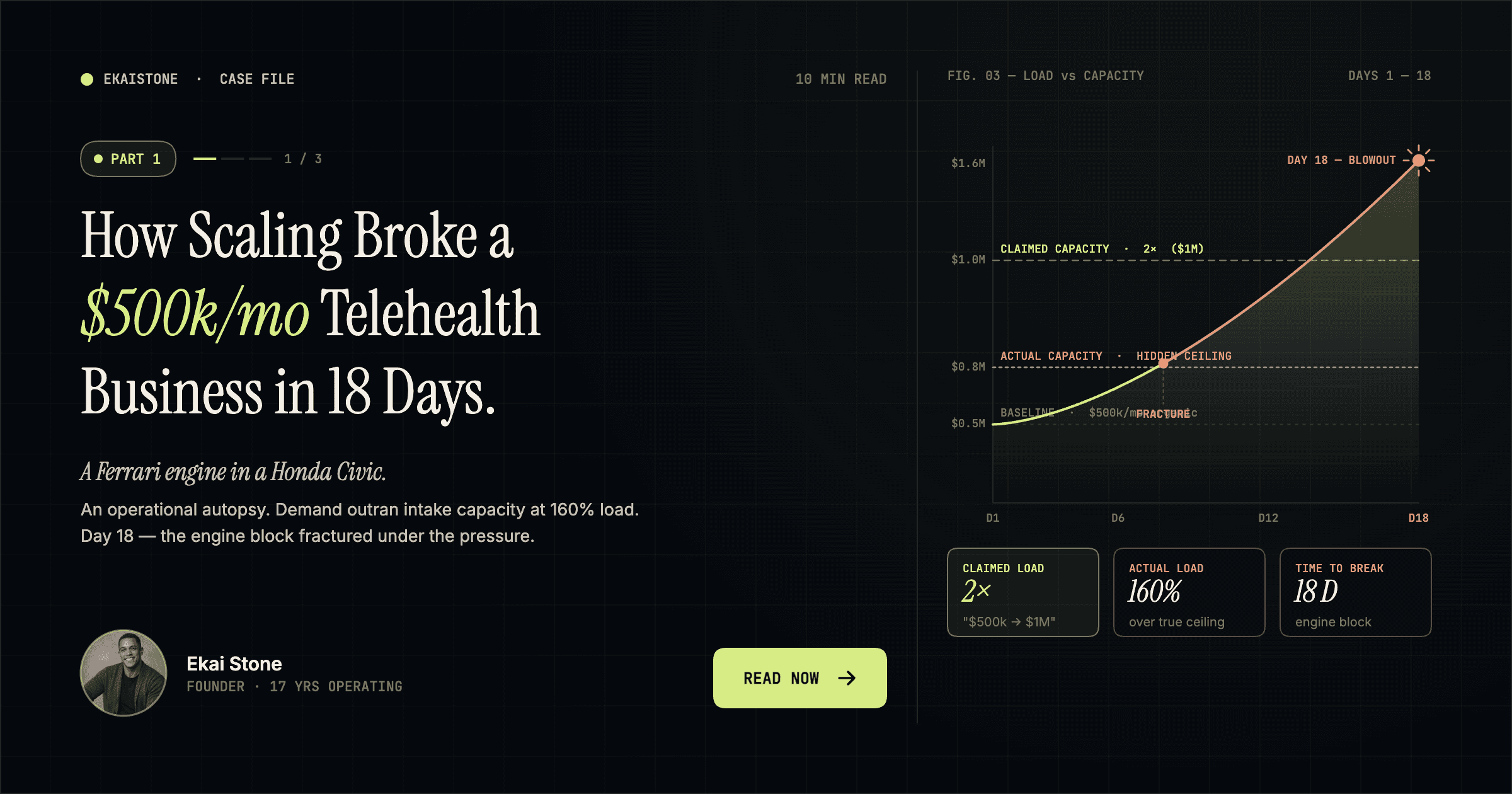
They estimated they were staffed to double $500,000/month revenue. That was wrong. It was a calculation based on false confidence and the system collapsed in 18 days.
Operator Disclaimer: This case study is not written to shame a business. It is a forensic review to demonstrate exactly what breaks when demand outpaces intake capacity, and how operational blind spots can capsize even successful brands.
This is Part 1 of an operational autopsy on a national telehealth brand that faced a critical system failure in just 18 days. I built them a "Ferrari engine" for patient acquisition, but their internal operations were akin to a Honda Civic with worn brakes. Read how running at 160% capacity broke their business, and why I eventually had to terminate the engagement to protect my standards.
Act I: The Misalignment on Capacity
I don’t say that to impress you. I say it because growth creates pressure. When you pour fuel into an engine, you create heat and force. If the engine block has a hairline fracture, that pressure doesn't make you go faster—it blows the block apart.
Most founders believe they want "scale." They believe they want "more new patients." What they often want is more revenue without the operational rigorousness required to earn it via cold traffic.
This is the story of "ABC Telehealth." It is a study of what happens when a client wants to dominate the market but struggles to adopt the operational maturity required to do so. It’s a story about a team that had built impressive organic momentum but underestimated the systems required for paid scale.
We started with a handshake and high hopes. We ended with me ending the contract two weeks early because their internal operations collapsed under the volume I generated. Rather than adapting, the leadership pointed fingers at the marketplace and the lead quality. This series reveals the truth of their new patient intake breakdown, staff churn, and process failure—shared so you can avoid these mistakes.
If you're a telehealth business looking to scale, read this closely.
The Setup: High Potential, Hidden Risks This client arrived via a trusted referral. They were a national telehealth brand focusing on high-ticket essentials: Weight Loss Meds (GLP-1s) and Hormone Replacement Therapy. The demand in this sector is massive. If you can build a compliant, high-trust funnel, the unit economics are incredibly healthy.
They wanted to scale. Specifically, they wanted to add $500k/month in revenue using paid acquisition. They aimed to start with $20k/month and scale to $80k/month rapidly. I modeled this out aggressively. Based on my Phase 1 data, they were confident—opting to start with $20,000/month rather than a safer $10,000 test.
I jumped on the initial Zoom discovery call, ready to discuss unit economics, ROAS targets, and HIPAA compliance. That’s when I met the leadership team.
First, Jack Doe, the Founder. The face of the brand. He was charismatic and had built a massive organic following, which generated their existing $300k–$500k/month revenue. However, he appeared disengaged from the mechanics of the business, preferring to let others steer the ship.
Then there was John Doe, the CFO/Ops lead. In my line of work, you learn to read operational readiness instantly. John presented with a chaotic energy. He appeared disorganized for a high-stakes meeting, lacking the executive presence I usually see in brands doing this volume. He was supremely confident in their current state, frequently dismissing technical questions with generalizations.
Finally, Aaron Doe, a partner. Aaron brought an intense sales-floor energy that suggested volume and pressure were the solutions to strategy problems.
I should have paused there. But I saw the numbers. I saw the market potential. I believed I could help them fix the infrastructure, and that the influx of data would force them to level up their systems.
I was incorrect.
The Blind Spot: "We Can Handle It"
During that first call, we discussed the math of scaling.
They wanted to quadruple their spend. In the ad world, when you quadruple spend, you don't just get 4x the leads; you get 4x the support tickets, 4x the logistical drag, and 4x the need for speed.
I looked John (the CFO) in the eye and asked the most important question in growth marketing:
"If I turn this on, and we hit the numbers I know I can hit, can you handle the volume? Do you have the sales reps, the intake coordinators, and the medical staff to process this?"
John didn't blink. He leaned back and said:
"We are currently staffed to handle double our existing revenue. We can take another $500k a month. Just bring us the new patients."
I pressed him. "Are you sure? My systems don't produce passive 'contact us' form fills. I build Revenue Architecture. I’m going to flood your CRM with people ready to buy HRT and GLP-1s."
"We don't care about the details," John said. "We don't even care about ROAS right right now. We just want market share. Turn it on."
Rule #1 of Client Management: When a client says they "don't care about ROAS," it is usually a red flag. Everyone cares about ROAS when the bill arrives. This signaled a disconnect between their financial expectations, the reality of paid acquisition, and inexperience.
But as the CFO, he insisted the infrastructure was ready.
The Friction: Hustle vs. Systems
The cracks appeared before launch. Part of my role is acting as a Fractional CMO, advising on the entire funnel from the ad click to the patient intake.
I walked them through the math of lead handling. In high-ticket telehealth, patient experience is paramount. These are not just "leads"; they are patients seeking medical help. Speed-to-lead is critical. If you don't engage a patient inquiry within 5 minutes, conversion rates drop significantly.
I explained the benchmarks:
"To work these leads properly, calling, texting, nurturing, your reps should be capped at about 30 to 50 fresh leads per day. Beyond that, follow-up suffers, and good prospects slip through."
Aaron, the sales partner, pushed back immediately.
"30 leads?!" he said. "A real salesman can handle 100 calls a day! My guys are hungry. Don't tell me about caps. Just feed them."
I paused. I’ve trained BDC teams and built call centers. I know what burnout looks like.
"Aaron," I said calmly. "These are internet leads, not organic referrals. They require nurture. If you give a rep 100 leads, they will call everyone once, close the easy ones, and burn the rest. You will waste capital."
He dismissed the concern. He preferred the philosophy of "hustle" over "process." This is common in businesses doing $1M–$5M a year; they believe hard work got them there, not realizing that scaling to $10M requires systems, not just effort.
What I Recommended: To bridge this gap, I outlined a specific operational plan:
✓
Staffing Plan: Hire 2 additional intake coordinators immediately.
✓
Response SLAs: Mandatory <5 minute response time on business hours. Even Ai chat and Ai voice agents.
✓
Intake Queue: A dedicated triage lane for paid traffic vs. organic.
✓
Escalation Rules: Automated alerts if a patient sat in "New" status for >2 hours.
They declined to implement these prior to launch.
The Architecture (The Ferrari Engine)
Despite the friction, I went to work. I don't just run "ads." I build Paid Growth Infrastructure. For ABC Telehealth, I designed a sophisticated machine:
✓
Compliance-First Funnels: I ran verified flows for Weight Loss and TRT that filtered out unqualified traffic.
✓
High-Intent Routing: Logic where users self-verified phone numbers before entering the CRM.
✓
Outcome-Based Segmentation: We routed patients based on specific goals (energy, libido, muscle tone) rather than generic products.
✓
Attribution Integrity: A system where every dollar was tracked from the click to the patient intake form.
I built them a high-performance engine. It was sleek, data-driven, and capable of generating significant revenue.
The Handshake Before the Stress Test
We finalized the agreement. They wired the funds.
I looked at the dashboard. The campaigns were staged. The automations were live. The pixels were firing. Technically, everything was perfect.
But I had a sinking feeling. I realized I was handing a high-performance vehicle to a team that had succeeded largely on organic influence and ease. They were generating $300k–$500k on "easy street" using Jack's social media. They had never felt the friction of cold traffic at scale.
Jack was passive. John was confident but disorganized. Aaron was pushing for speed without regard for the speedometer.
I told them directly:
"I am going to do exactly what you asked. I am going to stress-test your business. If you are right about your capacity, you’re going to be very profitable. If you have overestimated your capacity, this is going to be painful."
John laughed. "Just launch it, Ekai."
So I did. And that’s when the wheels came off.
Next Up in Part 2: The launch results were massive. The volume was exactly what I promised. But remember that "staffed for $500k" claim? It took less than 10 days for their operation to buckle, leading to lost patient data and broken protocols.
If you’re a business owner reading this, ask yourself: If your new patient intake volume tripled tomorrow, would your business break?
Is your infrastructure ready for scale?
If you're a telehealth operator considering paid acquisition, or wanting to scale your current spend without breaking your fulfillment, let's have a conversation!
They estimated they were staffed to double $500,000/month revenue. That was wrong. It was a calculation based on false confidence and the system collapsed in 18 days.
Operator Disclaimer: This case study is not written to shame a business. It is a forensic review to demonstrate exactly what breaks when demand outpaces intake capacity, and how operational blind spots can capsize even successful brands.
This is Part 1 of an operational autopsy on a national telehealth brand that faced a critical system failure in just 18 days. I built them a "Ferrari engine" for patient acquisition, but their internal operations were akin to a Honda Civic with worn brakes. Read how running at 160% capacity broke their business, and why I eventually had to terminate the engagement to protect my standards.
Act I: The Misalignment on Capacity
I don’t say that to impress you. I say it because growth creates pressure. When you pour fuel into an engine, you create heat and force. If the engine block has a hairline fracture, that pressure doesn't make you go faster—it blows the block apart.
Most founders believe they want "scale." They believe they want "more new patients." What they often want is more revenue without the operational rigorousness required to earn it via cold traffic.
This is the story of "ABC Telehealth." It is a study of what happens when a client wants to dominate the market but struggles to adopt the operational maturity required to do so. It’s a story about a team that had built impressive organic momentum but underestimated the systems required for paid scale.
We started with a handshake and high hopes. We ended with me ending the contract two weeks early because their internal operations collapsed under the volume I generated. Rather than adapting, the leadership pointed fingers at the marketplace and the lead quality. This series reveals the truth of their new patient intake breakdown, staff churn, and process failure—shared so you can avoid these mistakes.
If you're a telehealth business looking to scale, read this closely.
The Setup: High Potential, Hidden Risks This client arrived via a trusted referral. They were a national telehealth brand focusing on high-ticket essentials: Weight Loss Meds (GLP-1s) and Hormone Replacement Therapy. The demand in this sector is massive. If you can build a compliant, high-trust funnel, the unit economics are incredibly healthy.
They wanted to scale. Specifically, they wanted to add $500k/month in revenue using paid acquisition. They aimed to start with $20k/month and scale to $80k/month rapidly. I modeled this out aggressively. Based on my Phase 1 data, they were confident—opting to start with $20,000/month rather than a safer $10,000 test.
I jumped on the initial Zoom discovery call, ready to discuss unit economics, ROAS targets, and HIPAA compliance. That’s when I met the leadership team.
First, Jack Doe, the Founder. The face of the brand. He was charismatic and had built a massive organic following, which generated their existing $300k–$500k/month revenue. However, he appeared disengaged from the mechanics of the business, preferring to let others steer the ship.
Then there was John Doe, the CFO/Ops lead. In my line of work, you learn to read operational readiness instantly. John presented with a chaotic energy. He appeared disorganized for a high-stakes meeting, lacking the executive presence I usually see in brands doing this volume. He was supremely confident in their current state, frequently dismissing technical questions with generalizations.
Finally, Aaron Doe, a partner. Aaron brought an intense sales-floor energy that suggested volume and pressure were the solutions to strategy problems.
I should have paused there. But I saw the numbers. I saw the market potential. I believed I could help them fix the infrastructure, and that the influx of data would force them to level up their systems.
I was incorrect.
The Blind Spot: "We Can Handle It"
During that first call, we discussed the math of scaling.
They wanted to quadruple their spend. In the ad world, when you quadruple spend, you don't just get 4x the leads; you get 4x the support tickets, 4x the logistical drag, and 4x the need for speed.
I looked John (the CFO) in the eye and asked the most important question in growth marketing:
"If I turn this on, and we hit the numbers I know I can hit, can you handle the volume? Do you have the sales reps, the intake coordinators, and the medical staff to process this?"
John didn't blink. He leaned back and said:
"We are currently staffed to handle double our existing revenue. We can take another $500k a month. Just bring us the new patients."
I pressed him. "Are you sure? My systems don't produce passive 'contact us' form fills. I build Revenue Architecture. I’m going to flood your CRM with people ready to buy HRT and GLP-1s."
"We don't care about the details," John said. "We don't even care about ROAS right right now. We just want market share. Turn it on."
Rule #1 of Client Management: When a client says they "don't care about ROAS," it is usually a red flag. Everyone cares about ROAS when the bill arrives. This signaled a disconnect between their financial expectations, the reality of paid acquisition, and inexperience.
But as the CFO, he insisted the infrastructure was ready.
The Friction: Hustle vs. Systems
The cracks appeared before launch. Part of my role is acting as a Fractional CMO, advising on the entire funnel from the ad click to the patient intake.
I walked them through the math of lead handling. In high-ticket telehealth, patient experience is paramount. These are not just "leads"; they are patients seeking medical help. Speed-to-lead is critical. If you don't engage a patient inquiry within 5 minutes, conversion rates drop significantly.
I explained the benchmarks:
"To work these leads properly, calling, texting, nurturing, your reps should be capped at about 30 to 50 fresh leads per day. Beyond that, follow-up suffers, and good prospects slip through."
Aaron, the sales partner, pushed back immediately.
"30 leads?!" he said. "A real salesman can handle 100 calls a day! My guys are hungry. Don't tell me about caps. Just feed them."
I paused. I’ve trained BDC teams and built call centers. I know what burnout looks like.
"Aaron," I said calmly. "These are internet leads, not organic referrals. They require nurture. If you give a rep 100 leads, they will call everyone once, close the easy ones, and burn the rest. You will waste capital."
He dismissed the concern. He preferred the philosophy of "hustle" over "process." This is common in businesses doing $1M–$5M a year; they believe hard work got them there, not realizing that scaling to $10M requires systems, not just effort.
What I Recommended: To bridge this gap, I outlined a specific operational plan:
✓
Staffing Plan: Hire 2 additional intake coordinators immediately.
✓
Response SLAs: Mandatory <5 minute response time on business hours. Even Ai chat and Ai voice agents.
✓
Intake Queue: A dedicated triage lane for paid traffic vs. organic.
✓
Escalation Rules: Automated alerts if a patient sat in "New" status for >2 hours.
They declined to implement these prior to launch.
The Architecture (The Ferrari Engine)
Despite the friction, I went to work. I don't just run "ads." I build Paid Growth Infrastructure. For ABC Telehealth, I designed a sophisticated machine:
✓
Compliance-First Funnels: I ran verified flows for Weight Loss and TRT that filtered out unqualified traffic.
✓
High-Intent Routing: Logic where users self-verified phone numbers before entering the CRM.
✓
Outcome-Based Segmentation: We routed patients based on specific goals (energy, libido, muscle tone) rather than generic products.
✓
Attribution Integrity: A system where every dollar was tracked from the click to the patient intake form.
I built them a high-performance engine. It was sleek, data-driven, and capable of generating significant revenue.
The Handshake Before the Stress Test
We finalized the agreement. They wired the funds.
I looked at the dashboard. The campaigns were staged. The automations were live. The pixels were firing. Technically, everything was perfect.
But I had a sinking feeling. I realized I was handing a high-performance vehicle to a team that had succeeded largely on organic influence and ease. They were generating $300k–$500k on "easy street" using Jack's social media. They had never felt the friction of cold traffic at scale.
Jack was passive. John was confident but disorganized. Aaron was pushing for speed without regard for the speedometer.
I told them directly:
"I am going to do exactly what you asked. I am going to stress-test your business. If you are right about your capacity, you’re going to be very profitable. If you have overestimated your capacity, this is going to be painful."
John laughed. "Just launch it, Ekai."
So I did. And that’s when the wheels came off.
Next Up in Part 2: The launch results were massive. The volume was exactly what I promised. But remember that "staffed for $500k" claim? It took less than 10 days for their operation to buckle, leading to lost patient data and broken protocols.
If you’re a business owner reading this, ask yourself: If your new patient intake volume tripled tomorrow, would your business break?
Is your infrastructure ready for scale?
If you're a telehealth operator considering paid acquisition, or wanting to scale your current spend without breaking your fulfillment, let's have a conversation!
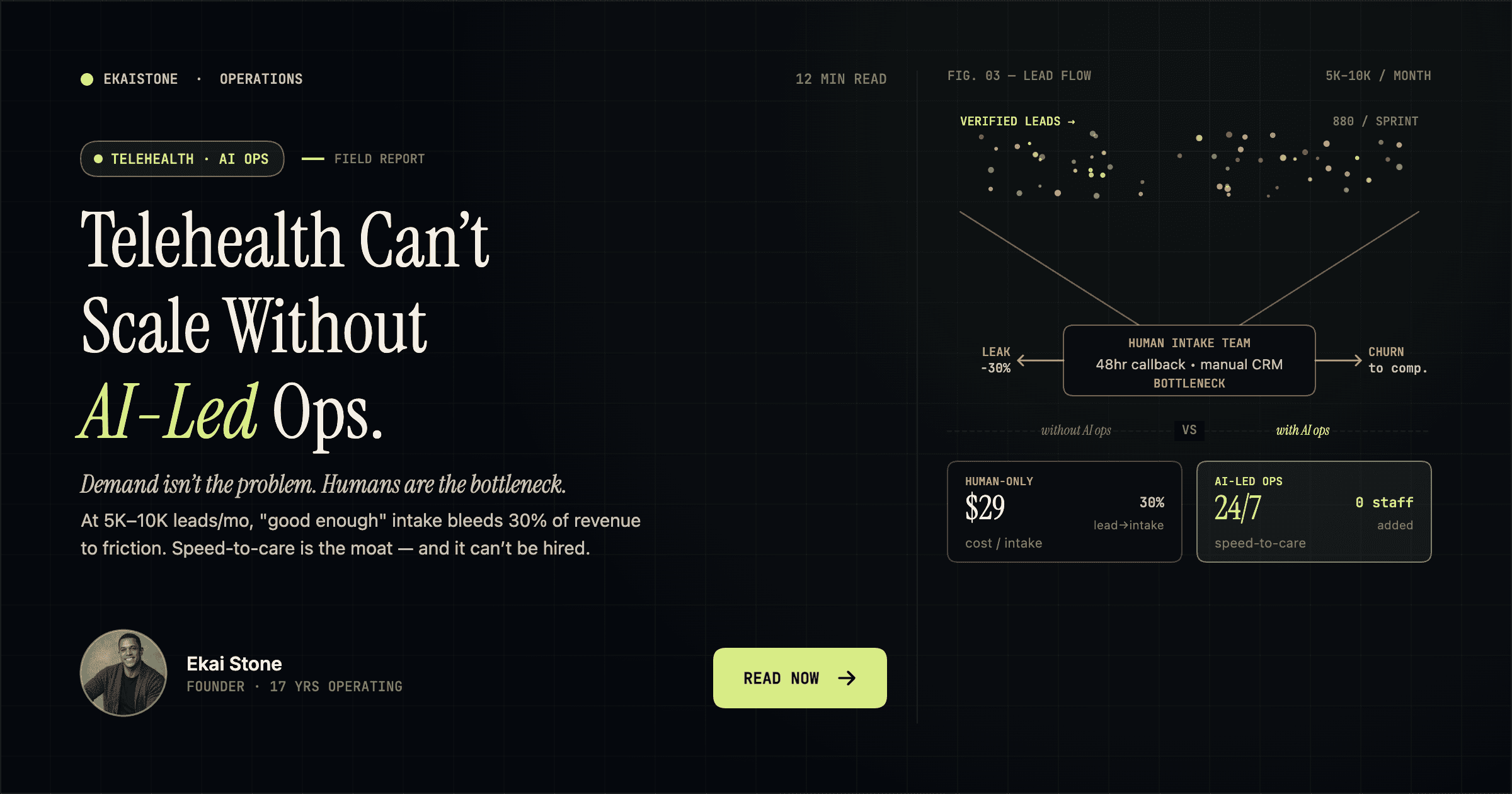

Where online business owners learn how to scale with structure, discipline, and long-term stability.
Where online business owners learn how to scale with structure, discipline, and long-term stability.