Part 2: When 880 Leads Hit a One-Rep Bottleneck

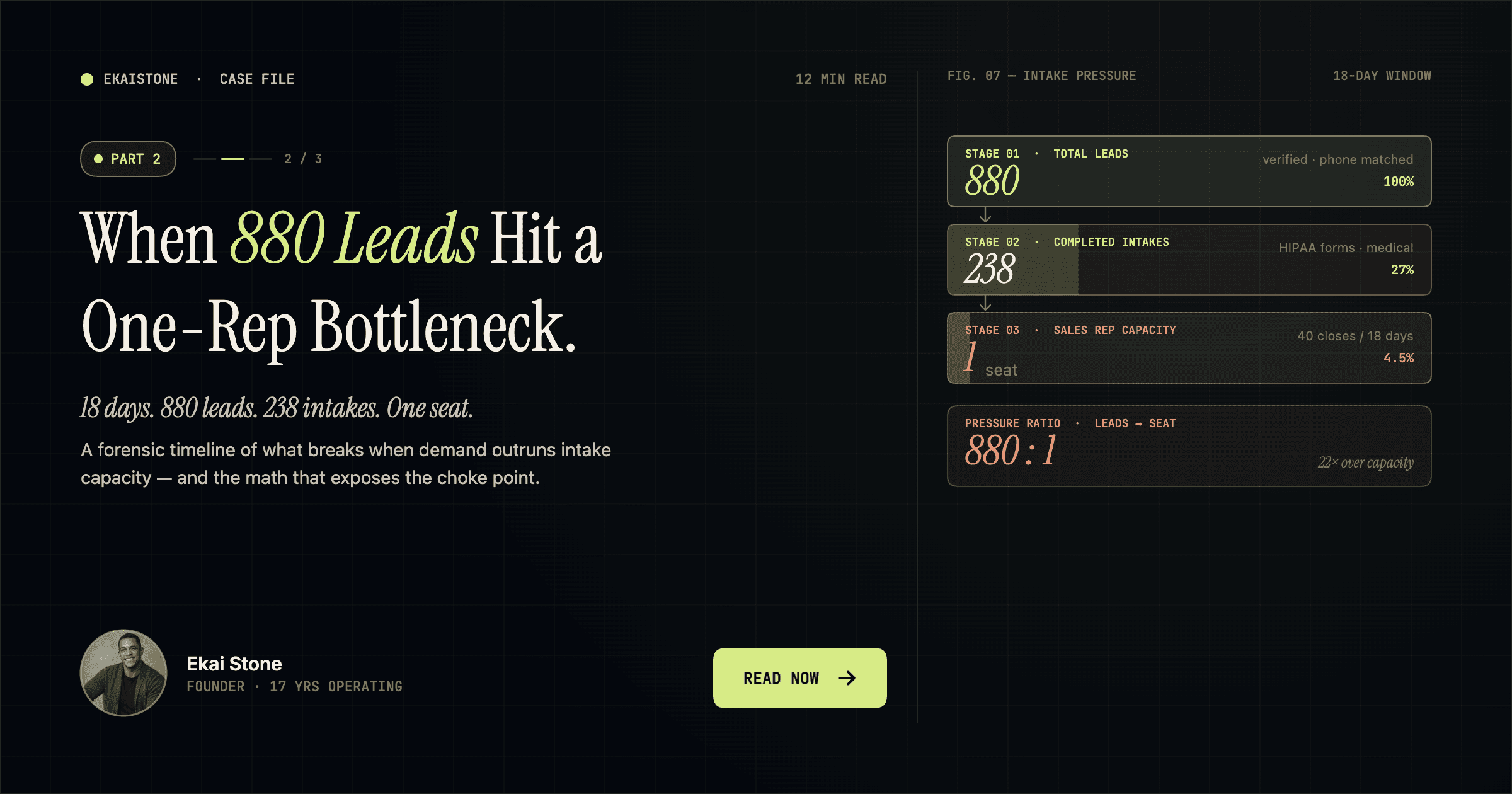
18 Days. 880 Leads. 238 New Patients. One Sales Rep.
In Part 1, I detailed the "Capacity Misalignment". The moment a CFO estimated his team would/could handle an additional $500k/month in volume and pushed to launch immediately starting with a $20k/month budget scaling to $80k/m within 6 months. In Part 2, I break down the forensic timeline of what happened when we executed that plan. From the "Sugar High" of $29 medical intakes to the operational bottleneck that left hundreds of patients stalled and capital inefficiently utilized.
Operator Disclaimer: This case study is not written to shame a business. It is a forensic review to demonstrate exactly what breaks when demand outpaces intake capacity. It highlights how even successful organic brands can struggle with the operational rigors of paid acquisition.
This is the analysis of a system that collapsed under the weight of unmanaged volume.
Act II: The Surge
In Part 1, I outlined the setup. "ABC Telehealth" had strong organic revenue ($300k–$500k/mo) but lacked the infrastructure for cold traffic. I cautioned the CFO, John, that my architecture produces revenue, not just inquiries. He assured me they were staffed for double their current revenue.
So, I turned phase 2 of my system on. For exactly 18 days, the metrics were impeccable, but operations caught up to the math.
The Sugar High (Jan 2 – Jan 19)
When you build Revenue Architecture correctly, you don’t "ramp up" slowly. You toggle a switch.
I deployed the infrastructure I described in Part 1:
✓
Targeted Ads
✓
The Outcome-Based Lead Forms (Filtering for specific weight loss goals or TRT outcomes)
✓
The Verification Layer (Phone number validation)
✓
The Intake Router (Pushing qualified leads immediately to HIPAA-compliant medical forms)
The market response was immediate. In just 18 days, we generated:
880 Total Leads
238 Completed Medical Intakes

Let’s pause on that second number. These weren't accidental clicks. These were 238 human beings who clicked an ad, verified their phone number via 8-digit sms code, entered a secure form, shared their driver's license, and physically signed multiple consent sections.
The cost to acquire a completed medical intake? ~$29 😎
In high-ticket telehealth, where Customer Acquisition Cost (CAC) often floats between $150 and $300, securing HIPAA-compliant intakes for $29 is a rare efficiency. It is a "print money" scenario. The ad spend was efficient. The targeting, creative, and UX were performing perfectly.
I looked at the dashboard on January 7th and thought: "We are winning. They will need to hire intake support by next week."
I was half right. They did need support. But they didn't have it.
The Operational Reality Check
Remember the CFO’s claim?
"We are currently staffed to handle double our existing volume."
This was the estimation error that stalled the ship.
When I saw the lead count climb past 500, I messaged the team:
"How’s the pipeline looking? Are we clearing the queue?"
Radio silence.
I decided to log into their CRM to conduct a spot audit. The reality became clear immediately. They didn't have a "team" dedicated to this channel. They had a single sales rep.
Let’s do the math. The campaign generated ~48 new leads per day. A highly trained sales professional with perfect automation support can effectively handle about 30 fresh internet leads a day. This allows for requisite double-dialing, SMS follow-up, and the 15-minute discovery chat to move people into treatment.
The representative at ABC Telehealth who was also a partner with other business responsibilities was running at 160% capacity every single day, with no breaks, for two weeks straight. It was a case of human bandwidth limitations. No matter how dedicated, one person cannot drink from a firehose without spilling water.
The Audit: Stalled Data
When operations fail, they leave a trail of digital evidence. I started clicking through the contact records. As a Revenue Architect, this is the difficult part, watching potential revenue stall because the intake system is clogged.
Here is what I found in the audit:
✓
The Pipeline Stagnation: I found numerous leads sitting in the "New Lead" stage for 3 to 10 days. Untouched. No call. No manual text. In online lead gen, speed-to-lead is vital. A patient seeking medical help expects a response. After 10 days, the lead is cold.
✓
The Patient Experience Risk: We had eager new patient intakes sitting unreviewed. This isn't just sales; it's a liability. Patients had submitted identity verification information expecting to speak to a provider. Instead, they were waiting in a digital queue.
✓
Attribution Failure: This was the technical breakdown. I had built a "Paid Traffic Integrity" rule set: If a lead comes from Meta, they must use the Meta-Specific Intake Link to fire the pixel. Because the sales rep was overwhelmed, he abandoned the SOP. He began texting leads from a personal device and sending generic "Linktree" style menus. This bypassed the tracking infrastructure, cutting the feedback loop to the ad algorithm.
I sent a Loom video to the executive team showing the screen recordings. I stated:
"Marketing didn't fail. Marketing exposed that Operations is broken."
What I Recommended: To stop the bleeding, I offered a stabilization plan:
✓
Pause & Recalibrate: Halt spend for 48 hours to clear the backlog.
✓
Staffing: Immediately hire 2 reps to process the "New Lead" queue.
✓
Workflow: Enforce the <5 minute response SOP for medical intakes.
✓
Training: I offered to personally train the new hires.
The Internal Friction
In those same 18 days, two Nurse Practitioners (NPs) resigned. High churn during a growth phase is usually a symptom of systemic stress. Medical professionals protect their licenses; if operations are disorganized or pressure is applied without process, they will exit.
So now, we had:
✓
A sales funnel overflowing with New Patients Waiting for Treatment.
✓
A sales capacity that was capped.
✓
A medical fulfillment team that was shrinking.
The Executive Pivot
This is the moment where a partnership is tested. The ideal response is:
"Ekai, we are overwhelmed. Let's pause, hire the people you recommended, and fix the intake."
That is the Partner Mindset. However, John and Aaron retreated into the safety of their previous organic model.
I received a text from the CFO: "The leads are trash."
I paused. I pulled up the dashboard.
"John, 238 people gave you their driver's license and signed consent forms. How is that trash?"
"They aren't closing," he replied. "They're just unserious bargain shoppers."
This is a common defense mechanism when operations are overwhelmed or general inexperience with ads. It is easier to blame the "quality" of the customer than the "quality" of the sales team.
My reply was direct:
"Window shoppers click links. Serious patients share driver's licenses. If they seem 'unserious,' it is because they are being contacted 3-10 days late. If you walk into a Ferrari dealership and nobody talks to you for an hour, you walk out. That doesn't mean you couldn't afford the car. It means the service failed."
This marked a divergence in philosophy. The relationship shifted from collaborative to adversarial. They attempted to build a case that the marketing was at fault to justify the operational bottleneck and internal staff churn, rather than accepting my offer to help them fix the hiring gap.
I wasn't worried about the narrative. I document everything. Every Loom, SOP, warning, DAILY metrics, and recommendations. The data was irrefutable.
The Cliffhanger
We were at a breaking point.
We had spent about $7,000 in ad spend. Conservatively, that queue represented $150,000+ in 12-month patient value before compounding LTV. Even closing just the intakes on lab orders and paid consult calls would have liquidated the ad spend 5x over.
But they were inefficient with capital, not because of the ads, but because they were paying overhead for a staff that was churning and a leadership team that was paralyzed by the new volume.
On January 19th, the leadership communicated that they wanted to revert to organic marketing. They chose the comfort of their previous momentum over the rigors of building a paid acquisition engine. They were walking away from the LegitScript investment, the setup fees, and the ad spend.
I sat in my office and assessed the situation. I had a choice.
I could try to save the retainer. That’s the Vendor / Agency Mindset; 'save the contract do anything to keep the money'. Or, I could accept that you cannot scale a partner who is unwilling to grow their operations with me and who's been toxic and confrontational every step of the way.
I realized that keeping them as a client was a risk to my reputation and their patient experience. If they continued to collect intakes without processing them, it would be negligent.
I formally terminated the engagement.
It was a difficult decision. I had a robust email strategy launched in November that was generating ~$3,000 per send, and a GLP-1 retention sequence ready to deploy. I was excited to see those results. But growth requires teamwork, and foundation and the foundation here had cracked.
Next Up in Part 3: The fallout and the very expensive lesson. I’ll break down the "After Action Report" I sent, outlining exactly why the revenue was lost and how to ensure your business doesn't suffer the same fate.
Is your intake team ready for volume?
If you are a telehealth operator considering paid acquisition, or wanting to scale paid acquisition without breaking your fulfillment, we need to audit your downstream capacity first.
18 Days. 880 Leads. 238 New Patients. One Sales Rep.
In Part 1, I detailed the "Capacity Misalignment". The moment a CFO estimated his team would/could handle an additional $500k/month in volume and pushed to launch immediately starting with a $20k/month budget scaling to $80k/m within 6 months. In Part 2, I break down the forensic timeline of what happened when we executed that plan. From the "Sugar High" of $29 medical intakes to the operational bottleneck that left hundreds of patients stalled and capital inefficiently utilized.
Operator Disclaimer: This case study is not written to shame a business. It is a forensic review to demonstrate exactly what breaks when demand outpaces intake capacity. It highlights how even successful organic brands can struggle with the operational rigors of paid acquisition.
This is the analysis of a system that collapsed under the weight of unmanaged volume.
Act II: The Surge
In Part 1, I outlined the setup. "ABC Telehealth" had strong organic revenue ($300k–$500k/mo) but lacked the infrastructure for cold traffic. I cautioned the CFO, John, that my architecture produces revenue, not just inquiries. He assured me they were staffed for double their current revenue.
So, I turned phase 2 of my system on. For exactly 18 days, the metrics were impeccable, but operations caught up to the math.
The Sugar High (Jan 2 – Jan 19)
When you build Revenue Architecture correctly, you don’t "ramp up" slowly. You toggle a switch.
I deployed the infrastructure I described in Part 1:
✓
Targeted Ads
✓
The Outcome-Based Lead Forms (Filtering for specific weight loss goals or TRT outcomes)
✓
The Verification Layer (Phone number validation)
✓
The Intake Router (Pushing qualified leads immediately to HIPAA-compliant medical forms)
The market response was immediate. In just 18 days, we generated:
880 Total Leads
238 Completed Medical Intakes
Let’s pause on that second number. These weren't accidental clicks. These were 238 human beings who clicked an ad, verified their phone number via 8-digit sms code, entered a secure form, shared their driver's license, and physically signed multiple consent sections.
The cost to acquire a completed medical intake? ~$29 😎
In high-ticket telehealth, where Customer Acquisition Cost (CAC) often floats between $150 and $300, securing HIPAA-compliant intakes for $29 is a rare efficiency. It is a "print money" scenario. The ad spend was efficient. The targeting, creative, and UX were performing perfectly.
I looked at the dashboard on January 7th and thought: "We are winning. They will need to hire intake support by next week."
I was half right. They did need support. But they didn't have it.
The Operational Reality Check
Remember the CFO’s claim?
"We are currently staffed to handle double our existing volume."
This was the estimation error that stalled the ship.
When I saw the lead count climb past 500, I messaged the team:
"How’s the pipeline looking? Are we clearing the queue?"
Radio silence.
I decided to log into their CRM to conduct a spot audit. The reality became clear immediately. They didn't have a "team" dedicated to this channel. They had a single sales rep.
Let’s do the math. The campaign generated ~48 new leads per day. A highly trained sales professional with perfect automation support can effectively handle about 30 fresh internet leads a day. This allows for requisite double-dialing, SMS follow-up, and the 15-minute discovery chat to move people into treatment.
The representative at ABC Telehealth who was also a partner with other business responsibilities was running at 160% capacity every single day, with no breaks, for two weeks straight. It was a case of human bandwidth limitations. No matter how dedicated, one person cannot drink from a firehose without spilling water.
The Audit: Stalled Data
When operations fail, they leave a trail of digital evidence. I started clicking through the contact records. As a Revenue Architect, this is the difficult part, watching potential revenue stall because the intake system is clogged.
Here is what I found in the audit:
✓
The Pipeline Stagnation: I found numerous leads sitting in the "New Lead" stage for 3 to 10 days. Untouched. No call. No manual text. In online lead gen, speed-to-lead is vital. A patient seeking medical help expects a response. After 10 days, the lead is cold.
✓
The Patient Experience Risk: We had eager new patient intakes sitting unreviewed. This isn't just sales; it's a liability. Patients had submitted identity verification information expecting to speak to a provider. Instead, they were waiting in a digital queue.
✓
Attribution Failure: This was the technical breakdown. I had built a "Paid Traffic Integrity" rule set: If a lead comes from Meta, they must use the Meta-Specific Intake Link to fire the pixel. Because the sales rep was overwhelmed, he abandoned the SOP. He began texting leads from a personal device and sending generic "Linktree" style menus. This bypassed the tracking infrastructure, cutting the feedback loop to the ad algorithm.
I sent a Loom video to the executive team showing the screen recordings. I stated:
"Marketing didn't fail. Marketing exposed that Operations is broken."
What I Recommended: To stop the bleeding, I offered a stabilization plan:
✓
Pause & Recalibrate: Halt spend for 48 hours to clear the backlog.
✓
Staffing: Immediately hire 2 reps to process the "New Lead" queue.
✓
Workflow: Enforce the <5 minute response SOP for medical intakes.
✓
Training: I offered to personally train the new hires.
The Internal Friction
In those same 18 days, two Nurse Practitioners (NPs) resigned. High churn during a growth phase is usually a symptom of systemic stress. Medical professionals protect their licenses; if operations are disorganized or pressure is applied without process, they will exit.
So now, we had:
✓
A sales funnel overflowing with New Patients Waiting for Treatment.
✓
A sales capacity that was capped.
✓
A medical fulfillment team that was shrinking.
The Executive Pivot
This is the moment where a partnership is tested. The ideal response is:
"Ekai, we are overwhelmed. Let's pause, hire the people you recommended, and fix the intake."
That is the Partner Mindset. However, John and Aaron retreated into the safety of their previous organic model.
I received a text from the CFO: "The leads are trash."
I paused. I pulled up the dashboard.
"John, 238 people gave you their driver's license and signed consent forms. How is that trash?"
"They aren't closing," he replied. "They're just unserious bargain shoppers."
This is a common defense mechanism when operations are overwhelmed or general inexperience with ads. It is easier to blame the "quality" of the customer than the "quality" of the sales team.
My reply was direct:
"Window shoppers click links. Serious patients share driver's licenses. If they seem 'unserious,' it is because they are being contacted 3-10 days late. If you walk into a Ferrari dealership and nobody talks to you for an hour, you walk out. That doesn't mean you couldn't afford the car. It means the service failed."
This marked a divergence in philosophy. The relationship shifted from collaborative to adversarial. They attempted to build a case that the marketing was at fault to justify the operational bottleneck and internal staff churn, rather than accepting my offer to help them fix the hiring gap.
I wasn't worried about the narrative. I document everything. Every Loom, SOP, warning, DAILY metrics, and recommendations. The data was irrefutable.
The Cliffhanger
We were at a breaking point.
We had spent about $7,000 in ad spend. Conservatively, that queue represented $150,000+ in 12-month patient value before compounding LTV. Even closing just the intakes on lab orders and paid consult calls would have liquidated the ad spend 5x over.
But they were inefficient with capital, not because of the ads, but because they were paying overhead for a staff that was churning and a leadership team that was paralyzed by the new volume.
On January 19th, the leadership communicated that they wanted to revert to organic marketing. They chose the comfort of their previous momentum over the rigors of building a paid acquisition engine. They were walking away from the LegitScript investment, the setup fees, and the ad spend.
I sat in my office and assessed the situation. I had a choice.
I could try to save the retainer. That’s the Vendor / Agency Mindset; 'save the contract do anything to keep the money'. Or, I could accept that you cannot scale a partner who is unwilling to grow their operations with me and who's been toxic and confrontational every step of the way.
I realized that keeping them as a client was a risk to my reputation and their patient experience. If they continued to collect intakes without processing them, it would be negligent.
I formally terminated the engagement.
It was a difficult decision. I had a robust email strategy launched in November that was generating ~$3,000 per send, and a GLP-1 retention sequence ready to deploy. I was excited to see those results. But growth requires teamwork, and foundation and the foundation here had cracked.
Next Up in Part 3: The fallout and the very expensive lesson. I’ll break down the "After Action Report" I sent, outlining exactly why the revenue was lost and how to ensure your business doesn't suffer the same fate.
Is your intake team ready for volume?
If you are a telehealth operator considering paid acquisition, or wanting to scale paid acquisition without breaking your fulfillment, we need to audit your downstream capacity first.


Where online business owners learn how to scale with structure, discipline, and long-term stability.
Where online business owners learn how to scale with structure, discipline, and long-term stability.