Telehealth Can’t Scale Without AI-Led Operations

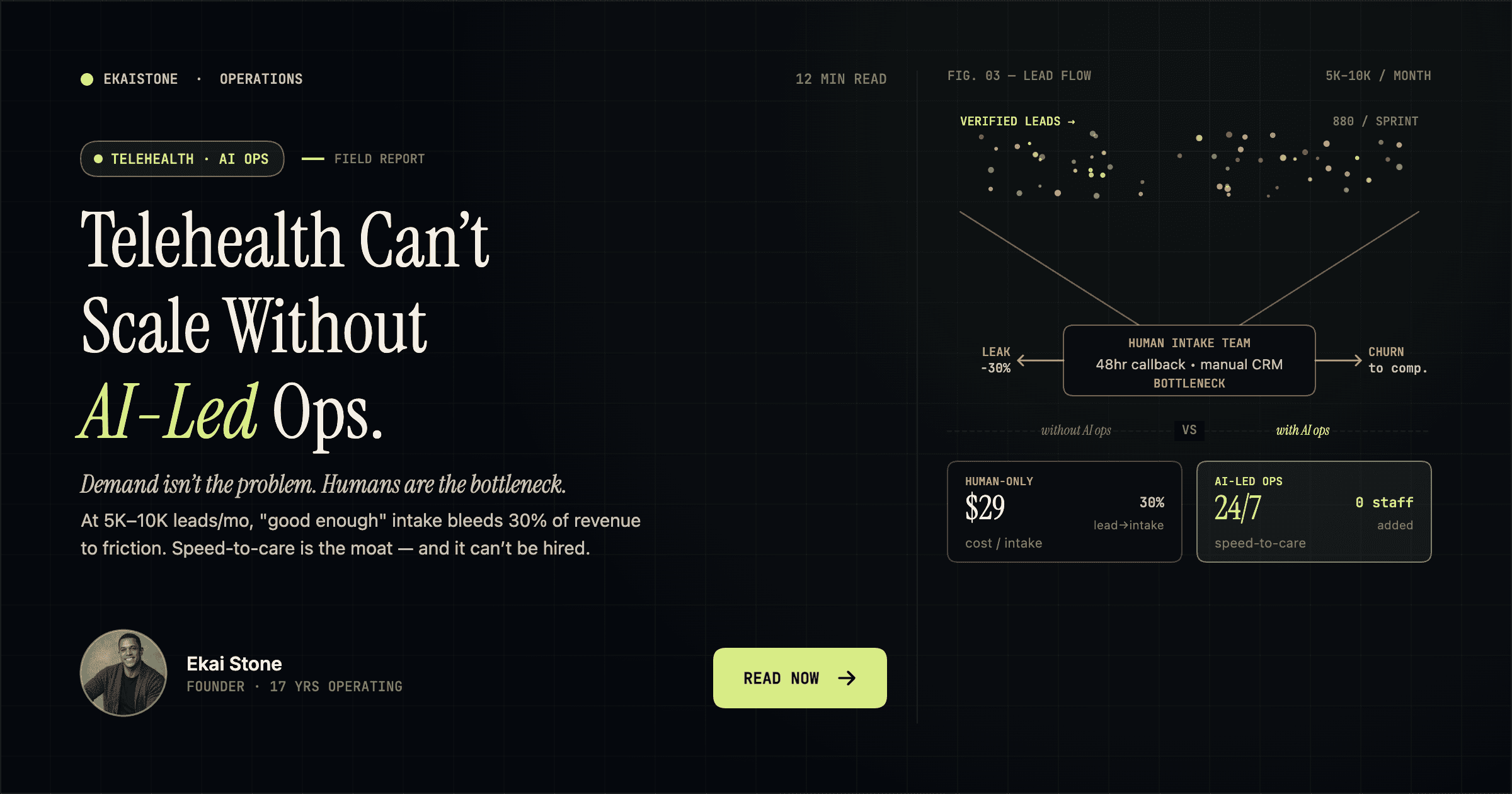
I generate 5,000 to 10,000 verified leads per month for each telehealth clinic I manage. The problem isn’t demand.
At scale, human-dependent operations become the bottleneck and growth caps. Growth doesn’t have to depend on hiring more staff. Here’s why.
The Scaling Illusion: Why Volume Kills Unstructured Clinics
Growth is a pressure test. If you have 1,200 leads a month, your intake team can be "good enough." They can remember to call people back. They can manage a messy CRM. They can manually bridge the gap between a Facebook lead form and a provider's calendar.
At 5,000 or 10,000 leads, "good enough" results in massive revenue leakage.
I recently audited a telehealth operation where the backend collapsed under the weight of its own success. They had the leads. They had the providers. But the space between becoming a lead and sitting with a doctor was a black hole. Qualified patients were waiting 48 hours for a callback. By then, they’d already booked with a competitor.
In telehealth, speed-to-care is your greatest competitive advantage. If your operations rely solely on human intervention for the first three touchpoints, you are intentionally choosing to lose 30% of your potential revenue to friction.
Hard Data: The Limits of Human Reach
To understand why this happens, we have to look at the math. In a recent real-world deployment for a telehealth client, I observed the following results. These are not hypothetical figures, but actual operational data:
✓
Ad Spend: $7,000
✓
Verified Leads: 880 (Each phone number verified via 8-digit SMS code on Meta)
✓
HIPAA-Complete Medical Intakes: 238
✓
Conversion: ~30% lead-to-intake conversion (My proprietary ad strategy and CRM automations. Zero human outreach. An Ai agent is not introduced yet.)
✓
Cost per Intake: $29
This performance was achieved through a combination of my strategic proprietary Ad UX and CRM automations which leads the patient to self-completion within the first 24 hours. However, even with a 30% self-completion rate, 70% of those verified leads (over 600 people) remained in the "gap."
This is where the human element fails. To manually chase 600 leads with the persistence required to convert them would require a massive, expensive intake team. Most operators simply let those leads die.
Defining the Role: What AI Does
(And What It Absolutely Does Not Do)
Before we go further, we must draw a hard line regarding compliance and care.
Ai agents are NOT used for medical consultations. Ai does not replace your providers, it does not write prescriptions, and it does not deliver medical advice. I use Ai strictly as an operational layer in the Lead → Intake → Pre-order Bloodwork and Consult Call stage.
Think of Ai as your elite administrative front office.
✓
Answers common non-medical questions
✓
Qualifies patient intent
✓
Books consult appointments
✓
Follows up persistently to have leads complete new patient intake forms
✓
Patients have to prepay for their bloodwork consultations
By handling the logistical friction, Ai protects the sanctity of the patient-provider relationship. It ensures that when your provider finally speaks to a patient, that patient is prepared, qualified, and ready for care.
The Revenue Math: A Conservative Upside Scenario
⚡️ Let’s look at the financial logic of deploying an Ai agent to handle that 70% of "unconverted" leads.
If we take those 880 original leads and deploy an Ai agent that converts just 20% more of them into medical intakes, the shift in your annual revenue is staggering.
✓
Additional Intakes: 20% of 880 leads = 160 additional intakes.
✓
Conversion to Patient: If we assume a standard 30% of those intakes convert into paying patients, that is 48 new patients.
✓
Annual Revenue: Using a conservative annual Lifetime Value (LTV) of $2,200 per patient, the math is: 48 Patients × $2,200 LTV = $105,600 in additional annual revenue.
This is a conservative estimate based only on $7,000 of ad spend in 18 days.
Ai often converts at a much higher rate because it responds within seconds, not hours. When you consider that this revenue is recovered from leads you already paid for, the ROI on the architecture becomes the highest-leverage move in your business.
Use my unique ad strategy, CRM workflows, and AI agents that work in sync to move leads to patients 24/7.
Staff Cost Savings and "Infinite Scalability"
Beyond the recovered revenue, there is the matter of the "acquisition-side" payroll.
Managing a high-volume intake department is a management nightmare. You have recruiting costs, weeks of training, high turnover, and constant coverage gaps for nights and weekends.
Deploying Ai agents can save an operator $150,000 per year or more in staffing costs alone. Ai requires no management, never calls in sick, and provides 24/7 coverage.
More importantly, Ai is infinitely scalable. If you decide to double your ad spend tomorrow and go from 800 leads to 1,600, your labor cost does not move. Your throughput remains perfect. You have removed the marginal labor cost of growth.
Where the Revenue Leaks: The Three Major Breaches
In a revenue architecture audit, I look for "the bleed." In telehealth, it almost always happens in these three areas:
✓
The Intake Gap: A lead opts in at 9:00 PM. Your team starts at 9:00 AM. In those 12 hours, the patient’s intent decays. Without an Ai agent to instantly qualify them and walk them through prepaying for bloodwork (HRT) or booking them on your providers calendar (GLP-1's), you’re fighting an uphill battle the next morning.
✓
The Follow-Up Desert: Most human reps stop after two or three attempts. Data shows it often takes six to eight touchpoints to re-engage a distracted patient. Ai doesn't get discouraged. It follows up until the patient is either booked or disqualified.
✓
The Pre-Consult Bottleneck: Patients often stall when it comes time to add their drivers license number, or complete bloodwork. Ai nudges them through these administrative hurdles, ensuring your provider's calendar isn't filled with "no-shows" who aren't ready to buy.
Every manual handoff is a leak. Ai seals the pipe.
The Competitive Performance Gap
Many operators in the 45–65 age bracket resist this shift due to a lack of familiarity or a stubborn belief that "people only want to talk to people."
While you hesitate, your competitors are already integrating these systems. They are saving $15k a month on payroll, converting leads in 4 minutes, and reallocating those savings into their ad spend to outbid you for market share.
This hesitation creates a widening performance gap. The telehealth market is maturing; it is no longer enough to just have a good offer. You must have the superior operational machine. There is still time to modernize, but the window to gain a structural advantage is closing. If you do not act, you will be structurally outpaced by leaner, faster clinics.
Architecture Over Tools
The biggest mistake I see operators make is buying "Ai tools" and expecting them to fix a broken process.
A tool is a hammer. Architecture is the blueprint for the house. If you plug a high-powered Ai agent into a messy CRM with no clear SOPs, you’ve just automated your confusion. You don't need more tools; you need Revenue Architecture.
This is my role. I'm not a "tool installer." I'm a Revenue Architect. I design the end-to-end system from the moment a Meta ad is seen to the moment the patient completes their first consultation, ensuring that data flows, compliance is maintained, and revenue is captured.
In my [three-part telehealth operations case study], I broke down exactly how these infrastructure failures happen and how we re-engineer them for scale. The conclusion is always the same: Systems, not effort, drive revenue.
The New Standard for Telehealth Scale
Scaling a telehealth clinic without Ai-assisted operations is becoming a mathematical impossibility at high volumes.
It is a disservice to your patients, who deserve the speed-to-care that only automation can provide. It is a burden to your staff, who are forced to perform robotic tasks that lead to burnout. And ultimately, it is a failure of leadership to leave six figures of annual revenue on the table due to inefficient throughput.
If you are doing $250k/month and feeling the "ceiling" of your current operations, you aren't at a marketing limit. You are at an architectural limit. You can continue to hire more expensive staff to plug the leaks, or you can build a system that is infinitely scalable.
If you’re ready to stop the leakage and build a scalable revenue architecture, let’s talk.
I help high-volume telehealth operators design and deploy the infrastructure necessary to hit the $500k+/month mark without the chaos.
With my engagement models, see how we can align your operations with your growth goals.
I generate 5,000 to 10,000 verified leads per month for each telehealth clinic I manage. The problem isn’t demand.
At scale, human-dependent operations become the bottleneck and growth caps. Growth doesn’t have to depend on hiring more staff. Here’s why.
The Scaling Illusion: Why Volume Kills Unstructured Clinics
Growth is a pressure test. If you have 1,200 leads a month, your intake team can be "good enough." They can remember to call people back. They can manage a messy CRM. They can manually bridge the gap between a Facebook lead form and a provider's calendar.
At 5,000 or 10,000 leads, "good enough" results in massive revenue leakage.
I recently audited a telehealth operation where the backend collapsed under the weight of its own success. They had the leads. They had the providers. But the space between becoming a lead and sitting with a doctor was a black hole. Qualified patients were waiting 48 hours for a callback. By then, they’d already booked with a competitor.
In telehealth, speed-to-care is your greatest competitive advantage. If your operations rely solely on human intervention for the first three touchpoints, you are intentionally choosing to lose 30% of your potential revenue to friction.
Hard Data: The Limits of Human Reach
To understand why this happens, we have to look at the math. In a recent real-world deployment for a telehealth client, I observed the following results. These are not hypothetical figures, but actual operational data:
✓
Ad Spend: $7,000
✓
Verified Leads: 880 (Each phone number verified via 8-digit SMS code on Meta)
✓
HIPAA-Complete Medical Intakes: 238
✓
Conversion: ~30% lead-to-intake conversion (My proprietary ad strategy and CRM automations. Zero human outreach. An Ai agent is not introduced yet.)
✓
Cost per Intake: $29
This performance was achieved through a combination of my strategic proprietary Ad UX and CRM automations which leads the patient to self-completion within the first 24 hours. However, even with a 30% self-completion rate, 70% of those verified leads (over 600 people) remained in the "gap."
This is where the human element fails. To manually chase 600 leads with the persistence required to convert them would require a massive, expensive intake team. Most operators simply let those leads die.
Defining the Role: What AI Does
(And What It Absolutely Does Not Do)
Before we go further, we must draw a hard line regarding compliance and care.
Ai agents are NOT used for medical consultations. Ai does not replace your providers, it does not write prescriptions, and it does not deliver medical advice. I use Ai strictly as an operational layer in the Lead → Intake → Pre-order Bloodwork and Consult Call stage.
Think of Ai as your elite administrative front office.
✓
Answers common non-medical questions
✓
Qualifies patient intent
✓
Books consult appointments
✓
Follows up persistently to have leads complete new patient intake forms
✓
Patients have to prepay for their bloodwork consultations
By handling the logistical friction, Ai protects the sanctity of the patient-provider relationship. It ensures that when your provider finally speaks to a patient, that patient is prepared, qualified, and ready for care.
The Revenue Math: A Conservative Upside Scenario
⚡️ Let’s look at the financial logic of deploying an Ai agent to handle that 70% of "unconverted" leads.
If we take those 880 original leads and deploy an Ai agent that converts just 20% more of them into medical intakes, the shift in your annual revenue is staggering.
✓
Additional Intakes: 20% of 880 leads = 160 additional intakes.
✓
Conversion to Patient: If we assume a standard 30% of those intakes convert into paying patients, that is 48 new patients.
✓
Annual Revenue: Using a conservative annual Lifetime Value (LTV) of $2,200 per patient, the math is: 48 Patients × $2,200 LTV = $105,600 in additional annual revenue.
This is a conservative estimate based only on $7,000 of ad spend in 18 days.
Ai often converts at a much higher rate because it responds within seconds, not hours. When you consider that this revenue is recovered from leads you already paid for, the ROI on the architecture becomes the highest-leverage move in your business.
Use my unique ad strategy, CRM workflows, and AI agents that work in sync to move leads to patients 24/7.
Staff Cost Savings and "Infinite Scalability"
Beyond the recovered revenue, there is the matter of the "acquisition-side" payroll.
Managing a high-volume intake department is a management nightmare. You have recruiting costs, weeks of training, high turnover, and constant coverage gaps for nights and weekends.
Deploying Ai agents can save an operator $150,000 per year or more in staffing costs alone. Ai requires no management, never calls in sick, and provides 24/7 coverage.
More importantly, Ai is infinitely scalable. If you decide to double your ad spend tomorrow and go from 800 leads to 1,600, your labor cost does not move. Your throughput remains perfect. You have removed the marginal labor cost of growth.
Where the Revenue Leaks: The Three Major Breaches
In a revenue architecture audit, I look for "the bleed." In telehealth, it almost always happens in these three areas:
✓
The Intake Gap: A lead opts in at 9:00 PM. Your team starts at 9:00 AM. In those 12 hours, the patient’s intent decays. Without an Ai agent to instantly qualify them and walk them through prepaying for bloodwork (HRT) or booking them on your providers calendar (GLP-1's), you’re fighting an uphill battle the next morning.
✓
The Follow-Up Desert: Most human reps stop after two or three attempts. Data shows it often takes six to eight touchpoints to re-engage a distracted patient. Ai doesn't get discouraged. It follows up until the patient is either booked or disqualified.
✓
The Pre-Consult Bottleneck: Patients often stall when it comes time to add their drivers license number, or complete bloodwork. Ai nudges them through these administrative hurdles, ensuring your provider's calendar isn't filled with "no-shows" who aren't ready to buy.
Every manual handoff is a leak. Ai seals the pipe.
The Competitive Performance Gap
Many operators in the 45–65 age bracket resist this shift due to a lack of familiarity or a stubborn belief that "people only want to talk to people."
While you hesitate, your competitors are already integrating these systems. They are saving $15k a month on payroll, converting leads in 4 minutes, and reallocating those savings into their ad spend to outbid you for market share.
This hesitation creates a widening performance gap. The telehealth market is maturing; it is no longer enough to just have a good offer. You must have the superior operational machine. There is still time to modernize, but the window to gain a structural advantage is closing. If you do not act, you will be structurally outpaced by leaner, faster clinics.
Architecture Over Tools
The biggest mistake I see operators make is buying "Ai tools" and expecting them to fix a broken process.
A tool is a hammer. Architecture is the blueprint for the house. If you plug a high-powered Ai agent into a messy CRM with no clear SOPs, you’ve just automated your confusion. You don't need more tools; you need Revenue Architecture.
This is my role. I'm not a "tool installer." I'm a Revenue Architect. I design the end-to-end system from the moment a Meta ad is seen to the moment the patient completes their first consultation, ensuring that data flows, compliance is maintained, and revenue is captured.
In my [three-part telehealth operations case study], I broke down exactly how these infrastructure failures happen and how we re-engineer them for scale. The conclusion is always the same: Systems, not effort, drive revenue.
The New Standard for Telehealth Scale
Scaling a telehealth clinic without Ai-assisted operations is becoming a mathematical impossibility at high volumes.
It is a disservice to your patients, who deserve the speed-to-care that only automation can provide. It is a burden to your staff, who are forced to perform robotic tasks that lead to burnout. And ultimately, it is a failure of leadership to leave six figures of annual revenue on the table due to inefficient throughput.
If you are doing $250k/month and feeling the "ceiling" of your current operations, you aren't at a marketing limit. You are at an architectural limit. You can continue to hire more expensive staff to plug the leaks, or you can build a system that is infinitely scalable.
If you’re ready to stop the leakage and build a scalable revenue architecture, let’s talk.
I help high-volume telehealth operators design and deploy the infrastructure necessary to hit the $500k+/month mark without the chaos.
With my engagement models, see how we can align your operations with your growth goals.

Where online business owners learn how to scale with structure, discipline, and long-term stability.
Where online business owners learn how to scale with structure, discipline, and long-term stability.