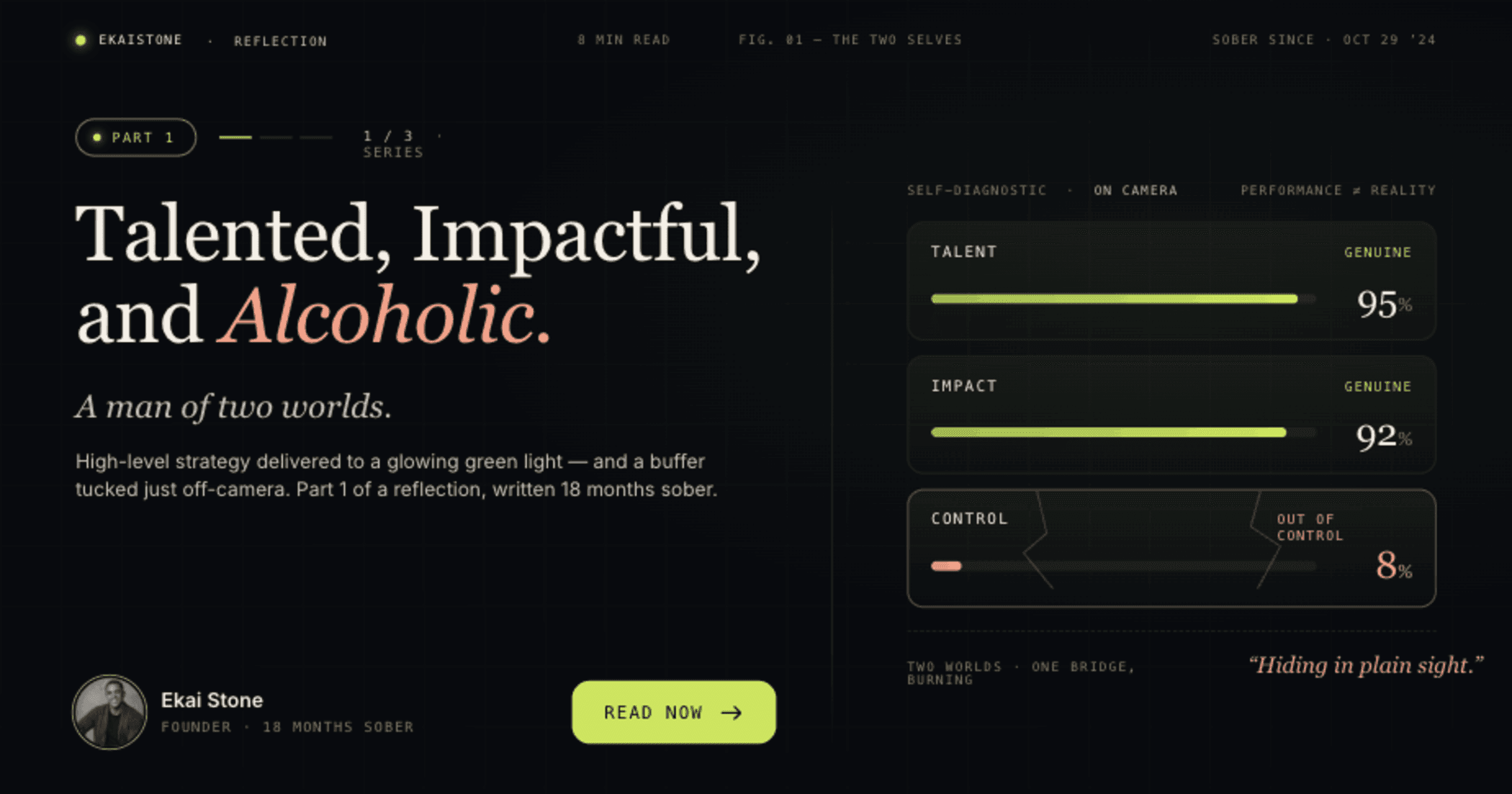
Talented, Impactful, and Alcoholic PART 1
Talented, Impactful, and Out of Control
The Zoom camera is a master of deception.
I spent years staring into that little green light, delivering high-level ad strategies, mapping out complex CRM workflows, and advising million-dollar founders on how to scale their operations. To them, I was the architect. I was the guy who could see the patterns in the data and build the infrastructure to support their growth.
I was producing results. I was making people money. I was charismatic, sharp, and seemingly in full command of my craft.
But just off-camera, usually tucked slightly behind the monitor or sitting in a coffee mug with a straw, was the reality. It might have been tequila, a stiff vodka mix, or a tall beer. It didn't really matter what it was—what mattered was that it had to be there.
I lived in a constant state of performance. I was a man of two worlds, and the bridge between them was burning.
I was genuinely talented, genuinely impactful, and also genuinely out of control.
This is Part 1 of a reflection on a life I no longer live. I’m writing this as a man who is now almost 18 months sober—October 29, 2024, was the day the cycle finally broke. I’m not writing this to shock you, and I’m certainly not writing it as a guru shouting advice from a mountaintop.
I’m writing this because I know the terrain of the pit. I lived there. And I know that in the world of high-performance entrepreneurship, there are a lot of people hiding in plain sight, just like I was.
The Toxic Friendship
For a long time, I didn't see alcohol as an enemy. In fact, it looked like friendship.
It was a toxic friendship, sure, but it was a constant one. Alcohol was there in the morning when the anxiety of a mounting inbox felt like a physical weight on my chest. It was there at lunch to "level me out." It was there before client calls to take the edge off the pressure. It was there during the late-night sessions when I was building out tracking systems and SOPs.
I didn't drink because I was lazy. I drank because I felt overloaded.
As entrepreneurs, we are told that "more" is the answer. More scale, more output, more intensity. I was carrying the weight of client expectations, team management, and the internal drive to build something meaningful. My nervous system was fried, and I didn't have the spiritual or emotional infrastructure to handle the voltage.
So, I used alcohol to soften the edges. I thought it was helping me work. I believed it was the lubricant that kept the machine running.
The reality was far more sinister. I would work in a short, brilliant burst of "buzzed" productivity, and then I would crash. I would pass out, lose control, or descend into a blackout. The next morning wasn't about growth; it was about recovery—doing just enough to function so that I could earn the right to drink again at 2 p.m.
I was building while bleeding. I was creating systems for others while my own internal system was in a state of total collapse.
Hiding in Plain Sight
There is a specific kind of loneliness that comes with being a "high-functioning" addict.
When you’re still getting results, people don’t question you. When the ROAS is high and the automations are working, no one asks what’s in your cup. This creates a dangerous feedback loop: If I’m still successful, then I don’t really have a problem.
But the cracks always show eventually.
I remember showing up to client calls with a black eye. I had a ready-made story: I told them I’d been attacked in Acapulco and had my wallet stolen. It sounded like a "wild entrepreneur" story. It was charismatic. It was believable.
The truth was far sadder. I had been blacked out in my own home and had likely smashed my face into a wall. I didn't even know how it happened.
That is the fragmentation of the life I was living. On the outside: stylish, connected, high-performing. On the inside: suffering, toxic, and quietly unraveling. I was managing perceptions more than I was managing my business. I was improvising my way through a life that lacked a foundation.
If you are reading this and you recognize that split—that feeling of being a "competent" leader who is drowning behind the scenes—understand this: Your talent is not the problem. Your potential isn't the problem. But your potential is currently capped by what you refuse to face.
If you’re a founder or operator who feels like your internal world is capping your external growth, and you’re ready to build with actual structure and discipline—not just more "hustle"
I help serious operators build the infrastructure for long-term stability.
The Allergy to Reality
In recovery circles, we often talk about being "allergic" to alcohol. It’s a physical reality for many of us. But as I look back with 18 months of clarity, I realized I was suffering from a second, deeper allergy.
I was allergic to reality.
I drank to numb myself from the dissonance. I felt a massive gap between the man I was living as and the man I knew I was called to be. I felt the pressure of a world that feels increasingly processed, false, and hyper-accelerated. I didn't know how to navigate the stress of modern business, the loneliness of leadership, or the unhealed pain from my past without a buffer.
I thought I needed to escape reality. What I really needed was to embrace myself.
I see this in so many founders today. We use "the grind" or "the vision" as a way to avoid the internal work. We think that if we just hit the next revenue milestone, the internal chaos will settle. But business problems are almost always life problems in disguise.
You can’t build a stable, nurtured, expanding company (what we call HONEY) on top of a fractured soul. It doesn't work. Eventually, the weight of the expansion will crush the unstable foundation.
The Geography of the Soul
At one point, I thought the solution was a change of scenery. I left my life in Cuernavaca and went to Cancun. I didn't go to the resorts. I went to a poor neighborhood, staying in a small apartment with a friend. I thought if I could just disappear, I could fix myself.
I spent five and a half weeks drinking large beers every day, staring at the walls, detached from my own spirit. I was trying to leave my life behind, but I brought my pain with me.
Geography is never the solution for an internal war.
I saw the life around me in that neighborhood—the simplicity, the struggle, the reality—and it became a mirror. I realized how far I had drifted from my own standards and my own calling. I wasn't just failing at business; I was failing at being a man of integrity. I was living below my God-given potential, not because I lacked the "how-to," but because I lacked the "who."
I eventually came home, but the drinking didn't stop. Not yet. It took more than a new city. It took a total surrender.
The Business of Redemption
When I finally reached out to my mother and admitted I needed help, it wasn't because of a single business failure. It was because I realized that the business wasn't the deepest wound. The real wound was inside me.
I didn't need better excuses. I didn't need a new marketing strategy. I needed a Savior, and I needed a system for living that wasn't rooted in escape.
Sobriety, for me, hasn't just been about the absence of alcohol. It’s been about the presence of God. It’s been about reclaiming consistency, peace, and spiritual strength.
When you remove the numbing agent, you are forced to deal with the raw data of your life. You have to learn how to manage a nervous system that has been overclocked for years. You have to learn how to lead without the "false confidence" of a buzz.
But on the other side of that struggle is a level of clarity that no "nootropic" or "biohack" can provide.
Today, my work as a Revenue Architect is better than it has ever been. Not because I’m smarter, but because I’m present. I’m no longer hiding. When I build a CRM automation or a tracking dashboard now, it’s coming from a place of order, not a place of chaotic desperation.
A Note to the High-Performer in the Pit
If you’re reading this and you’re secretly terrified that your "toxic friend" is the only thing keeping you going, I want you to hear me:
You are not your addiction. And your success is not dependent on your self-destruction.
A lot of entrepreneurs don’t need more tactics. They need healing, structure, and spiritual alignment. They need to stop building while they’re bleeding and start building from a place of wholeness.
This is why I’m building HONEY. It’s about more than just "operations." It’s about holistic operations. It’s about creating an environment—in your business and in your life—that is cleaner, truer, and closer to God.
I’m 18 months in, and the rebuilding process is the most rewarding "project" I’ve ever managed. The chaos is gone. The hiding is over. The potential that was once capped is finally starting to breathe.
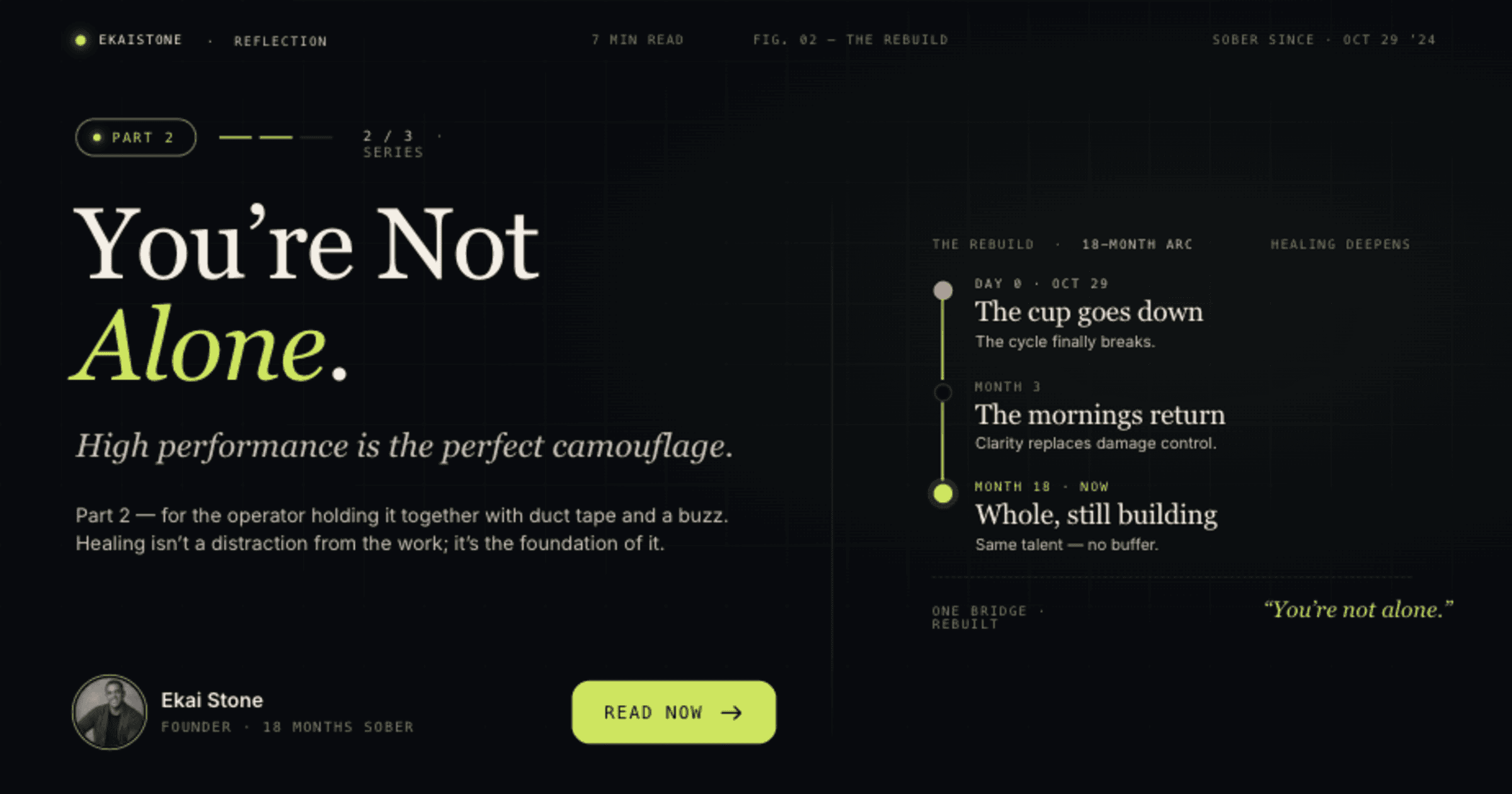
This is only Part 1. In the next piece, I want to talk more about the specific steps of rebuilding—how you move from a fragmented life to one of structural integrity and how faith becomes the ultimate operational system.
If this resonated with you, and you’re tired of the mask, just know that the pit isn't your permanent address. There is a way out, and it starts with the truth.
I’m Ekai Stone. I’ve lived in the darkness, and I’m telling you: the light is better for business.
Talented, Impactful, and Out of Control
The Zoom camera is a master of deception.
I spent years staring into that little green light, delivering high-level ad strategies, mapping out complex CRM workflows, and advising million-dollar founders on how to scale their operations. To them, I was the architect. I was the guy who could see the patterns in the data and build the infrastructure to support their growth.
I was producing results. I was making people money. I was charismatic, sharp, and seemingly in full command of my craft.
But just off-camera, usually tucked slightly behind the monitor or sitting in a coffee mug with a straw, was the reality. It might have been tequila, a stiff vodka mix, or a tall beer. It didn't really matter what it was—what mattered was that it had to be there.
I lived in a constant state of performance. I was a man of two worlds, and the bridge between them was burning.
I was genuinely talented, genuinely impactful, and also genuinely out of control.
This is Part 1 of a reflection on a life I no longer live. I’m writing this as a man who is now almost 18 months sober—October 29, 2024, was the day the cycle finally broke. I’m not writing this to shock you, and I’m certainly not writing it as a guru shouting advice from a mountaintop.
I’m writing this because I know the terrain of the pit. I lived there. And I know that in the world of high-performance entrepreneurship, there are a lot of people hiding in plain sight, just like I was.
The Toxic Friendship
For a long time, I didn't see alcohol as an enemy. In fact, it looked like friendship.
It was a toxic friendship, sure, but it was a constant one. Alcohol was there in the morning when the anxiety of a mounting inbox felt like a physical weight on my chest. It was there at lunch to "level me out." It was there before client calls to take the edge off the pressure. It was there during the late-night sessions when I was building out tracking systems and SOPs.
I didn't drink because I was lazy. I drank because I felt overloaded.
As entrepreneurs, we are told that "more" is the answer. More scale, more output, more intensity. I was carrying the weight of client expectations, team management, and the internal drive to build something meaningful. My nervous system was fried, and I didn't have the spiritual or emotional infrastructure to handle the voltage.
So, I used alcohol to soften the edges. I thought it was helping me work. I believed it was the lubricant that kept the machine running.
The reality was far more sinister. I would work in a short, brilliant burst of "buzzed" productivity, and then I would crash. I would pass out, lose control, or descend into a blackout. The next morning wasn't about growth; it was about recovery—doing just enough to function so that I could earn the right to drink again at 2 p.m.
I was building while bleeding. I was creating systems for others while my own internal system was in a state of total collapse.
Hiding in Plain Sight
There is a specific kind of loneliness that comes with being a "high-functioning" addict.
When you’re still getting results, people don’t question you. When the ROAS is high and the automations are working, no one asks what’s in your cup. This creates a dangerous feedback loop: If I’m still successful, then I don’t really have a problem.
But the cracks always show eventually.
I remember showing up to client calls with a black eye. I had a ready-made story: I told them I’d been attacked in Acapulco and had my wallet stolen. It sounded like a "wild entrepreneur" story. It was charismatic. It was believable.
The truth was far sadder. I had been blacked out in my own home and had likely smashed my face into a wall. I didn't even know how it happened.
That is the fragmentation of the life I was living. On the outside: stylish, connected, high-performing. On the inside: suffering, toxic, and quietly unraveling. I was managing perceptions more than I was managing my business. I was improvising my way through a life that lacked a foundation.
If you are reading this and you recognize that split—that feeling of being a "competent" leader who is drowning behind the scenes—understand this: Your talent is not the problem. Your potential isn't the problem. But your potential is currently capped by what you refuse to face.
If you’re a founder or operator who feels like your internal world is capping your external growth, and you’re ready to build with actual structure and discipline—not just more "hustle"
I help serious operators build the infrastructure for long-term stability.
The Allergy to Reality
In recovery circles, we often talk about being "allergic" to alcohol. It’s a physical reality for many of us. But as I look back with 18 months of clarity, I realized I was suffering from a second, deeper allergy.
I was allergic to reality.
I drank to numb myself from the dissonance. I felt a massive gap between the man I was living as and the man I knew I was called to be. I felt the pressure of a world that feels increasingly processed, false, and hyper-accelerated. I didn't know how to navigate the stress of modern business, the loneliness of leadership, or the unhealed pain from my past without a buffer.
I thought I needed to escape reality. What I really needed was to embrace myself.
I see this in so many founders today. We use "the grind" or "the vision" as a way to avoid the internal work. We think that if we just hit the next revenue milestone, the internal chaos will settle. But business problems are almost always life problems in disguise.
You can’t build a stable, nurtured, expanding company (what we call HONEY) on top of a fractured soul. It doesn't work. Eventually, the weight of the expansion will crush the unstable foundation.
The Geography of the Soul
At one point, I thought the solution was a change of scenery. I left my life in Cuernavaca and went to Cancun. I didn't go to the resorts. I went to a poor neighborhood, staying in a small apartment with a friend. I thought if I could just disappear, I could fix myself.
I spent five and a half weeks drinking large beers every day, staring at the walls, detached from my own spirit. I was trying to leave my life behind, but I brought my pain with me.
Geography is never the solution for an internal war.
I saw the life around me in that neighborhood—the simplicity, the struggle, the reality—and it became a mirror. I realized how far I had drifted from my own standards and my own calling. I wasn't just failing at business; I was failing at being a man of integrity. I was living below my God-given potential, not because I lacked the "how-to," but because I lacked the "who."
I eventually came home, but the drinking didn't stop. Not yet. It took more than a new city. It took a total surrender.
The Business of Redemption
When I finally reached out to my mother and admitted I needed help, it wasn't because of a single business failure. It was because I realized that the business wasn't the deepest wound. The real wound was inside me.
I didn't need better excuses. I didn't need a new marketing strategy. I needed a Savior, and I needed a system for living that wasn't rooted in escape.
Sobriety, for me, hasn't just been about the absence of alcohol. It’s been about the presence of God. It’s been about reclaiming consistency, peace, and spiritual strength.
When you remove the numbing agent, you are forced to deal with the raw data of your life. You have to learn how to manage a nervous system that has been overclocked for years. You have to learn how to lead without the "false confidence" of a buzz.
But on the other side of that struggle is a level of clarity that no "nootropic" or "biohack" can provide.
Today, my work as a Revenue Architect is better than it has ever been. Not because I’m smarter, but because I’m present. I’m no longer hiding. When I build a CRM automation or a tracking dashboard now, it’s coming from a place of order, not a place of chaotic desperation.
A Note to the High-Performer in the Pit
If you’re reading this and you’re secretly terrified that your "toxic friend" is the only thing keeping you going, I want you to hear me:
You are not your addiction. And your success is not dependent on your self-destruction.
A lot of entrepreneurs don’t need more tactics. They need healing, structure, and spiritual alignment. They need to stop building while they’re bleeding and start building from a place of wholeness.
This is why I’m building HONEY. It’s about more than just "operations." It’s about holistic operations. It’s about creating an environment—in your business and in your life—that is cleaner, truer, and closer to God.
I’m 18 months in, and the rebuilding process is the most rewarding "project" I’ve ever managed. The chaos is gone. The hiding is over. The potential that was once capped is finally starting to breathe.
This is only Part 1. In the next piece, I want to talk more about the specific steps of rebuilding—how you move from a fragmented life to one of structural integrity and how faith becomes the ultimate operational system.
If this resonated with you, and you’re tired of the mask, just know that the pit isn't your permanent address. There is a way out, and it starts with the truth.
I’m Ekai Stone. I’ve lived in the darkness, and I’m telling you: the light is better for business.

Where online business owners learn how to scale with structure, discipline, and long-term stability.
Where online business owners learn how to scale with structure, discipline, and long-term stability.