The Meta Ads Phishing Problem Nobody Is Fixing

The moment you hit "Publish" on a new campaign, something happens that Meta doesn't talk about in their official certifications.
It usually starts within minutes. Maybe an hour. You get a notification that looks official. Or an email with the Meta logo that feels urgent. “Your account has been restricted.” “Policy violation detected.” “Immediate action required to prevent permanent deactivation.”
If you’ve been an operator for more than a week, you know the drill. But if you’re new—or if the timing is just right—you might actually believe it.
I’ve spent years inside Meta Ads Manager. I’ve built revenue architectures for telehealth brands, B2B AI offers, and high-ticket coaches. And I’ve noticed a pattern that has become too consistent to ignore. It’s no coincidence.
The moment an account becomes active, the sharks start circling. And Meta is letting them into the water.
The Pattern: It’s Not Random
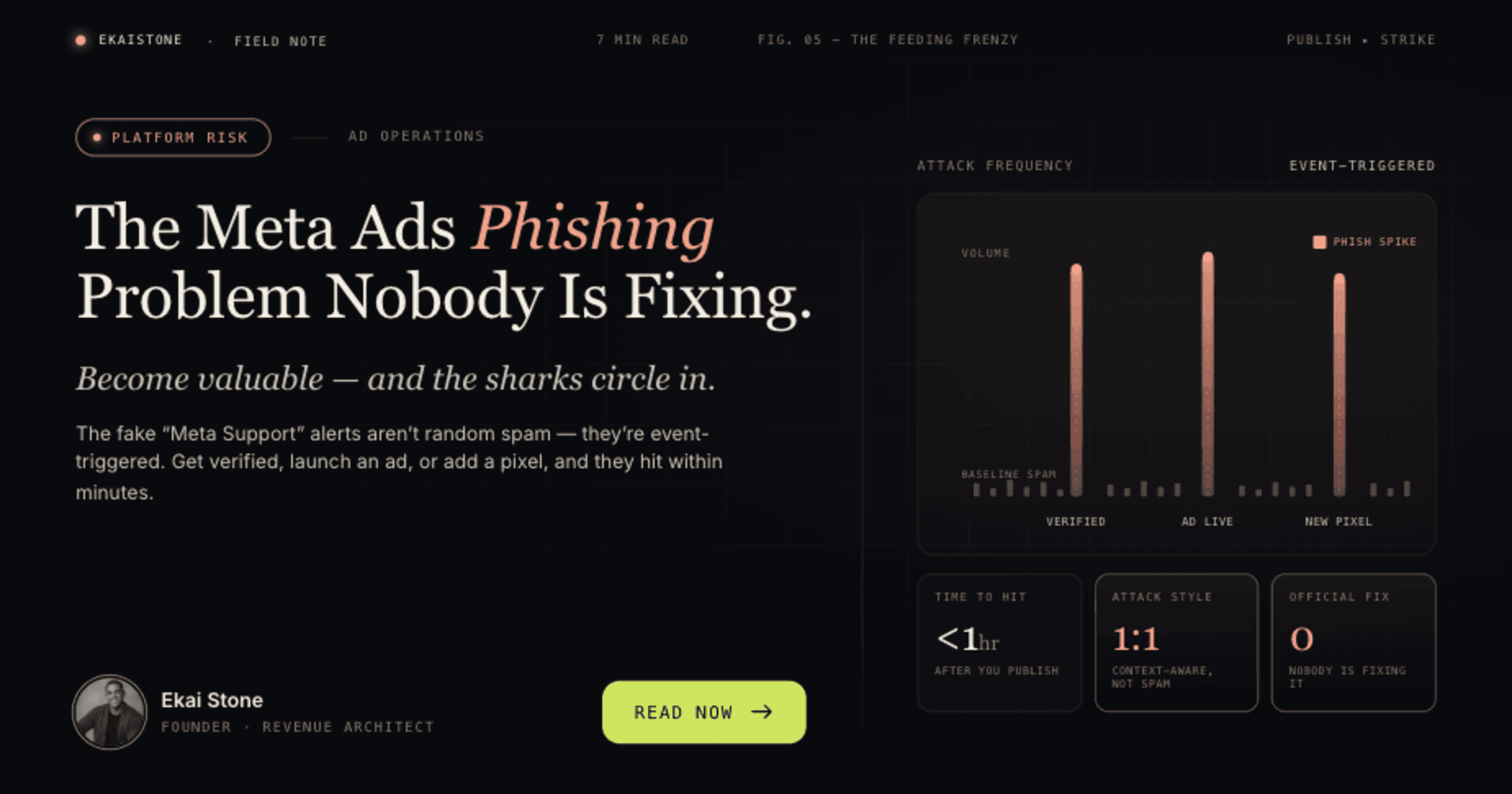
If these phishing attempts were just random spam, they’d hit my inbox at a steady rate. But they don't. They are event-triggered.
I’ve seen it happen like clockwork:
✓
The Verification Trigger: The moment a profile gets Meta Verified, the phishing attempts spike.
✓
The Launch Trigger: The moment the first ad in a new account goes live, the "Support" messages start flooding the inbox.
✓
The Asset Trigger: Create a new Pixel, a new Business Page, or a new Catalog? Suddenly, "Meta Business Support" is very concerned about your compliance.
These aren't generic "Dear Customer" emails. They are context-aware. They often mimic the exact state of your account. If you just launched a campaign, they’ll tell you your campaign was shut off. If you just got verified, they’ll tell you your verification is at risk.
This is what I call event-based exploitation. It’s not just "spam." It’s highly targeted targeting based on real-time activity within the Meta ecosystem.
Why This Feels Too Precise to Be Random
As a strategist, I look for patterns. When a system produces the same result across thousands of different variables, the problem is in the system itself.
I’m not saying Meta is intentionally selling our data to scammers. But I am saying the timing is too exact. Whether this is coming from bad actors exploiting Meta’s public-facing Graph API, scrapers monitoring business page changes, or deeper security failures across the third-party support chain—the result is the same.
Advertisers are being targeted the second they become "valuable" to the platform.
The messages are designed to bypass your logical brain and hit your "fight or flight" response. They use urgency: “You have 24 hours to appeal.” They use authority: “Official Meta Support Team.” And they often come from what look like legitimate sources.
It’s Not Just Me
I started digging into this and found that I wasn’t the only one noticing the "coincidence." I found advertiser after advertiser describing the exact same sequence of events.
On Reddit, a user named Kaffein shared how they received "multiple phishing emails" from an Outlook address posing as Meta for Business almost immediately. In that same discussion, Djaambo noted, “It was only yesterday when I started a new campaign” before getting hit with a fake notification that the campaign was shut off.
Another advertiser reported that "the day after I started my ad," they received their first fake violation message. User throwawaybpdnpd put it bluntly: it happens on “almost every client account I work on.”
One user, Airspore, asked the question we should all be asking: Why wouldn’t Meta prioritize protecting the businesses that give them money every single day?
When you have hundreds of media buyers and business owners reporting that scam messages are triggered by specific account actions, it stops being a "conspiracy theory" and starts being a documented platform vulnerability.
The Stakes: More Than an Annoyance
This isn't just about a cluttered inbox. For a media buyer or an agency owner, a compromised Meta account is a catastrophic event.
I’ve seen what happens when these scams work. The attackers steal login credentials, bypass 2FA, and take over Business Managers. They add themselves as admins, kick out the original owners, and run tens of thousands of dollars in fraudulent ads on the business's credit card.
Years of platform history, customer data, and brand reputation can be wiped out in an afternoon. For a small business, that can be the end of the road. For an agency, it’s a total loss of client trust.
We’re the ones funding this machine. Advertisers are the reason Meta is a multi-billion-dollar company. Yet, we’re left to navigate a minefield of phishing attempts the moment we try to spend money on the platform.
Meta’s Accountability Problem
Meta is a sophisticated technology company. They have the engineering talent to optimize an algorithm that can predict what you’ll buy before you even know you want it. They have the infrastructure to serve billions of people.
So why is real-time phishing protection for their paying customers seemingly an afterthought?
If your platform is sophisticated enough to deliver hyper-targeted ads, it should be sophisticated enough to prevent your own "Support" UI from being impersonated this easily.
We aren't asking for special treatment. We’re asking for basic protection. Meta does not get to profit from advertiser trust while treating advertiser security like a nuisance. If you profit from the ecosystem, you owe it to the people in that ecosystem to keep it safe.
At some point, the burden of security shouldn't just be on the person paying the bills. It should be on the platform collecting the checks.
How to Protect Your Assets
Until Meta decides to address this pattern, the responsibility falls on us. If you’re running ads or getting verified, here is the protocol I use for myself and my clients:
✓
Never Click the Email Links: This is Rule #1. If you get a notification saying your account is restricted, do not click the link in the email. Close your mail app, open your browser, and go directly to https://www.google.com/search?q=business.facebook.com. If there is a real issue, it will be in your Account Quality dashboard.
✓
Check the Sender Address: Meta will usually send emails from @support.facebook.com or @facebookmail.com. If you see an Outlook, Gmail, or a "https://www.google.com/search?q=meta-support-alert.com" address, it’s fake. Delete it.
✓
Use Hardware Security Keys: If you are a primary admin, 2FA via SMS is not enough. Use a physical security key (like a YubiKey). It is the single most effective way to prevent account takeovers.
✓
Report Everything: Forward suspicious emails to phish@fb.com. It might feel like shouting into a void, but it builds the data case that this is a widespread problem.
✓
Separate Knowledge from Suspicion: If this happens to you, document it. Save the screenshots. Save the email headers. Note the exact time it happened relative to your ad activity.
✓
Educate Your Team: If you have VAs, junior media buyers, or clients with admin access, they are the weakest link. Make sure they know that Meta will never ask for their password or a 2FA code via Messenger.
The Bottom Line
I'm tired of seeing good operators get burned because they trusted the wrong notification at the wrong time.
The pattern is real. The timing is too precise to be ignored. And the stakes are too high for Meta to remain this passive. If Meta wants our ad dollars, they need to earn the trust that comes with them. Trust is part of the product—or at least, it should be.
At the very least, you now know you’re not crazy for noticing the pattern. You’re being watched. Act accordingly.
If you’re tired of navigating the chaos of Meta Ads alone and want a partner who builds revenue architecture with security and systems at the core.
We don't just run ads; we build infrastructure that lasts.